
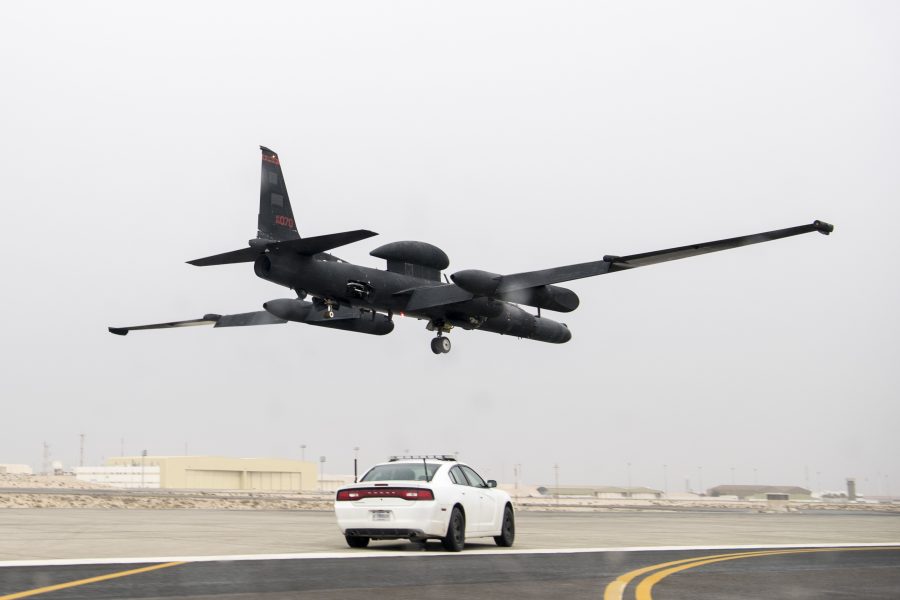
U-2S is the Air Force’s only manned, strategic, high-altitude, long-endurance ISR platform and is capable of SIGINT, IMINT, and MASINT collection. The aircraft’s modular payload systems allow it to carry a wide variety of advanced optical, multispectral, EO/IR, SAR, SIGINT, and other payloads simultaneously. Its open system architecture also permits rapid fielding of new sensors to counter emerging threats and requirements.
The original U-2A first flew on Aug. 4, 1955. The type was further developed into the larger, more capable U-2R, which first took flight on Aug. 28, 1967, and was delivered between 1967 and 1968. Current U-2s date to the 1980s when U-2R production was reopened under the designation TR-1 (later returned to U-2R designation in 1992).
The TR-1A first flew on Aug. 1, 1981, and was reengined and modernized starting in 1994, emerging as the U-2S. Current Block 20 U-2S feature glass cockpits, digital autopilot, modernized EW systems, and updated data links. Its major sensors are the ASARS-2A SAR, modernized SYERS-2C multispectral EO/IR imagery system, and enhanced Airborne Signals Intelligence Payload (ASIP). The aircraft is also capable of mounting the legacy optical bar camera for broad-area synoptic imagery, though operations from Beale concluded in 2022.
Modification and upgrades are focused on sustaining U-2 capability through its currently planned retirement, while meeting current and emerging requirements. Major recent efforts include ASARS-2B/C integration, avionics and navigation refresh, (Link-16/IFDL, MADL) modernization, next-generation SIGINT, and quick-response capabilities to meet emergent ISR requirements. ASARS-2B/C significantly improves the U-2’s high-altitude, deep-look radar ground mapping, moving target, and maritime capabilities and moves to an open, easily upgradable architecture, transferable to future platforms.
Avionics Technical Refresh (ATR) upgrades debuted in 2023 added open-architecture systems, enhanced C2 networking, and pilot workload management features. Two U-2s notably intercepted and photographed a Chinese ISR balloon over the central U.S. on Feb. 3, 2023, marking the two-seat TU-2S’s first operational use. A two-seater also flew a record-setting 14-hour maximum-endurance high-flight covering some 3,000 miles and overflying 48 states from Beale on July 31, 2025.
ACC retired the first TU-2S and three U-2S in early 2024 with plans to retire the entire fleet this year.
U-2S Dragon Lady Technical Data
Contractors: Lockheed Martin, Northrop Grumman (ASIP); Raytheon (ASARS); UTC Aerospace (SYERS/Optical Bar Camera).
First Flight: October 1994 (U-2S).
Delivered: September 1981-October 1989 (TR-1/U-2R).
IOC: Circa 1981 (U-2R).
Production: 35 (T/U-2S).
Inventory: 27 (U-2); four (TU-2).
Operator: ACC.
Aircraft Location: Beale AFB, Calif.; forward operating locations: Osan AB, South Korea; RAF Akrotiri, Cyprus; RAF Fairford, U.K.
Active Variants: •U-2S. Current variant of the U-2/TR-1. •TU-2S. A two-seat trainer aircraft originally designated U-2ST.
Dimensions: Span 105 ft, length 63 ft, height 16 ft.
Weight: Max T-O 40,000 lb.
Power Plant: GE Aviation F118-GE-101A turbofan, 17,000 lb thrust.
Performance: Speed 410 mph, range 7,000+ miles.
Ceiling: Above 70,000 ft.
Accommodation: Pilot (U-2S); two pilots (TU-2S) on RQ201 zero/zero ejection seats.
