
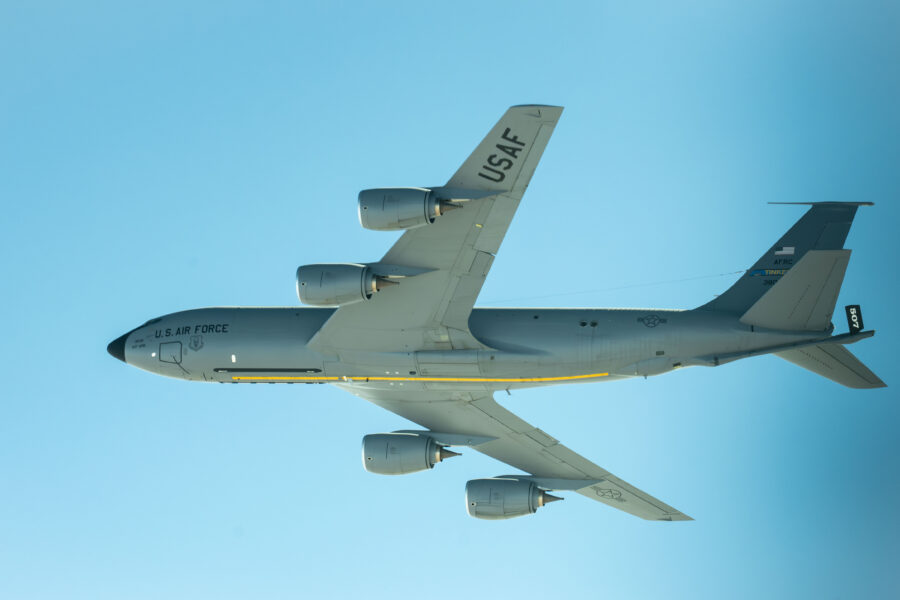
The KC-135 Stratotanker that lost part of its vertical stabilizer in a deadly midair collision over Iraq in March is among a group of damaged tankers that have returned to Tinker Air Force Base, Okla., to be fully repaired.
This Stratotanker is one of a handful of KC-135s that were damaged while supporting operations against Iran earlier this year. The tankers were repaired by Airmen from the 76th Aircraft Maintenance Group’s expeditionary depot maintenance flight, which allowed the planes to fly back to Tinker for more comprehensive repairs.
Those aircraft are now going into the depot maintenance process, where those patches will be fully repaired along with their regularly scheduled maintenance that takes place every five years, according an Air Force spokesperson.
The spokesperson said it is too soon to tell when these battle-damaged planes might return to service. Regular maintenance repairs typically take an average of 155 days to complete, the spokesperson said, but “it is reasonable to assume” these may take longer—particularly if inspectors find more hidden damage or engineering problems.
At least six KC-135s have been damaged but still left repairable since the start of Operation Epic Fury, and a seventh was completely destroyed, according to U.S. officials. Five of those damaged Stratotankers were hit during an Iranian missile strike on Prince Sultan Air Base, Saudi Arabia, in March. President Donald Trump confirmed five Stratotankers sustained at least some damage in a Truth Social post.
The sixth damaged KC-135 was involved in a collision with another Stratotanker over western Iraq on March 12, losing part of its tail. That tanker was able to make an emergency landing in Israel afterward, but the other Stratotanker crashed, destroying the plane and killing all six crew members aboard.
A U.K.-based aviation photographer posted an image Aug. 2 showing the KC-135 that survived the March 12 collision arriving at RAF Mildenhall, with a transplanted tail from another Stratotanker that had been sent out of its aircraft storage facility at Davis-Monthan Air Force Base, commonly referred to as the Boneyard. The tanker damaged in the midair collision later arrived at Tinker on Aug. 3, according to open-source flight tracking data. At least two other tankers damaged in the Middle East have been spotted transiting to the U.S. with temporary patches allowing them to fly.
The expeditionary maintenance unit completed more than 200 repairs over three weeks on the damaged tankers, enabling them to receive further repairs in the U.S.
The Air Force pulled at least one retired KC-135 out of the Boneyard after the March 12 crash.
Air Force Chief of Staff Gen. Kenneth Wilsbach told lawmakers in a June 9 hearing that all damaged KC-135s would eventually return to service. The most heavily damaged planes, however, might take a year or two to be fully repaired, Wilsbach told the Senate Appropriations subcommittee on defense. Wilsbach said some had already returned to service, but did not specify how many.
