
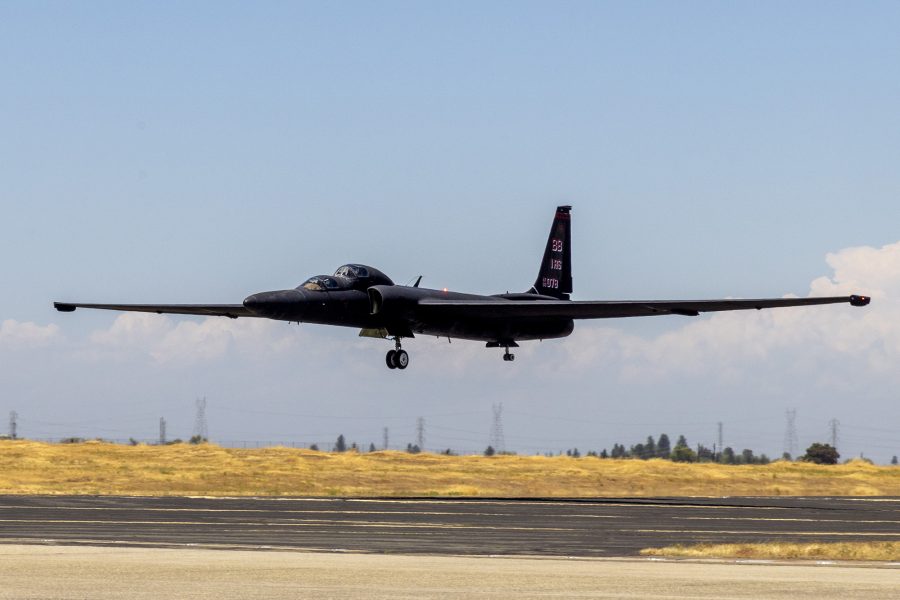
The famed U-2 Dragon Lady spy plane could get a reprieve from the Air Force’s chopping block under a new 2027 spending bill proposed by the House Appropriations defense subcommittee.
Earlier this year, the service said when rolling out its budget request that it wanted to retire its last 23 U-2s, a Cold War-era reconnaissance aircraft, in 2027. Increasingly, the Pentagon is shifting toward unmanned aircraft for intelligence, surveillance, and reconnaissance.
But lawmakers on the House Appropriations Committee aren’t ready to let go of the Dragon Lady. The 2027 spending bill unveiled June 10 would bar the Air Force from retiring more than two U-2s. According to a summary, the bill would also provide $81 million for depot maintenance to fully restore four U-2s.
This is not the first time members of Congress have tried to limit U-2 divestments. In the 2026 spending bill, the Air Force was limited to retiring eight U-2s. And previous versions of the annual defense policy bill have blocked any retirements.
The U-2 fleet now averages more than 40 years old, and its mission capable rate has declined in recent years. It offers a unique high-altitude ISR capability, though.
E-7
The proposed appropriations bill would also provide $1.55 billion in research, development, test, and evaluation for the Air Force to continue work on the E-7 Wedgetail, a Boeing-made airborne battle management aircraft intended to replace the E-3 Sentry. That funding was not in the Air Force’s original 2027 budget proposal.
The Pentagon has fluctuated over the last year on whether or not to continue with the E-7 program, at one point attempting to cancel it outright in favor of targeting satellites. Lawmakers pushed back to save the E-7, and in May, Air Force Secretary Troy Meink told lawmakers his department was working on a $1.5 billion budget amendment that would restore funding for the E-7 and pay for five production aircraft, in addition to the two rapid prototype planes now in the works.
Other Programs
Other provisions in the appropriations bill roughly line up with the Air Force’s original request—though notably, it sticks with the Pentagon’s discretionary budget request, leaving billions of dollars dependent on a party-line reconciliation bill.
The appropriations bill would provide $5 billion in R&D funds for the Air Force’s sixth-generation F-47 fighter, another Boeing program, and another $915 million for the Navy’s companion aircraft, the F/A-XX. That is in line with the Air Force’s F-47 request, but much higher than the Navy’s original request for its version of a next-generation fighter.
The draft legislation also earmarks $2.8 billion in R&D funding and $2.2 billion in procurement funds for the Northrop Grumman B-21 Raider stealth bomber.
It would budget $3.5 billion to buy 15 KC-46 Pegasus aircraft, and $2.6 billion to buy 24 F-15EX fighters, both made by Boeing and in line with the Air Force request. It also includes $977 million to procure Collaborative Combat Aircraft, which are semi-autonomous drones that will fly along fighters such as the F-47 and F-35 and carry out missions such as strike, reconnaissance, or electronic warfare operations.
The proposed budget also includes $660 million to buy three EA-37B Compass Call planes for electronic warfare missions, $300 extra million for Air National Guard C-130J Super Hercules transport aircraft, and $6.9 billion for F-35 fighters.
The Pentagon’s budget request calls for $6.9 billion in discretionary spending to buy 24 Air Force F-35As and eight F-35Bs and Cs for the Navy and Marine Corps. The request also includes another $9.9 billion in “mandatory” reconciliation spending, to buy 53 more F-35s—14 more for the Air Force and 39 more for the Navy and Marine Corps.
The draft budget would provide the Pentagon $10.6 billion to procure critical munitions including the:
- AGM-158 Joint Air-to-Surface Standoff Missile, or JASSM
- AIM-120 Advanced Medium-Range Air-to-Air Missile, or AMRAAM
- AIM-260 Joint Advanced Tactical Missile, or JATM
- Tomahawk missile
- Terminal High Altitude Area Defense, or THAAD
- Long-Range Anti-Ship Missile; or LRASM
- PAC-3 Patriot interceptor
The bill would also provide multiyear procurement authority for those munitions, as well as for new-entrant low-cost munition systems including the Family of Affordable Mass Missiles, or FAMM, Low-Cost Hypersonic Strike systems, and Ground-Launched Low-Cost Cruise Missile Systems. The bill would provide $355 million to buy FAMM systems for the Air Force.