


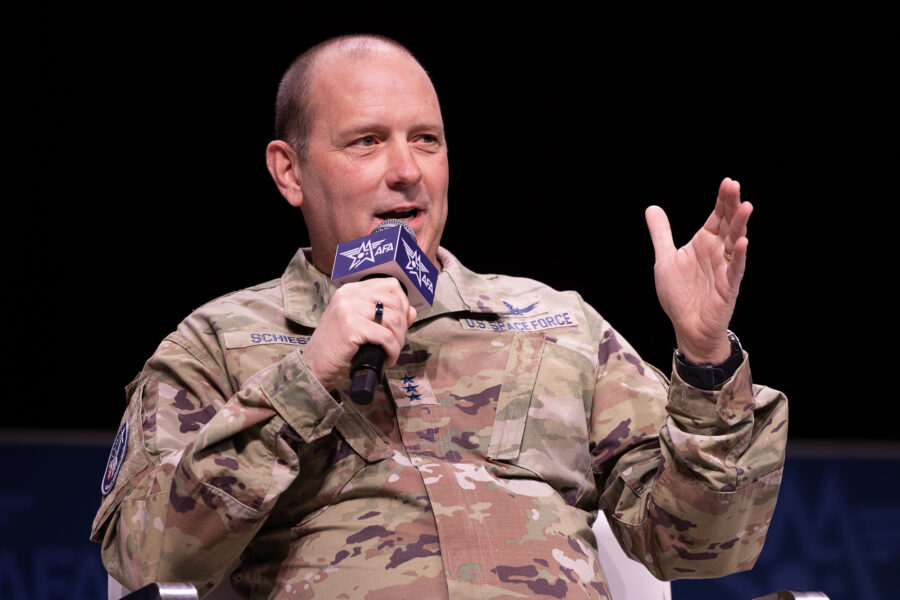
The Senate approved Lt. Gen. Douglas Schiess as the Space Force’s next Chief of Space Operations.
Schiess will receive a fourth star and take the helm of the Space Force following a unanimous Aug. 6 vote, approving his nomination to become the third CSO since the service’s establishment in 2019.
Outgoing CSO Gen. Chance Saltzman, who is retiring from the military after 35 years of service, praised Schiess in a statement.
“Lieutenant General Schiess is an exceptional leader and brings the experience and vision needed to guide the service into its next chapter,” Saltzman said. “I look forward to watching the Space Force continue to thrive under his leadership.”
Schiess is a career space operator. In the early 1990s, he served on an intercontinental ballistic missile crew at Grand Forks Air Force Base, N.D., and later operated GPS and military satellite communications systems. From 2018 to 2020, he oversaw launch operations at Cape Canaveral Space Force Station, Fla., and in 2023 became the first commander of U.S. Space Forces-Space, the service’s component to U.S. Space Command. Most recently, he served as deputy CSO for operations, where he developed and implemented the policy that guides Space Force operations around the globe.
As the Space Force’s top officer, Schiess will lead a service poised for growth—both in size and in budget. The Space Force is on a path to double its force of more than 10,000 uniformed Guardians to 20,000 over the next five years. And its $71 billion fiscal 2027 budget request is more than double what the service requested last year, amid growing demand for space capabilities.
Much of that growth will focus on countering growing threats from U.S. adversaries. During his confirmation hearing earlier this summer, Schiess acknowledged that China, in particular, is moving “breathtakingly fast” to field space capabilities that could threaten U.S. operations in orbit.
“They built a kill chain to be able to see our carrier strike groups, our bombers, at a much farther pace, speed, and distances, and they’ve also developed missiles and weapons systems to go after that,” Schiess said during the July 16 hearing. “So, the Space Force needs to be able to bring capability to deny, degrade that kill web to be able to protect the joint force.”
Schiess also emphasized deterrence as central to his strategy for countering growing threats in space.
“The space domain is increasingly contested and vital to modern warfare,” he said. “Our purpose is not confrontation, but deterrence, ensuring no adversary believes aggression against the United States will succeed.”
In a statement congratulating Schiess on his confirmation, Air & Space Forces Association President & CEO Lt. Gen. Burt Field, USAF (Ret.), highlighted the growing importance of space capabilities to joint military operations.
“Doug Schiess takes charge of America’s newest service at a crucial time in American and Space Force history,” said AFA President & CEO Lt. Gen. Burt Field, USAF (Ret.). “No modern military action takes place without space at its core, not just as an enabler, but an indispensable component required to win. General Schiess is well prepared to lead the Space Force at a dynamic time of growth and technological change. We are confident that he is the right leader at the right time to take the Space Force into its second decade.”