


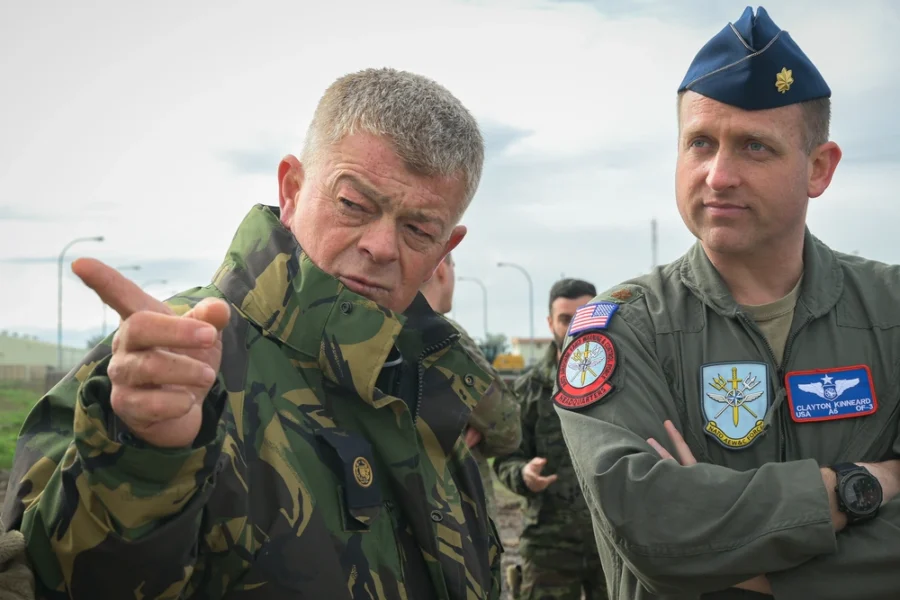
The Air Force is now training hand-picked Airmen to translate the service’s wartime airfield needs into the native tongues of non-English speaking allies. These aren’t linguists; they’re Airmen from across the force, trained to patch bomb-damaged concrete runways or fix fighter aircraft.
What makes them different is they already speak the languages of allies in Taiwan, the Philippines, Korea, and other countries. This experience makes them perfect candidates for Air University’s newest version of the Language Enabled Airmen Program, or LEAP, that focuses on Agile Combat Employment operations, according to Chris Chesser, deputy director of the Air Force Culture and Language Center and architect of LEAP-ACE.
“They are aviators, cyber specialists, civil engineers, aircraft maintenance specialists, medical professionals, etc., who have advanced intermediate to advanced level language proficiency,” Chesser told Air & Space Forces Magazine. “The reason they need this course is because up to this point, they have not been exposed to the technical vocabulary that spans multiple modalities, such as airfield operation, aircraft maintenance, airfield damage repair, medical operations. We teach them the technical vocabulary in the target language.”
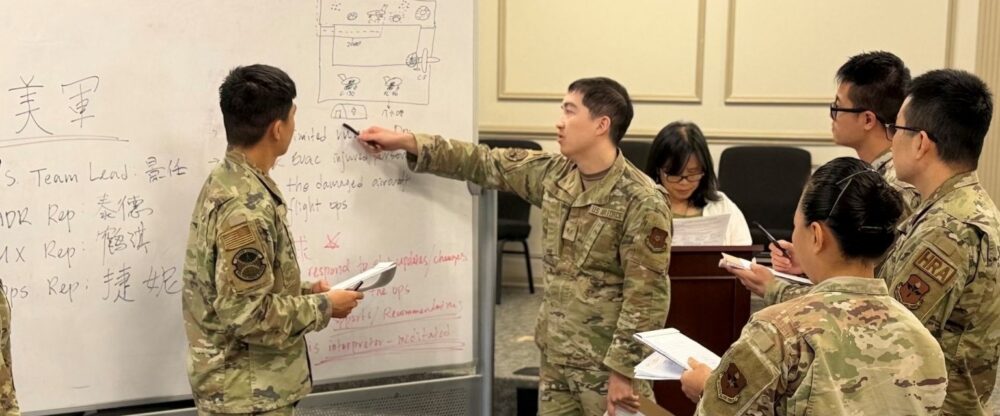
Since April, the new program has trained six, eight-member teams of Airmen, from the officer and enlisted ranks, to translate ACE in a specific language. Each three-week rotation teaches a separate language to two teams. In April, it was Japanese or Korean. In June, the course focused on Mandarin Chinese, the primary language of Taiwan, or Tagalog, which is spoken in the Philippines. And in July, it covered Russian or Ukrainian.
All of the students are former graduates of the original LEAP, an effort stood up in 2009 to create a career-spanning program to develop a cadre of foreign language-proficient Airmen and Guardians from across all specialties to serve as cultural and linguistic experts for their fellow service members.
But program officials saw a need to offer a team-focused course designed especially for ACE doctrine, which was formally unveiled in 2021. The ACE strategy involves deploying teams of Airmen to establish ad-hoc airfields to remote locations of the future battlefield. For the concept to work, the Air Force can’t afford to become tongue-tied when working with host-nation allies, said Howard Ward, director of the Culture and Language Center.
“The why behind this course is speed; the how is through ACE concepts and technical vocabulary and then fusing that with language training,” Ward said. “None of us are going to be faster than the slowest amongst us, that slows the whole team down. So, we have to be able to understand each other, breaking through any cultural barriers … so that when we get together with allies, we’re moving at one really, really fast speed.”
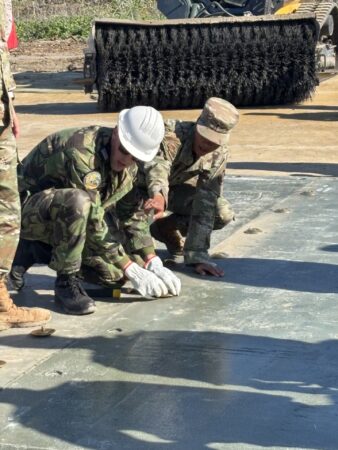
Course developers gained momentum in February 2025 from the lessons a group of LEAP scholars brought back from a joint Airfield Damage Repair exercise at Morón Air Base, Spain. U.S. Airmen deployed to Spain from bases across Europe to work alongside Spanish and Portuguese air force personnel to solve the multiple logistical and technical challenges of repairing concrete runways.
U.S. Air Force 1st Lt. Aliyah Brown, a logistics readiness officer and LEAP scholar joined operations at the airfield repair site to ease communications challenges between U.S., Portuguese, and Spanish forces.
“We ensured that Portuguese personnel understood what was needed, when, where, and why—helping prevent confusion and delay in a highly dynamic and fast-paced environment,” she said in a recent Culture and Language Center press release.
“Being an interpreter in that environment is not just about utilizing your fluency but also actively participating in getting the right people in the right place to leverage the full extent of what they bring to the operation,” Brown added.
From there, it was clear that the LEAP-ACE course should focus on training teams of language proficient, ACE specialists from multiple career fields that could serve as a model for future operations, Ward said, adding that the ADR exercise at Morón Air Base was “a real turning point in developing the concept of where it is today.”
Each three-week course rotation puts students through “multiple drills of interpretation practice, where they employ the technical vocabulary and the ACE doctrine concepts that they learn from our warfighting education directorate here at Air University,” Chesser said. “The course culminates in bilateral and trilateral regional crisis scenarios involving tabletop board games, where they have to put everything into practice.”
Another key difference in the new LEAP-ACE course is that students are recruited to ensure there is the right mix of ranks and career fields needed to form a realistic ACE team.
Using the Language Enabled Airman Development Resource portal allows course officials to track the roughly 3,800 Airmen and Guardian LEAP scholars across each service.
“This tool gives us literally an ability to search for service members who match the required proficiency for that course, the required language for that course, and then we can drill in deeper to get a sense of what experiences they’ve had, where they’re stationed, their rank of course, and put together a student team,” Chesser said.
“We’re not just bringing in some random students; we try to put together a rank structure that will make sense, so you will have a field grade officer, for example, providing some leadership,” he added.
So far, course officials have only recruited Airmen for the course, but they plan to bring Guardians and other service members into the course as it matures.
Going forward, Air Force personnel specialists should be able to easily locate LEAP-ACE graduates if the need arises,” Ward said. “Now all of that data is in the system of records, so that when they’re trying to find folks that have those capabilities, they can easily be found.”
In the future, these student teams may not come together in the same way again, but the course graduates will have the experience to meld quickly with any team assembled, Ward said.
“The idea is we’re not going to have a crawl, walk, run kind of timeline that we’ve seen in other conflicts before,” Ward said. “It’s pretty certain that adversaries are going to force us to run right off the bat. We have to be ready to go fast and go large on day one.”