
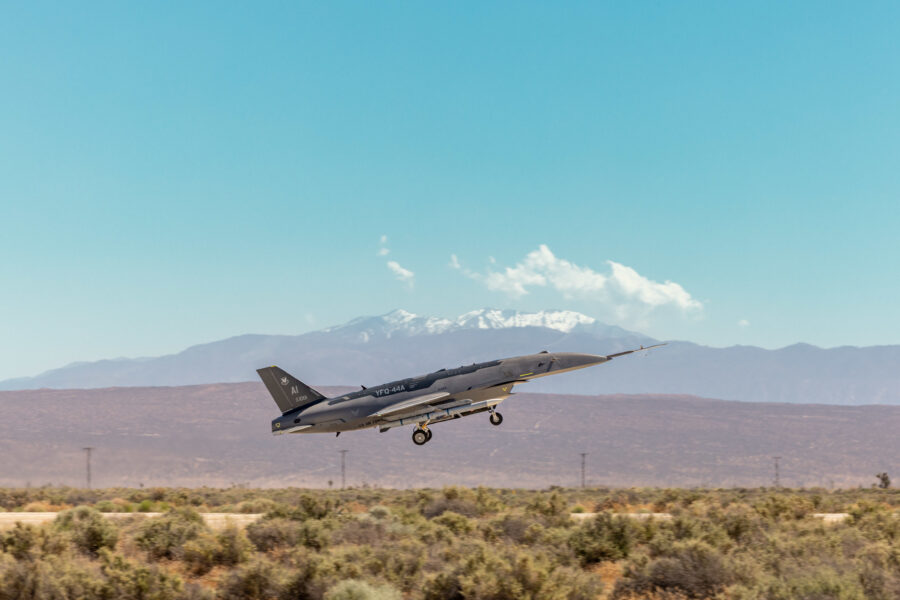
Two of the Air Force’s semi-autonomous drones flew air combat maneuvers coordinated by an “AI pilot,” or mission autonomy software, in a test Oct. 26, a first for the Air Force’s Collaborative Combat Aircraft program.
The autonomy software, called Hivemind, was from Shield AI, which announced the flight Nov. 9. The aircraft were FQ-44As, built by Anduril Industries.
The test, which took place at the Nevada Test and Training Range, involved the FQ-44s flying in formation and carrying out beyond-visual-range air combat maneuvers directed by the Hivemind software, Shield AI vice president of Hivemind engineering Todd Wesley said in an interview with Air & Space Forces Magazine.
It builds on another landmark flight Oct. 8 at Edwards Air Force Base, Calif., when an F-22 pilot in flight directed an FQ-44 Fury, also using the Hivemind autonomy software.
“The difference here was, it was a full-on tactical air-to-air engagement,” Wesley said. “The initial test in early October was essentially a stepping stone to this capability. … This was kind of a graduation, so to speak, exercise beyond what happened in early October.
Unlike the Oct. 8 test, Wesley said, there was no human pilot in the sky for the Oct. 26 flight. Instead, an operator on the ground provided high-level directions to the pair of CCAs as they engaged a virtual threat. The test was a success, he said, and Shield AI is looking forward to more complex tests in the future.
“We’ll continue to expand the complexity of engagements that our live-flight pilots, our quarterbacks, will be directing and interacting with, and we will be adding additional assets to the live-fly exercises,” Wesley said.
That will include building up to larger teams, teams of teams, and more intricate operations such as changing assets between teams that are in-flight, he said. Flights with CCAs carrying and employing live munitions will come later, he said, but he couldn’t say when.
“It starts to prove out more and more of the orchestration capabilities of these systems, and making sure that how we design the human-machine interface allows the humans in the cockpits to be able to manage this level of complexity, and learn those answers and where we need to simplify to do so appropriately,” Wesley said.
The Air Force is betting big on CCAs as a way to extend the reach and mass of its combat fleet. Service officials have previously made reference to one manned fighter controlling anywhere from two to five CCAs, though more recently, some have suggested a ratio of one-to-eight. Not only will that require human pilots to keep track of an entire formation, it will require autonomy software to coordinate their maneuvers with minimal direction.