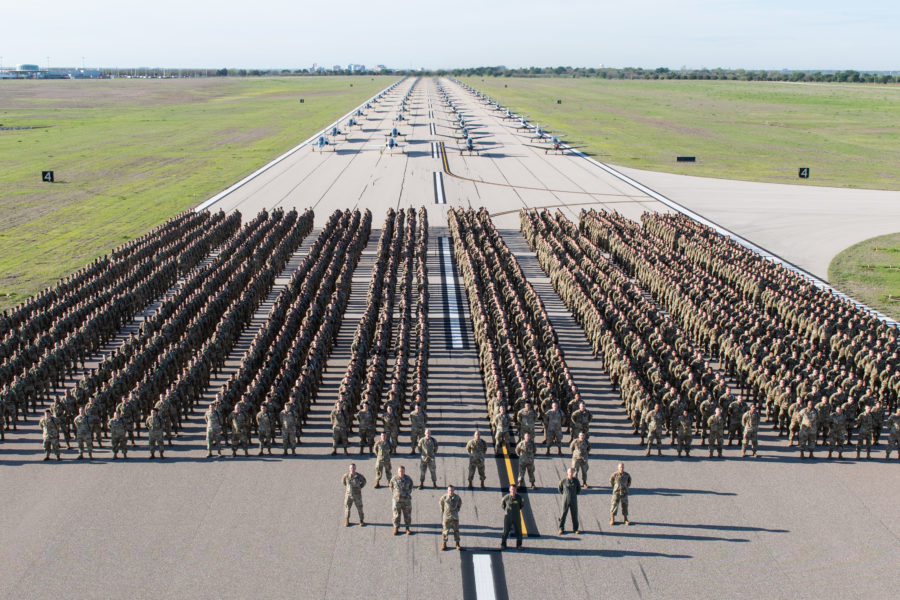
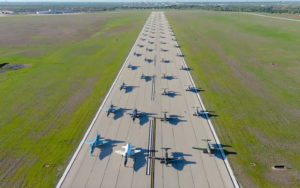
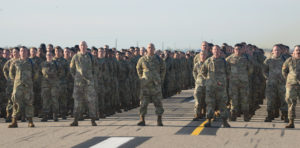
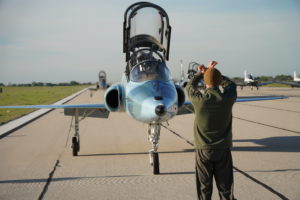
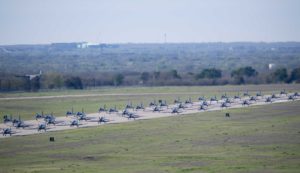
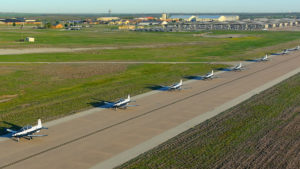
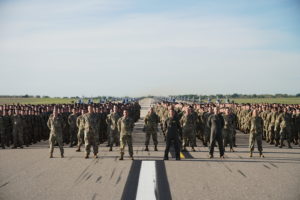
Four thousand Airmen and 80 aircraft participated in a one-of-a-kind elephant walk April 7, 2023, at Sheppard Air Force Base, Texas. Photo by Alan Quevy.
Audio of this article is brought to you by the Air & Space Forces Association, honoring and supporting our Airmen, Guardians, and their families. Find out more at afa.org
Air Force leaders often promote the skill of America’s Airmen as the U.S. military’s most powerful, if intangible, advantage. Officials at Sheppard Air Force Base, Texas, found a way to highlight the human element of airpower recently: an elephant walk with its aircraft and Airmen.
Elephant walks are used as a show of force, with fighters, bombers, and other aircraft coming together on the same runway to send the message that the USAF has plenty of powerful hardware at its disposal.
On April 7, Sheppard lined up 4,000 Airmen and 80 trainer aircraft on a runway to showcase the power of its people as well as its planes. The base said it was possibly the largest elephant walk in Air Force history—nearly 70 F-15Es took part in an elephant walk in 2012. Sheppard hosts technical and flying training, allowing for a unique display of man and machine. The base trains pilots in partnership with U.S. allies, many of whom were in their jets during the elephant walk, giving it an international aspect, a base spokesperson told Air & Space Forces Magazine.
“This elephant walk really illustrates the scope and magnitude of what we do here,” Brig. Gen. Lyle K. Drew, commander of the 82nd Training Wing, said in a news release. “The key to airpower is exceptional Airmen, and the key to exceptional Airmen is exceptional training. That’s what we do here at Sheppard, and this elephant walk was our message to the world that the U.S. and its international partners remain committed to delivering the best-trained Airmen in the world.”
Around 65,000 Airmen pass through Sheppard annually, and roughly 150,000 of the USAF’s Active-Duty Airmen were trained at Sheppard, the spokesperson said. The 82nd Training Wing is the Air Force’s largest technical training wing.
Airmen from the wing lined the runway in front of the horde of aircraft from the 80th Flying Training Wing, which brought out 40 T-6 Texan and 40 T-38 Talon trainers. The 80th Flying Training Wing hosts the Euro-NATO Joint Jet Pilot Training Program—known as ENJJPT—which teaches foreign combat pilots through a partnership between the U.S. and its allies.
“The fundamental technical and pilot training missions that happen here every day affect literally every base and every combat sortie in the Air Force–not to mention the impact on our global partners,” Col. Brad Orgeron, the commander of the 80th Flying Training Wing, said. The base trains Airmen in 52 specialties, with a contingent of international students passing through at any given time as well. The 80th trains pilots in a partnership with 14 countries, with around 200 new pilots earning their wings there. Five NATO members—Germany, Belgium, the Netherlands, Norway, and Denmark—only train new fighter pilots at Sheppard, the base spokesperson added.
“We want our allies to know that we are committed to and value our shared training experience with them, and we want our potential adversaries to know that we are bound together with our friends and partners from the very beginning of our military careers as we train side by side to defend our way of life,” Orgeron said.
Audio of this article is brought to you by the Air & Space Forces Association, honoring and supporting our Airmen, Guardians, and their families. Find out more at afa.org
The Air Force’s B-52 bomber may soon be able to carry up to 20 stealthy long-range anti-ship missiles to strike moving targets at sea, a key capability in a potential fight with China.
The Air Force has begun evacuating stealth fighters, gunships, and special operations planes ahead of Hurricane Isaias expected landfall over the Gulf Coast this weekend.
A reported surge of MQ-9 Reaper drones to Latin America could widen the scope of intelligence gathering and free up more strike options against cartels in the region, experts tell Air & Space Forces Magazine.
Northrop Grumman has broken ground on a major new production facility for the B-21 Raider, the company and the Air Force announced Oct. 6. The construction comes as a top service official said testing on the bomber is going well in the lead up to its planned introduction into the…
An OA-1K Skyraider II belonging to Air Force Special Operations Command went off the runway while landing at a small Oklahoma City airport Oct. 5 and is waiting to be moved, according to officials and flight tracking data.
More than two dozen F-35 Lightning II fighters are heading to Kingsley Field, Ore., after Air Force Secretary Troy Meink signed the official record of decision to base the jets there on Oct. 5, clearing the last bureaucratic hurdle for the Air National Guard base to host the service’s third…
Northrop Grumman’s Talon Blue YFQ-48A Collaborative Combat Aircraft took its first flight Oct. 3, heightening the competition for the Air Force’s future combat fleet.
The Air Force’s plans to field 1,000 semi-autonomous fighter and intelligence, surveillance, and reconnaissance drones within just a few years made headlines at AFA’s Air, Space & Cyber conference last month. But beyond the service’s signature Collaborative Combat Aircraft and Massed Modular Aircraft programs, a half-dozen or so firms are pitching…
✓
Thank You!
Check your inbox to verify your email address and finish setting up your AFA account.
★
Welcome Back!
An account with this email already exists. Please log in to continue.
Subscribe to the Air & Space Forces Daily Report
The latest news from Air & Space Forces Magazine, as well as news from other leading publications, delivered right to your inbox every morning!
We’re sorry, there has been an error. Please review your input or try again later.