
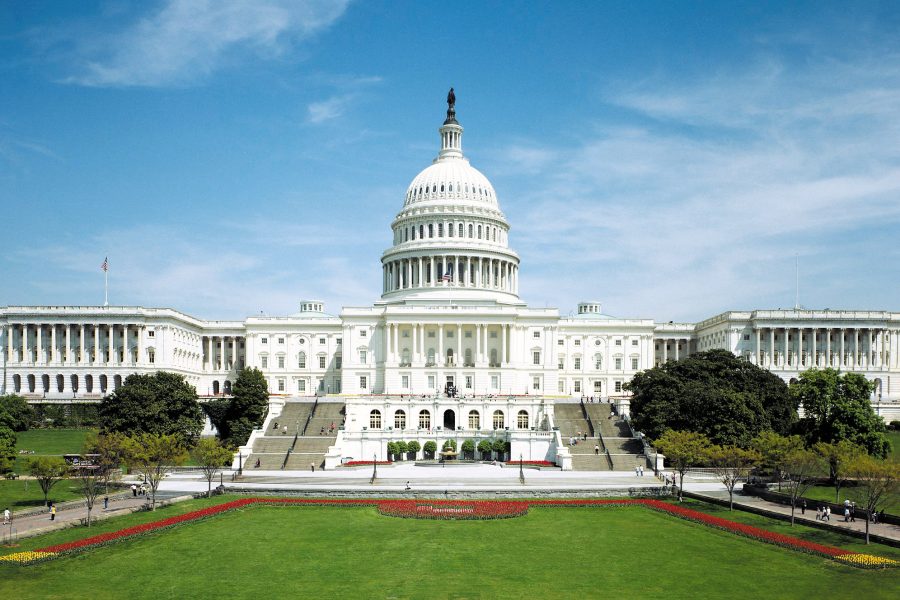
Congress returned to Washington, D.C., Nov. 9, for a six-week “lame-duck” session following last week’s historic win for the Democrats.
Come January, the party will control strong majorities in both the House and Senate—but between now and Jan. 3, 2027, when the new Congress is sworn in, lawmakers face a stack of unfinished business, including long-stalled defense legislation.
Republicans retain their narrow majorities in the House and Senate through the end of the year, but some who lost elections may not return for the final few weeks, and what can be accomplished is far from clear. Congress watchers say the election effectively killed the Pentagon’s hopes for a $1.5 trillion budget; the request is now clearly dead. How much spending survives is now the central question.
Long-time defense analyst Byron Callan of Capital Alpha Partners doubted from the start whether the $1.5 trillion topline could survive. The White House plan split the request in two, including a $1.15 trillion “base” appropriations bill and $350 billion more to be funded through a separate reconciliation bill, using a procedure that can enable a majority party to circumvent the Senate’s 60-vote requirements for certain spending legislation.
Callan wrote in a Nov. 4 newsletter that the chances of Republicans passing a reconciliation bill at just 10 percent.
“The magnitude of Democratic gains in the House and Senate from the midterm elections suggests that nothing will get done by Congress for defense legislation” in November or December, he wrote.
Travis Sharp, director of defense budget studies at the Center for Strategic and Budgetary Assessments, likewise sees a reconciliation bill as remote. Republicans passed a reconciliation package in 2025. That bill, dubbed the One Big Beautiful Bill Act, included $150 billion for defense. But this year is different, Sharp told Air & Space Forces Magazine.
“Besides the Iran war, which was an obvious sticking point … the other sticking point was last year … there was a tax cut on the table,” Sharp said. “The tax cut could be offered to fiscal conservatives in exchange for them supporting a big defense reconciliation package. This year, there’s no tax cut to trade.”
Still, Republicans could try to band together in a last-ditch effort to fund their top priorities. Sen. Bernie Moreno (R-Ohio) predicted before the election that a reconciliation bill would pass in some form during the lame-duck session. If Republicans lost their majorities, he suggested then, they could still tack as many of their legislative priorities as possible onto a single bill. He called the scenario a “Last Supper.”
Defense Secretary Pete Hegseth, in a post-election Nov. 5 social media post, called on “every patriotic member of Congress” to support a reconciliation bill of “at least $350 billion.”
Time is short, however. The complex parliamentary procedures required are time consuming. The 2025 reconciliation bill was launched last year on April 10, and didn’t pass Congress until July 3.
Aside from time, ill-will could also be a factor for lawmakers who blame the President for their defeat. Even more fundamentally, experts agree that a subset of Republicans who lost their election may not even show up for the lame duck sessions, giving Democrats who are present more leverage.
“What happens in the lame duck is really going to be a function of attendance,” retired Air Force Col. Todd Harmer, now with American Defense International, said on the Nov. 7 episode of the Mitchell Institute for Aerospace Studies’ “Aerospace Advantage” podcast. “There are a significant number of members that did not get reelected that are never coming to D.C. again. … So whatever passes in the lame duck is going to require Democrat votes.”
Republicans took a stab at a reconciliation package this summer, a slimmed-down bill, which leaders portrayed as a way to help pay war costs and replenish munitions stockpiles used in the Iran conflict. The White House submitted a supplemental funding request to cover those costs among other programs, totaling $67.1 billion for the Pentagon.
But even that scaled-back package stalled. The House passed an initial framework, but the Senate declined to take it up, making a larger measure now seem far-fetched.
Other factors working against reconciliation are competing priorities, chief among them the current continuing resolution that’s funding the Pentagon and the rest of the government; it runs out Dec. 11.
While a government shutdown does not seem likely, neither do 2027 appropriations. That means another CR must be passed to keep the government operating at least into January.
For Republicans, there’s at least some incentive to cut a deal with Democrats while they still hold majorities to secure at least some of their priorities. For Democrats, there’s an incentive to wait until they are in power. Some defense hawks may be willing to cross the aisle to support Pentagon funding, but there will be limits to that, longtime congressional adviser and retired Air Force Col. Anthony “Lazer” Lazarski predicted on the Aerospace Advantage podcast.
“The Democrats are going to focus on a smaller and smarter defense budget and they’re going to be looking for parity for defense and nondefense spending, and that’s going to put them at odds with the administration,” said Lazarski, now with Cornerstone Government Affairs.
Rep. Adam Smith (D-Wash.), currently the Ranking Member on the House Armed Services Committee, illustrated that dynamic this past week. In a letter to colleagues officially declaring he would seek to chair the committee in the new Congress, he argued for a topline well short of $1.5 trillion.
“We must thoroughly review our national defense strategy and develop a more realistic and sustainable approach that does not require a defense budget in excess of $1 trillion or paid for through draconian cuts to critical domestic programs,” he wrote.
There is precedent for defense appropriations getting done during the lame-duck session. In an Oct. 28 analysis, the Center for Strategic and International Studies’ Seamus Daniels wrote that “during the last three midterm election years (2014, 2018, and 2022), full-year defense appropriations for the relevant fiscal years … were passed prior to the end of the respective calendar year and the adjournment of each respective Congress—despite control of one chamber flipping in each instance.”
But the scale and split of the Pentagon’s 2027 defense spending plan makes this year’s situation unique.
NDAA
Meanwhile, some authorities expire with the end of the calendar year if the National Defense Authorization bill does not become law. While negotiations over government funding are contentious, the annual defense policy measure is a largely bipartisan affair and is usually considered must-pass legislation.
A version of the bill cleared the House in July, and Rep. Rob Wittman told reporters last month that informal negotiations between the House and Senate had already started, according to Roll Call.
But some elements of the 2027 bill are contentious, with fault lines over the war with Iran, the Trump administration’s campaign against drug cartels in Latin America,and the renaming of the Department of Defense to Department of War.
Other issues likely to come up in any lame-duck negotiations include a proposal from the Pentagon to create an Autonomous Warfare Command, the Pentagon’s support for border security and immigration enforcement, the deployment of troops to American cities, and a push from the Trump administration to reduce the U.S. force posture in Europe.
“Especially for the NDAA, any of the poison pills—policy provisions that are partisan—will have to be smoothed out in order to get bipartisan support for the bill,” Harmer said.