
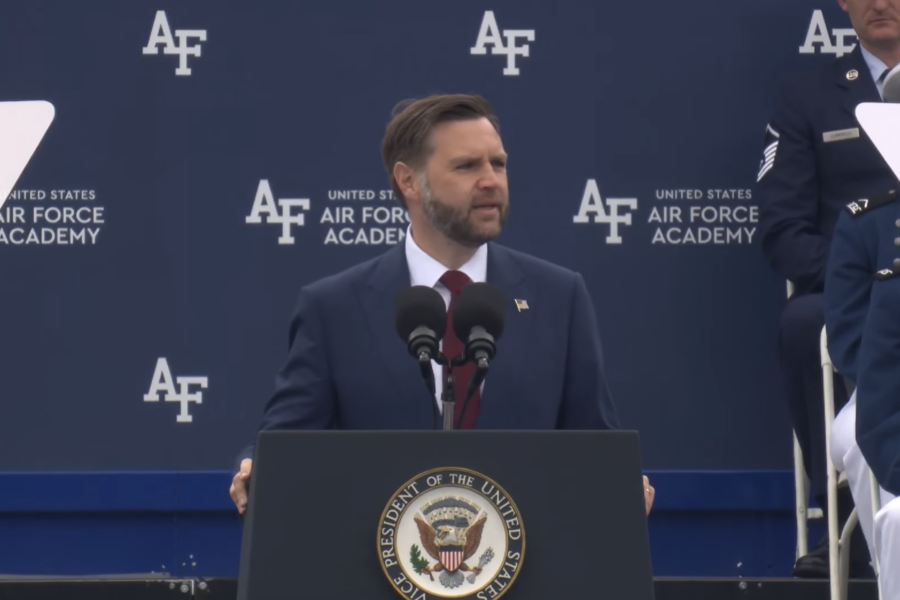
Vice President JD Vance told new officers graduating from the U.S. Air Force Academy they will need to be adaptable in a new and unpredictable era—and that artificial intelligence may change warfare, but not the need for leaders capable of making critical decisions.
Vance was on hand to help commission more than 900 new officers into the Air Force and Space Force at USAFA’s May 28 Commencement ceremony. But first he had a message for the graduates, reminding them of a 150-year-old military adage: “No plan survives first contact with the enemy.”
Plans are essential, Vance said, but flexibility has always been a defining characteristic of airpower and spacepower. The “unpredictability of warfare is becoming impossible to ignore,” Vance said. “We ask you to apply that same adaptability, that same innovation that you learned at this academy to an entirely new era of warfare, one shaped by autonomous systems, AI, and cyber operations—technologies evolving far faster than military institutions have historically been accustomed to.”
AI’s rapid maturation has made it a common topic for graduation speakers across the country this spring, in some cases generating boos from graduates unnerved about technology’s impact on their futures.
But for new military leaders, the challenges are especially relevant. Lt. Gen. Tony D. Bauerfeind, the academy’s superintendent, touted the academy’s rapid adoption of AI at the graduation, and Vance urged graduates to “use technology to make you better.” He joked that in taking up the topic, he was not expecting boos from the uniformed cadets arrayed before him.
“The thing I worry about most with AI is how it will change warfare,” he said. Referencing the new encyclical on AI released earlier this week by Pope Leo XIV, Vance argued that even as AI will “inevitably” change warfare, humans must remain in control.
“If the warfare of the future is to live up to the moral values of our ancestors, decisions over life and death must be made by humans and not machines,” Vance said, drawing applause.
“So as AI transforms the battlefield—in some ways positively, in some ways not—I ask that you be jealous and selfish about your role as the decision-maker in warfare. Use technology to make you better, but never submit to it. You are the masters of warfare, and both your minds—but also your hearts—are the opposite of artificial.”
Vance referenced the military’s operations this year in Iran and Venezuela, telling graduates to be prepared for challenges ahead. “When the President needs options, it’s our Air Force and our Space Force who provide them, redefining what is possible, mission after mission, through sheer human daring,” Vance said. “It is American airpower that allows us to penetrate denied airspace and strike critical targets across enormous distances with speed, efficiency, and precision. And when the President says he will not allow Iran to have a nuclear weapon, it is the men and women you will join in just 60 days who give force to that promise and to that guarantee.”
Vance cited investments in the Trump administration’s $1.5 trillion defense budget request for 2027, including funds for the F-47 fighter, Golden Dome missile defense project, and barracks improvements, while Air Force Secretary Troy Meink cited the B-21 Raider bomber, Sentinel intercontinental ballistic missile, Collaborative Combat Aircraft, T-7A Red Hawk jet trainer, and proliferated satellite constellations.
“Your career will be marked by rapid change,” Meink told graduates. “We are modernizing nearly every mission area in our department. … It will be up to you, young men and women with fresh ideas and unmatched technical education, you will be expected to navigate through this changing world.”
Bauerfeind said the class of 2026 has shown the capacity to adapt as the academy has gone through major changes, both before and during his tenure.
“You are leaving the academy in a better place than when you entered it, as you will do with every assignment you take in your future,” Bauerfeind said. “As warrior-scholars, you integrated rigorous academics, immersive training, and cutting-edge research to prepare you for combat leadership. Your education was deliberately designed to ensure you are the warfighters who can outthink, outmaneuver, and outfight our adversaries.”
The Class of 2026 secured 35 percent more pilot training slots than last year, Bauernfeind said, and they led the rest of the Cadet Wing to its highest GPA in 20 years and best PT test scores in 10 years. More and better will follow: Applications for the Class of 2030, which will be inducted just a few weeks from now, were up 11 percent over the prior year—enabling admissions to be more selective and competition to grow even more intense.


Class of 2026 Stats
The U.S. Air Force Academy class of 2026 that graduated May 28 included 931 cadets, including 13 international cadets. Their cumulative GPA was 3.21, and 42 were prior enlisted.
The 918 American cadets commissioned into every military service except the Coast Guard:
- 805 in the Air Force
- 94 in the Space Force
- 4 in the Army
- 4 in the Navy
- 2 in the Marine Corps
Among those heading into the Air Force, there were:
- 455 tapped to be manned pilots
- 13 to be drone pilots
- 9 to be combat systems officers
- 4 to be air battle managers
