
Air Force bases inside the U.S. are heavily guarded, but they could fall victim to the same type of spectacular drone attack that struck bomber bases deep inside Russia last year, retired Air Force Gen. Glen D. VanHerck, former head of U.S. Northern Command and NORAD, said July 30.
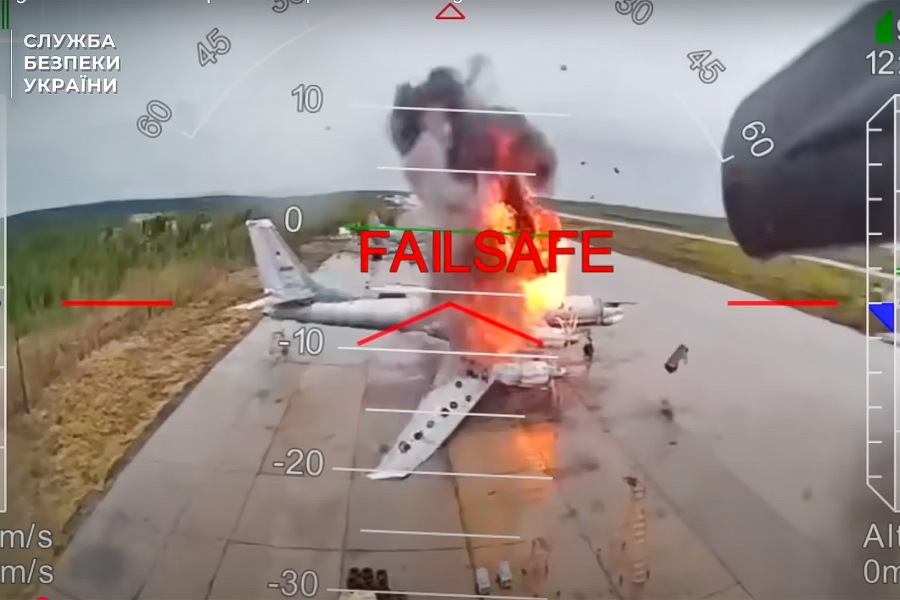
Ukrainian forces shocked the world on June 1, 2025, when they secretly drove 18-wheeler trucks into Russia and launched 117 quadcopters loaded with explosives at strategic Russian bomber bases, destroying roughly 40 bombers and early warning aircraft.
“All of that could occur right here, right here in the United States of America,” VanHerck said during a virtual event at AFA’s Mitchell Institute for Aerospace Studies. “It’s not a new threat. It was innovators who came up with a new concept of operations and employed it, and that threat exists here today.”
VanHerck’s comments highlighted the concerns of a new Mitchell policy paper that recommends the Air Force should adopt a sweeping new strategy aimed at protecting U.S. air bases from future drone attacks.
The report’s author, retired Air Force Brig. Gen. Houston Cantwell, compared Operation Spiderweb to a Hollywood-style stunt “out of a Jason Bourne movie.” But the attack was very real—as were its impacts: roughly $7 billion worth of damages on Russian defense infrastructure, he said.
“It really showed the world how unpredictable and how flexible this new capability of small UAVs can be,” said Cantwell, a senior fellow at Mitchell. “Operation Spiderweb showed that there could be an avenue of attack to a base, to a vital infrastructure, from any avenue of attack with a little more creativity.”
In his paper, Cantwell suggests that the Air Force should go beyond its current “point defense” approach and adopt a comprehensive strategy for defeating an adversary’s ability to launch effective drone attacks on air bases. To Cantwell, the strategy should also include an expanded array of airborne early-earning sensors as well as an offensive strike plan to attack enemy drone manufacturing capabilities. The strategy also has to include a new, multilevel protective posture to help air base personnel adapt to changing drone threat levels.
VanHerck agreed with Cantwell’s proposed strategy but stressed that it would need additional initiatives to protect bases in the homeland.
If an Operation Spiderweb “was developed in the central part of the country here, and then projected out to key critical infrastructure or locations, it would require local citizens potentially knowing what they’re looking at, local law enforcement or state law enforcement agencies contacting federal, and a broad array of law enforcement and potentially military putting the whole picture together with the intel community to understand what’s going on,” VanHerck said. “We’re not there from a policy and organization standpoint yet, and most people don’t think about or understand that threat is here today and could present itself right away within our homeland.”
The Air Force got its first taste of how easily drones can infiltrate secure perimeters in late December 2023, when unidentified drones flew for days over Langley Air Force Base, Va.. More drone incursions followed at bases in Ohio, Utah, and the United Kingdom.
The service came under heavy scrutiny from lawmakers who questioned why base commanders were so unprepared to track and if necessary, destroy drones hovering over vital military aircraft.
In response, the Air Force published new doctrine on the “Point Defense of Air Bases” in April 2025 to ensure the service plays a more active role in air defense, a mission that has traditionally been an Army responsibility. The doctrine gives air base commanders more freedom to identify threats and “secure air operations using organic PD capabilities.” The Air Force also stood up the Point Defense Task Force and Point Defense Battle Lab to develop to identify new training, equipment and tactics needed for the new mission.
The service has also created the first point defense flights, specialized units of Airmen trained to rapidly deploy to the Pacific and other hotspots and defend future remote air bases from drone attack. In the long-term, the service is developing a new job specialty code for base defense as the first step in developing this new career field.
Air Force Col. Cody Moore, who just finished commanding the Point Defense Task Force under Air Combat Command, is keenly aware of the threats that U.S. air bases face but is also confident that the service is much more prepared to deal with drone attacks than it was in December 2023.
“You’ve got to put all those pieces of the puzzle together,” Moore said, describing how Airmen are being identified and trained to “identify the various levels of threat, and then also the appropriate level of force to use.”
“We are also providing leadership training to those base commanders to understand their specific authorities, how they should work with local law enforcement because outside of the gate, they’re a big piece of that too, and then also how to communicate that within the Air Force and with NORAD and NORTHCOM and all of the other civilian agencies that are a part of this,” Moore said. “That’s what makes this so complicated and dense—you need all of those pieces to be successful.”