
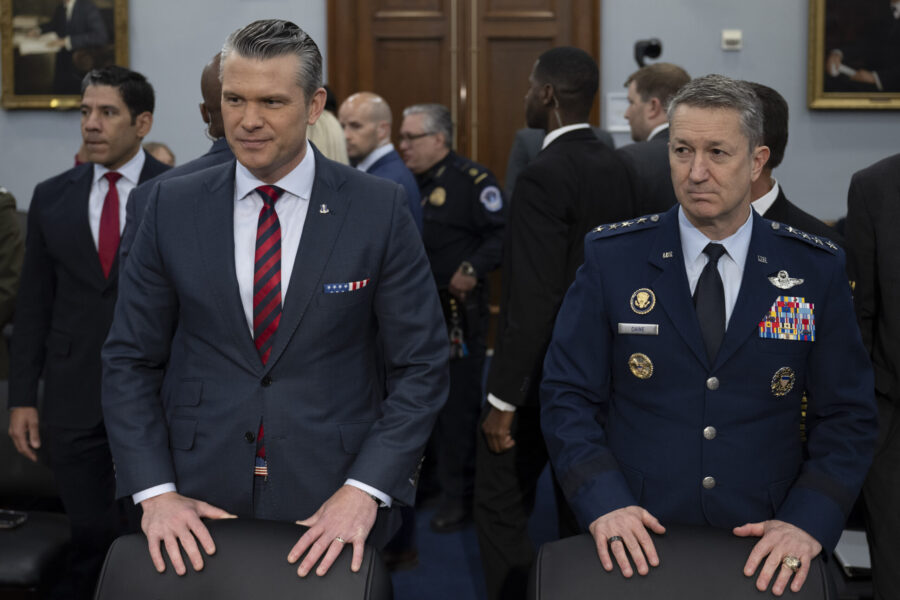
The Pentagon’s cost estimate for the Iran war has risen to $37.5 billion, Defense Secretary Pete Hegseth told a congressional committee July 21—and without emergency supplemental funding, the military will have to “curtail” training to cover those costs, he added.
Hegseth and Chairman of the Joint Chiefs of Staff Gen. Dan Caine appeared before the Senate Appropriations Committee to defend the White House’s supplemental funding request from last month, which includes $67.1 billion in defense spending. But the wide-ranging hearing reinforced how complex the Pentagon’s overall budget outlook has become, especially with the cost of the Iran conflict expected to keep rising as hostilities reintensify.
Even the new cost estimate is not completely straightforward. Hegseth told Sen. Dick Durbin (D-Ill.) that the total includes some military pay, operations and maintenance, and “other anticipated costs” through the end of the fiscal year on Sept. 30, but it apparently does not include any costs to repair or rebuild military infrastructure damaged in the conflict.
Regardless of how the estimate is calculated, those costs carry an impact, Hegseth told Sen. Susan Collins (R-Maine).
“There is training, training right now and training in the future, that would have to be curtailed if we do not get our budget needs met and met urgently,” Hegseth said.
Hegseth’s comments appear to confirm a report from The Washington Post that some military training and exercises have been canceled or delayed to divert funds for Iran operations.
Back in late April, the Pentagon’s acting comptroller Jules “Jay” Hurst III estimated the cost of the conflict to be $25 billion, though he cautioned the total was not completely comprehensive and did not include military construction costs. Hurst revised that estimate to $29 billion by early May, and White House Office of Management and Budget Director Russell Vought said in late June that the cost was up to $30 billion.
In the last 10 days, U.S. Central Command has launched a series of large-scale strikes in retaliation for Iranian strikes on shipping in the Strait of Hormuz, as the fragile ceasefire between the two sides collapsed. That’s led the U.S. Air Force to rush fighter jets to the region. All these moves carry financial costs.
Supplemental Squeeze
The full supplemental funding request the White House sent Congress on June 24 includes $87.6 billion. The bulk of that—$67.1 billion—is for the Pentagon, but exactly how much of that is meant to pay for the Iran conflict is less clear, defense budget analysts have previously noted to Air & Space Forces Magazine.
In a letter to Congress, OMB said the request included $21 billion for munitions, $17.3 billion for operational costs, and $1.5 billion for fuel costs, all of which could be counted as related to Iran. But other elements, like $4 billion for high-priority Space Force programs, $5.1 billion for cybersecurity and autonomy, and $1.7 billion for drones, were unrelated.
“The president’s request is not even primarily a request to cover the costs of the Iran war,” Sen. Patty Murray (D-Wash.) argued. “This request is chock full of asks to fund unrelated DOD priorities, which should be considered through our annual appropriations process, not in an emergency supplemental.”
In written testimony, Hegseth broke down the request between $21.3 billion for “sustaining military readiness” and $45.9 billion for “accelerating critical capabilities.” While never explicitly mentioning Iran operations in the statement, Hegseth did categorize $15.1 billion of the request as being “for core operational costs, funding military pay, and operational shortfalls in training and readiness accounts and other mission-related costs” and $2 billion to “replace equipment lost or damaged during combat operations.” The $21 billion in munitions would go toward “high-demand” weapons like Joint Direct Attack Munitions, hypersonics, and more.
In her own statement, Collins argued that the supplemental is critical to making sure service members have what they need.
“We should not undermine the readiness of our service members for any engagement or refuse to rebuild critical capabilities,” Collins said. “Our men and women in uniform do not decide where they are sent or the missions to which they are assigned. Congress has a responsibility to ensure that they have the tools, the training, and the support that they need to accomplish their missions.”
Many Democrats on the committee, though, signaled they view supporting the supplemental as supporting the Trump administration’s approach to the Iran conflict.
It appears congressional Republicans are preparing to forge ahead with the supplemental without any Democratic support—over in the House, Republicans are in the midst of advancing a budget resolution with $60 billion for defense through the reconciliation process, a maneuver designed to circumvent the Senate’s requirement for a supermajority of 60 votes to pass.
While the White House and congressional Republicans had previously talked about including $350 billion from the Pentagon’s 2027 budget request in this reconciliation bill—the third Congress is pursuing in this session—now leaders are saying the legislation’s $60 billion will go toward Iran war costs and munitions, the priorities identified in the supplemental.
