


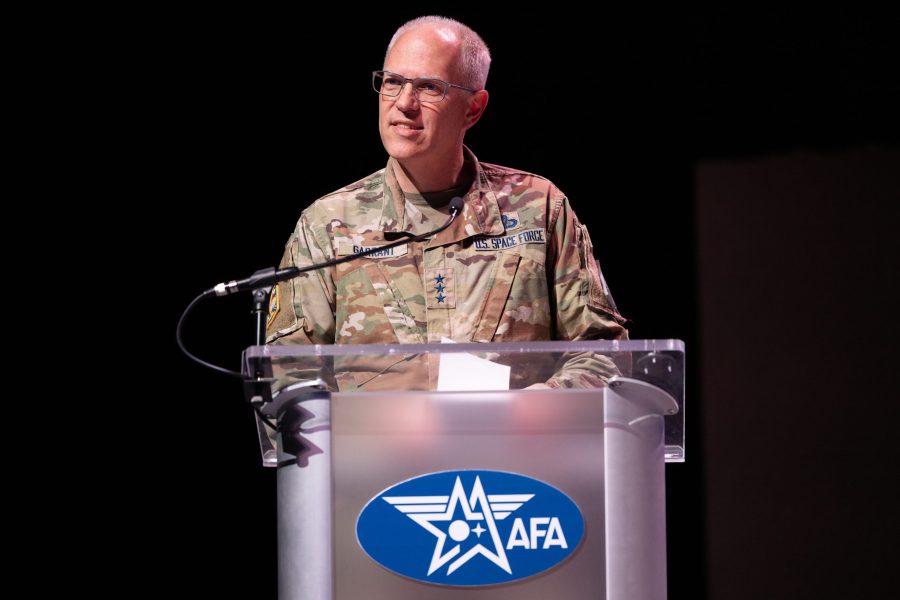
As the Space Force enacts sweeping acquisition reforms over the next few years—changes that will shift the way it sets requirements, manages programs, and fields systems to operators—the head of its acquisition field command wants to ensure this transformation doesn’t disrupt program execution.
When Defense Secretary Pete Hegseth rolled out his acquisition transformation initiative last November, the Space Force appeared to have a headstart on several key tenets of that strategy. It had spent the prior year scouring its procurement programs for opportunities to better partner with commercial companies, tightening the link between operational units and acquisition teams, and speeding up fielding timelines for key systems like the Deep-Space Advanced Radar Capability and the Remote Modular Terminal, a satellite communications jammer it rapidly designed and fielded.
Since Hegseth’s strategy hit the streets, the Space Force has continued to make progress on many of its early reform tasks, namely: the delegation of contracting authorities to acquisition experts; and the incremental rollout of nine mission-focused portfolio acquisition executives, which the service finalized in mid-June.
But there’s more work ahead over the next 18 months to meet the Pentagon’s November 2027 deadline for fully operationalizing these new structures. And Space Systems Command Commander Lt. Gen. Philip Garrant said he’s watching closely to make sure the acquisition enterprise’s performance doesn’t suffer in the meantime.
“Over the next year, as we realign people with the new portfolios—and there’s some instances where we did a lot of combining from different organizations with different processes and different cultures and we’re really trying to hire a lot more people—I want to make sure that we don’t take our eye off the program execution,” he said in an interview at SSC’s headquarters at Los Angeles Air Force Base, Calif. “In the end, we’ve got to execute these programs. It is of concern to me.”
Garrant highlighted a few of the service’s major focuses as it looks to implement acquisition reform. On the personnel front, it’s working to realign all of its unit manning documents with the PAEs, which requires a lot of paperwork and administrative lift.
It’s also creating several new processes and forums designed to streamline requirements generation and validation, following the Pentagon’s decision last year to disband the Joint Capability Integration and Development System. That work includes the establishment of a capability trade council made up of representatives from the service acquisition office as well as the user community that will help negotiate requirements trades from the PAEs.
The Space Force is also rethinking what role SSC will play in providing the organizational structure to support the new PAEs. Garrant said the service hasn’t made any formal decisions, but intends to reduce the size of SSC headquarters and redistribute personnel among the PAEs. For example, each portfolio team would have finance and contracting personnel assigned to support them.
“When I say that the headquarters will shrink, it’s not that people are losing their jobs,” he said. “It’s just the opposite. It’s how we’re accounting for where the staffs are.”
He noted that in the service’s ongoing quest to craft the right organizational structure to house its PAEs, it considered expanding its Integrated Mission Delta construct—which pairs Space Operations Command’s Mission Deltas with System Deltas from SSC—and creating mission-focused commands that would combine operators and acquirers within a single field command. Ultimately, the service opted not to restructure its field commands in that way, though it’s still looking at options to more closely couple its operator-acquirer teams.
“Short of having combined field commands, SSC appreciates the value of having MDs and SYDs near each other and continues to look for opportunities to staff program offices near their operational counterparts,” Garrant said.
The Space Force is also working with Congress to make sure its PAEs have the authorities they need to craft portfolio-level budgets and shift funding between programs as new technology emerges or as threats evolve. Appropriators have been hesitant to provide what is an unprecedented level of budget and reprogramming authority, and Garrant said the Space Force—and the Pentagon more broadly—has some homework to do in terms of providing lawmakers the information and assurance they need.
Those discussions are in the early phases, but they’re a high priority as that level of budget flexibility is central to the new PAE structure, he said.
“It will allow us to go very fast, particularly as requirements change,” Garrant said. “When you look at the [fiscal 2027 budget] and how large it is, to have that budget flexibility would be pretty important. I know the PAEs would really like to have that.”