
SCOTT AIR FORCE BASE, Ill.—In an operational first, U.S. Transportation Command planners turned to artificial intelligence agents for help when Spain closed its airspace and bases to U.S. aircraft supporting strikes on Iran in March.
Spain’s abrupt March 2 announcement came just three days into Operation Epic Fury, but TRANSCOM responded quickly by using AI agents to evaluate available airfields in the region, Ryan Samuelson, the chief data and AI officer for the joint command, told Air & Space Forces Magazine.
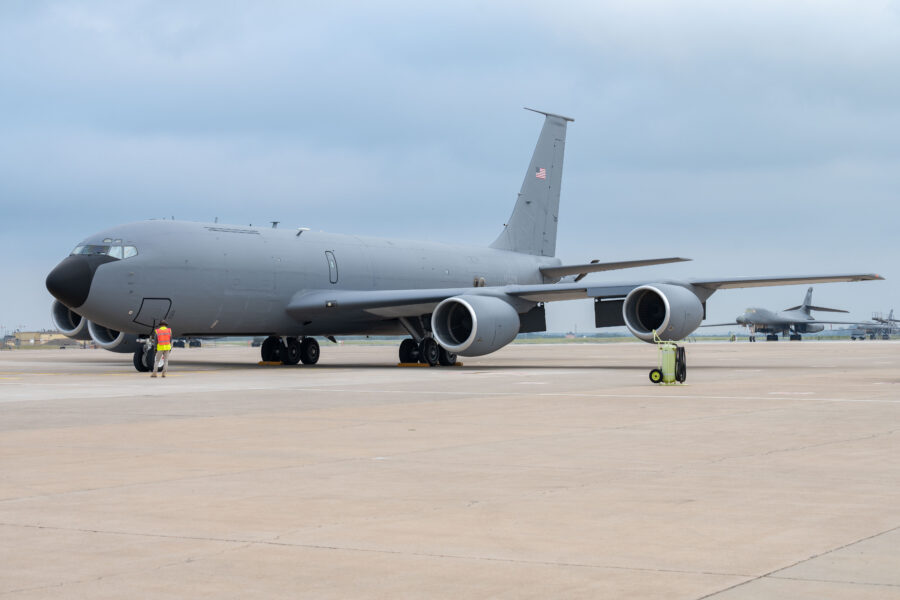
The U.S. used both Morón Air Base and Naval Station Rota in Spain as key logistical hubs in its buildup to Epic Fury, and more than a dozen KC-135 refuelers had to leave the country after the Spanish government’s decision.
“Within a very short time period of hearing that, we here at TRANSCOM got into our AI toolset and said, ‘if I had to move tankers to these various locations, how much capacity do I have,’” said Samuelson, a retired Air Force brigadier general.
“We used AI agents inside our database that looked at the capacity of every one of those fields—from a working maximum on ground to a parking maximum on ground to access basing and overflight constraints,” Samuelson added. “I can put all of those constraints in and in a matter of minutes and hours, I can begin to get a much more optimized picture that would have taken me an awful lot of time, days, to come up with that solution. That was real world what we did in Operation Epic Fury when we needed to move tankers out of Spain.”
Samuelson’s vignette offers a glimpse of how AI is starting to have measurable impacts on how TRANSCOM and other commands support and conduct major combat operations.
“Virtually every service component is adapting to having a more maneuver approach to their mission, which then requires us to make some adaptations as well, and to explore where we may need to request more resourcing or to take advantage of autonomy and also to leverage artificial intelligence,” TRANSCOM Commander Gen. Randall Reed said, adding that AI is already improving how his command approaches its mission to project and sustain combat forces.
“In some cases, it provides us options; in some cases, it becomes a little bit predictive,” Reed said. “And in other cases, it validates years of experience, modeling, experimentation, and exercises.”
Currently, TRANSCOM is relying on the Defense Department’s War Data Platform and Palantir’s Maven Smart System. Those allowed planners to collect and fuse data during Epic Fury to better predict the battlefield support needs of the Air Force and other services, sometimes weeks into the future, Samuelson said.
So instead of waiting for units to say “we’re getting low on fuel out here at Prince Sultan Air Base, or I’m running low on ammunition in a Patriot area, or I don’t have certain classes of supply within theater … entities like TRANSCOM can fuse that data and begin to think, ‘how are we going to move that in advance of the request,’” said Samuelson, who is also the director of the Joint Distribution Process Analysis Center for the command.
“What we want to be able to do is take that data and use modeling to say ‘we understand where you are now, but based on prescriptive and predictive analytics … you’re going to need this at the current expenditure rate, or you’re going to need this based on the change of maneuver. So, we are going to start positioning assets to get you that before you even ask for that.’ That’s fundamentally changed with data and the tools that we’re using now from five years ago.”
In the past, planners did “a whole lot of work, making phone calls and waiting for a request to come in, which would then have to be validated” before a solution could be identified, he said.
The command has also worked with its air component, Air Mobility Command, to develop dashboard alerts to notify leaders when aircraft mission capable rate drop by more than 5 percent.
“So instead of looking at everything, you’re allowing the machines to find anomalies in the data sets that may cause you problems,” Samuelson said. Planners preparing for major lift operations can also direct AI agents to quickly crunch data to identify the predictive maintenance aircraft will need over the next three weeks, he said.
“The tools that we have brought online in the last two years, particularly in AI machine learning, both predictive and prescriptive analytic models that we’re using, are game-changers for the Air Force that I grew up in for 28 years,” he said.
