
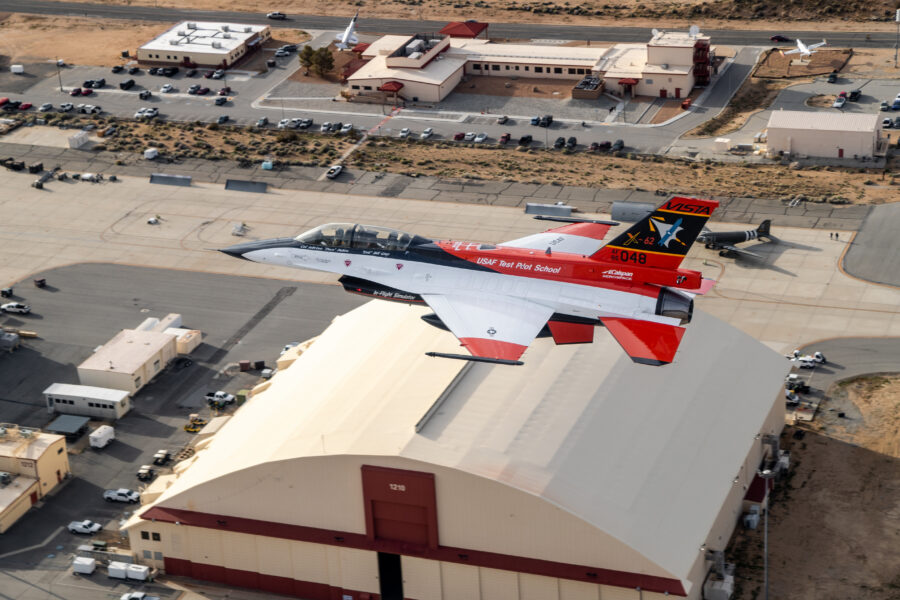
The Air Force’s X-62 autonomous test fighter carried out multiple artificial intelligence-controlled intercepts of a crewed jet in a series of experiments earlier this year, the service said Aug. 4.
A heavily modified F-16D, the X-62 is also known as the Variable In-flight Simulation Test Aircraft, or VISTA. In the tests, it used Lockheed Martin’s Infrared Search and Track Legion Pod to demonstrate how autonomous aircraft intercepts might work, the Air Force said in a statement.
Lockheed Martin, in a separate release, said the X-62 completed 27 AI-controlled intercepts of a live T-38 Talon jet during eight test flights.
The tests were conducted by the Air Force Test Pilot School under a program called HAVE HEAT and took at Edwards Air Force Base, Calif. The tests concluded in April, the Air Force said.
The tests mark a step forward in the march toward adding uncrewed fighters to the force. The Collaborative Combat Aircraft now in development will be semi-autonomous, flying without crews and able to maneuver on their own, but taking direction from crewed fighter jets.
According to the Air Force, the X-62 used AI agents to interpret live infrared sensor sensor data to direct the plane to intercept its target in real time.
“HAVE HEAT represents a meaningful expansion of avionics capability towards integrated, AI-driven control of multiple sensors and air vehicles for mission autonomy,” said Lt. Col. Joshua Strafaccia, dean of faculty for research at the Test Pilot School in the release. “This bridges a capability gap and positions us to test advanced autonomy faster.”
Chase Kohler, chief spokesman for the 412th Test Wing at Edwards, told Air & Space Forces Magazine that the tests marked both a first for the X-62 and a leap forward from 2024 tests in which VISTA’s AI agent took on crewed fighters in simulated dogfights. In the earlier tests, human operators locked onto targets while the AI pilot flew the plane; in the latest tests, the plane’s AI locked onto the targets itself.
Lockheed said the experiments advance AI testing from simulated data to “real time, on-board sensor streams.” The company’s work included integrating the Skunk Works AI agent into the X-62 and completing ground tests within three months.
“Our ongoing partnership with [the Test Pilot School] is driving important progress with this latest flight test series demonstrating that our AI can effecitvely and reliably close the sensor-to-action loop aboard an operational combat aircraft,” said Ron Fehlen, vice president and general manager for Lockheed Martin Skunk Works in the release. “Our autonomous agents consumed classsified infrared search and track feeds and executed combat-critical maneuvers in real time. This achievement marks a decisive advance toward delivering AI-augmented air dominance for the United States.”
The Air Force also said it had carried out another program, HAVE HOLIDAYS, in which it integrated multiple modular technologies with the X-62’s Enterprise Open Mission System Architecture computer, including an autonomous agent made from an unidentified non-prime contractor, to test enhanced safety rules. The integration and evaluation also covered advanced sensors.
Kohler said work has begun on integrating RTX’s new PhantomStrike radar into the X-62, part of a Mission Systems Upgrade that includes sensors, expanded computing capacity, and data communications. PhantomStrike is a compact and power-efficient air-cooled active electronically scanned array, or AESA, radar.
Kohler said installation and integration work for PhantomStrike is expected to be finished by the end of 2026, as well as ground testing and some limited flight tests. In early 2027, he said, more elaborate tests will resume.