
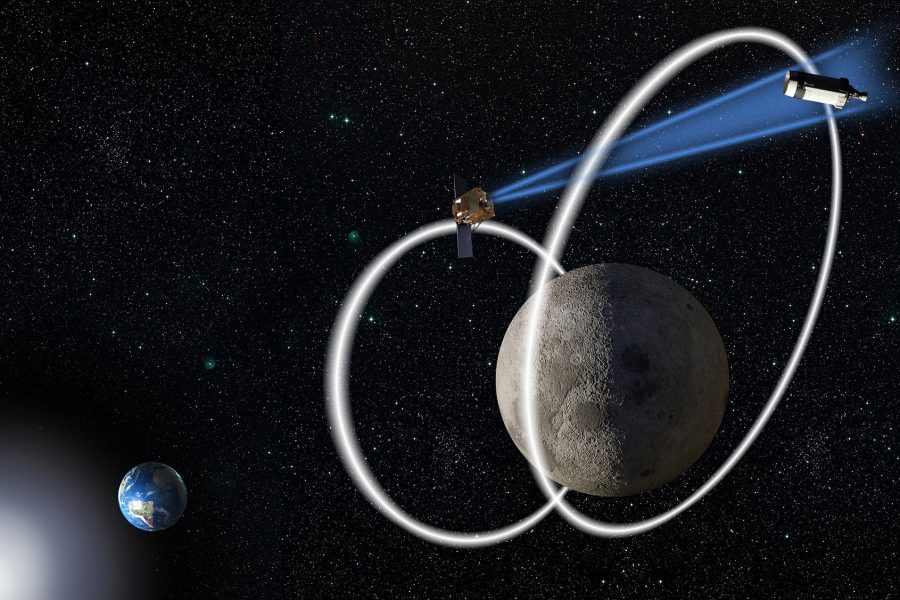
COLORADO SPRINGS, Colo.—The Space Force announced April 16 the establishment of a Cislunar Coordination Office to manage and craft a roadmap for the service’s nascent deep-space missions under the leadership of Jaime Stearns.
In a speech at the Space Symposium here, Maj. Gen. Stephen Purdy, senior advisor to the Air Force Secretary for space acquisition, announced the new civilian-led office. “Let’s get these program management individuals and engineers together,” Purdy said. “We will build the roadmaps, we will build the scheduling, we will absolutely be looking to partner with industry.”
Stearns has held several program management roles within the Air Force Research Laboratory and most recently led strategic communications in the Space Rapid Capabilities Office. She previously led an AFRL project called Oracle that aims to launch several cislunar domain awareness satellites in the coming years.
Cislunar space is generally defined as the region beyond geosynchronous orbit extending to the moon and even further. An Air Force Research Laboratory fact sheet describes its volume as being 1,728 times that of geosynchronous orbit.
While much of the U.S. government’s lunar focus today is centered on NASA and its push to return astronauts to the Moon through the Artemis program, the Defense Department has a handful of programs aimed at better understanding cislunar space. The Space Force hasn’t dedicated significant funding to these efforts, but the creation of the Cislunar Coordination Office indicates the service is thinking more seriously about its role in the region. Officials have said that shift is linked to a White House executive order, released in January, that describes the military’s space responsibilities as extending from very low Earth orbit to cislunar and calls for more investment in deep-space navigation capabilities.
Speaking with reporters in February at AFA’s Warfare Symposium in Aurora, Colo., Chief of Space Operations Gen. Chance Saltzman said the executive order’s mention of cislunar operations is significant.
“Just having that discussion at that level is tremendous for us,” Saltzman said. “It helps with resources. … As U.S. interests go further and further into space, there’s going to be a need to protect and defend those interests.”
The Space Force’s new coordination office will partner with other entities like the intelligence community and the Defense Advanced Research Projects Agency, but Purdy said it will work most closely with NASA.
“NASA has obviously got quite an accelerating plan going on there,” he said. “They have quite a lot of activity, from a [positioning, navigation, and timing] and comms perspective. They own that mission, so we look forward to partnering with them and then getting out to industry and figuring out how you can plug in there.”