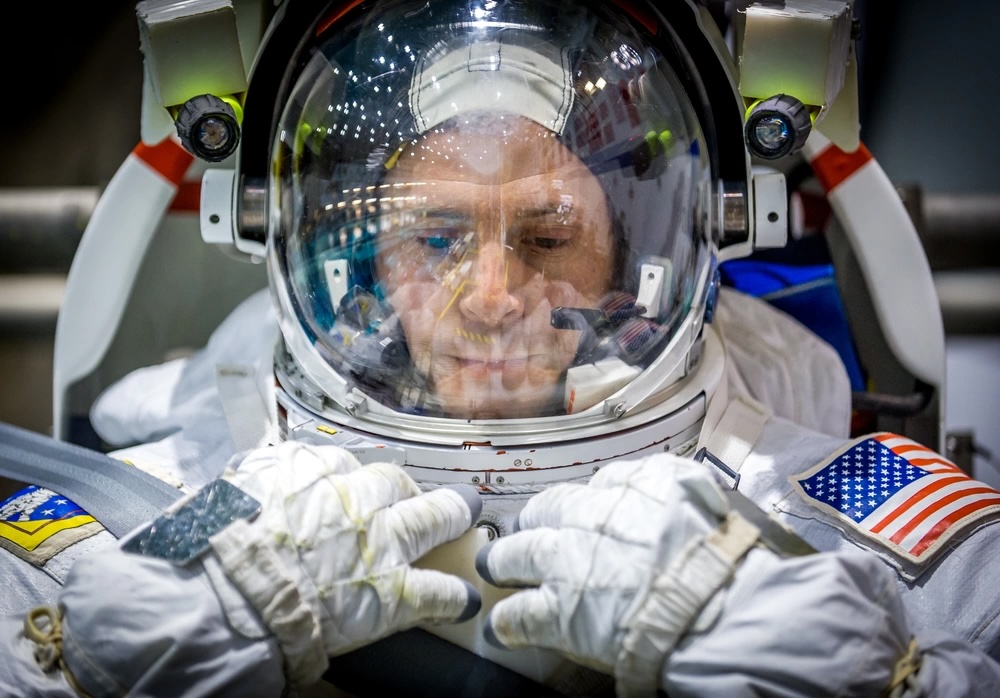
To counter Chinese ambitions, the U.S. Space Force must start work now to put Guardians in orbit and on the moon in the decades to come, according to a new paper from AFA’s Mitchell Institute for Aerospace Studies.
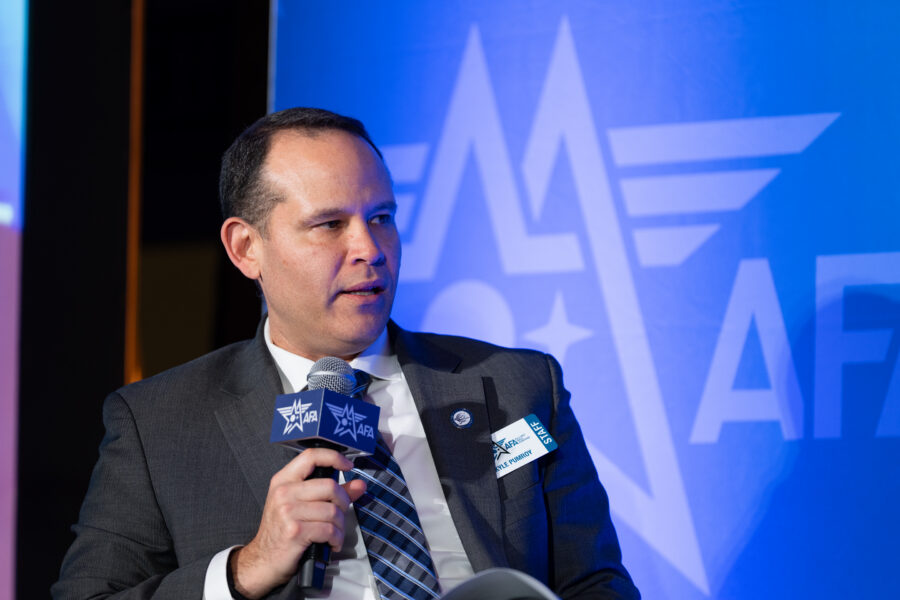
The report, authored by retired Col. Kyle Pumroy, outlines the threats that China’s manned spaceflight program poses and steps the Space Force, NASA, and industry can take to counter future space conflict scenarios.
Pumroy, a senior resident fellow at Mitchell, said in a May 21 press roundtable that without a serious commitment to at least starting the process of putting Guardians in space, the U.S. risks falling behind in what many are now calling the new space race.
Service leaders shouldn’t be preoccupied with establishing a massive presence ripped from the pages of science fiction in the long term, Pumroy added. Instead, he said, they should start planting seeds with a handful of personnel that would grow into dozens and potentially a future force with 100 or more space-focused Guardians and Title 10 authorities for the USSF to operate with humans in space.
“We’re not talking about building rovers with lasers to put on the moon in the next few years,” Pumroy said. “It’s to begin developing the skills, tools, and concepts necessary for future Title 10 missions now using low-Earth orbit as a proving ground for a small number of Guardians.”
Those Guardians could learn their trade as a follow-on course to the existing Space Test Course, a 12-month graduate course at the Air Force Test Pilot School at Edwards Air Force Base, Calif.
The Space Force has ambitions to double its size to 20,000 Guardians over the next five years. That growth is needed, leaders argue, to cover the service’s expanding mission set, which includes satellite communications; targeting; position, navigation, and timing; intelligence, surveillance, and reconnaissance; and space control.
Whether that growth and those missions require putting Guardians in space is an idea that has been bandied about before and received support from outside experts. It’s come up more and more in 2026, but thus far, Space Force leaders have been more reserved.
In January, Vice Chief of Space Operations Gen. Shawn Bratton said at a conference that the idea was on the fledgling service’s long “to-do list.” But he did not provide further details. In February, at AFA’s Warfare Symposium, Maj. Gen. Robert W. Claude, director of Task Force-Futures on the Space Staff, said that “I can’t sit here today and tell you that we will or we won’t have Guardians in space at any point in the future.”
The Threat
The new Mitchell report makes the case that China’s combined military and civilian approach to space and its track record of violating territorial norms such as in the South China Sea and the Arctic serve as warnings for potential competition rather than cooperation with the United States in space.
“We’ve seen year in and year out that here terrestrially China has violated existing norms, and so even if we establish them, would they adhere to them?” said retired Col. Charles Galbreath, director of Mitchell’s Spacepower Center of Excellence.
As evidence of the growing threat, the paper notes that China has achieved nearly all of its spaceflight goals between 1992 and 2022 and has had a continuous presence of Taikonauts, the Chinese term for astronauts, aboard the Tiangong space station since June 2022. Those Taikonauts are military members, not civilian astronauts.
With continued advances in human spaceflight, Pumroy argues the Chinese could create a “Space Silk Road,” that would give the nation control over assets and logistics from satellites to potential lunar resources such as minerals.
To counter that, Pumroy offered several recommendations in the report:
- The National Security Adviser should direct the creation of a strategy for a military human spaceflight program to bridge the civil-military gap and establish a national security imperative.
- The Space Force should have ownership of that military human spaceflight program and incorporate it into its new objective force document outlining its future needs.
- The Space Force should establish a follow-on to the Space Test Course
- The Space Force should build up the Space Test Course to expand its infrastructure and produce more students
- The Space Force should expand career-broadening opportunities with NASA and commercial space station/commercial spaceflight industries
- Congress should fund NASA support to the military human spaceflight program, expansion of the Space Test Course spaceflight program, and opportunities for Guardians to spend time on space stations in orbit
Human Need
China’s ambitions are to have a fully operational, manned lunar station by 2040.
Pumroy said that if China has humans in space, the U.S. must also have humans to counter their abilities and not rely solely on unmanned machines.
“Space security will likely require both unmanned and manned systems and missions,” Pumroy said. “Humans bring adaptability, persistence, judgement, credibility, and deterrent value that machines alone cannot fully replicate.”
The approach to building this future manned space mission will require Guardians to partner with NASA and commercial industry to build the technology and practices they need to be operational in space.
That combination would counter China’s governmental control over industry, space, and military programs.
That could mean more Guardians accompanying astronauts on space station missions. Space Force Brig. Gen. Nick Hague spent six months on the International Space Station in 2024-2025 as a NASA astronaut, and Col. Nick Hopkins joined USSF while in orbit on the station in 2020, but both are now retired from NASA.