


As the Space Force makes plans for two on-orbit refueling and maneuver demonstrations in 2027—and closely watches similar government and commercial endeavors—the service official overseeing the effort says he want to take these capabilities from demo to operations in short order.
Both of the upcoming demonstrations will fly on the Space Force’s USSF-23 mission, which is targeted for launch early next year. For the refueling effort, the service is working with the Defense Innovation Unit and the Air Force Research Laboratory to demonstrate the ability for a commercial servicing vehicle—in this case Astroscale’s Provisioner spacecraft—to mate with and refuel a spacecraft, then refuel itself at a prepositioned fuel depot, and then return to the original spacecraft to refuel it a second time. AFRL developed the Tetra 5 satellite that will be used for the mission, and DIU is leading the tanker effort with contractor Orbit Fab providing the depot.
The second effort is focused on maneuver, and specifically the ability to tug a spacecraft to different locations within the same orbit. Starfish Space’s Otter vehicle will serve as the tug for this mission and will mate with a nonoperational Space Force satellite.
The demonstrations are meant to inform the Space Force’s roadmap for on-orbit servicing and refueling, helping it close the loop on questions around the feasibility and affordability of these capabilities and the operational impact of satellite life extension. They will also help the service craft a longer term plan for how to build an in-space logistics architecture.
But the missions have near-term implications, too, according to the director of Space Systems Command’s servicing, mobility, and logistics office, Col. Scott Carstetter. He told reporters May 20 he hopes to be able to leverage the experimental satellites for operations once they’ve completed their initial demonstration activities.
“We’re looking to operationalize these demonstrations that we’re doing to see how we can actually use them operationally with programs and operational clients that we have in need today,” he said, noting that his office has the funding it needs to transition the efforts into procurement. In fact, he said, SSC’s contract with Starfish includes servicing operational satellites.
“The first vehicle that we’ll mate with is a non-operational vehicle that we’re going to move to a disposable orbit,” Carstetter said. “And once we demonstrate that capability, then we can mate with operational satellites to conduct things like life extension and those sorts of things.”
Carstetter’s office was created in 2023 as a centralized hub to explore the utility of on-orbit servicing and refueling, but it’s not the only organization experimenting with the technology. Later this summer, the Defense Advanced Research Projects Agency and Northrop Grumman subsidiary SpaceLogistics will launch a robotic servicing spacecraft called the Mission Robotic Vehicle to geosynchronous orbit.
It will take MRV about a year to reach orbit via its electric propulsion system. Once it arrives, the vehicle will use its robotic arms—built by DARPA and the Naval Research Laboratory—to install jetpack-like pods onto three satellites that are running low on fuel. Those alternate propulsion sources are called Mission Extension Pods and were built by SpaceLogistics.
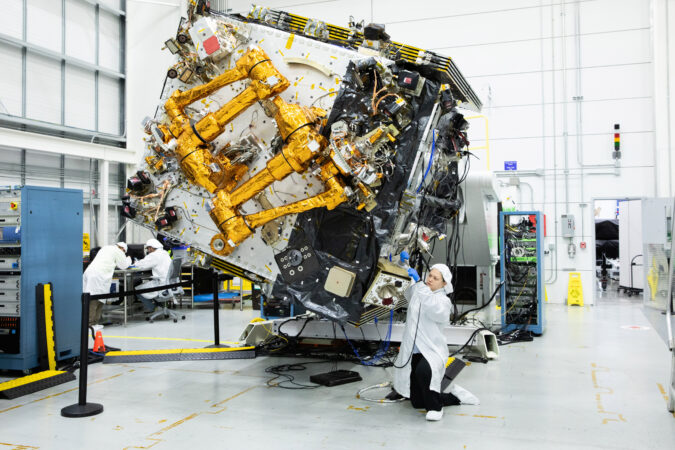
The company invited reporters to see the MRV on May 19 at its Sterling, Va., facility before it ships to Cape Canaveral Space Force Station, Fla., in the coming months. After it performs the contracted pod installations, the MRV, which can operate on orbit for at least 10 years, will be available to service other satellites in a variety of ways—whether that’s repositioning a spacecraft, repairing it, or upgrading it with a new sensor.
Rob Hauge, president of SpaceLogistics, said the company has had conversations with several potential government and commercial customers about other operational missions it could perform once in orbit.
“We’re spending a lot of time right now educating the government as well as industry on the capabilities of the MRV, so that they can start planning and thinking about what that capability could do for them,” he said.
Carstetter said his office is closely watching the initial MRV operations as well as other upcoming demonstrations, whether government-led or commercially derived, and looking for opportunities to put those capabilities on contract.
“We’ll be looking to set up some level of contracting that we’ll be able to access those resources while they’re on orbit if the need arises from our operational community,” he said.
The Space Force didn’t request funding for the servicing, mobility, and logistics office in its fiscal 2027 budget request. For now, Carstetter said, they’re relying on prior-year funding to run the planned demonstrations and other efforts the office is managing. He said he expects that to change in the coming years as the service solidifies its plans to operationalize the capability, though he noted that at least some of the resources will be baked into the budgets of the programs that plan to use the service and may not be reflected within his office’s funding line.
He highlighted the Space Force’s RG-XX program as an example of this. In April, that program office selected an initial pool of vendors to potentially develop a fleet of small reconnaissance satellites in geosynchronous orbit. The program is the first in the Space Force to have a requirement for the satellites to be refuelable. The program is still refining its acquisition approach for refueling and is weighing whether to pursue a dedicated vehicle or a contracted service, Carstetter said. But whatever the program chooses, funding would likely be embedded within its own budget rather than within the SML line.
Over time, as the service develops a longer term plan for servicing, mobility, and logistics, Carstetter said there may be a need to increase his team’s funding to support that enterprise.
“The time when you’ll see the SML budget plus-up is longer-term, once we have an enterprise solution where we’re building, ideally, an architecture and a logistics enterprise that feeds the entire space domain,” he said.