


Editor’s Note: This is the second in a two-part series on Air Education & Training Command’s new aircraft simulators. Part 1, on Detachment 24, is available here.
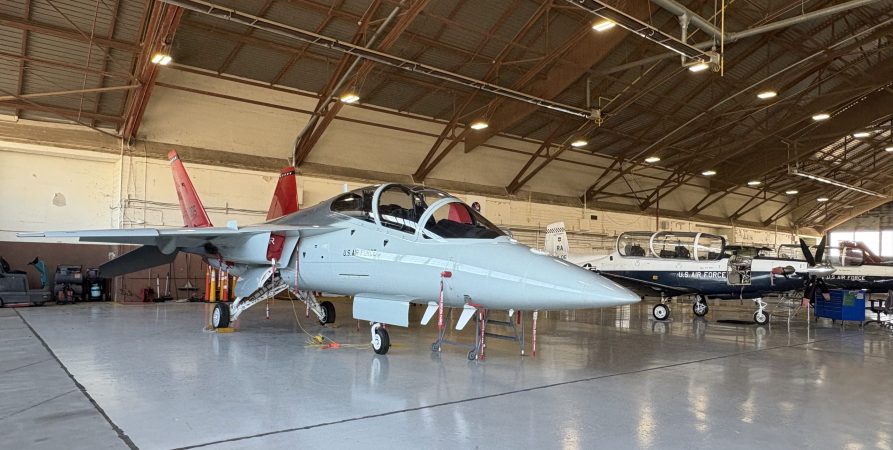
JOINT BASE SAN ANTONIO-RANDOLPH, Texas—When the first T-7A Red Hawk touched down here in late December, senior leaders celebrated a major step forward in the future of Air Force pilot training. Sleek, and eye-catching with their red tails, the first two jets look the part.
Not far away, in a nondescript building with antennas rising above, a key part of that future is taking shape: The T-7’s Ground-Based Training System is taking shape. Designed to bridge the gap between simulators and true flying, the GBTS opens a whole new chapter in simulation.
Air & Space Forces Magazine visited in January as the first few systems were being tested by the 99th Flying Training Squadron, assisted by contractor Boeing.
“The quality of the simulator, between the hardware and the operational flight program, is leaps and bounds better in the T-7,” said Lt. Col. Michael “Hyde” Trott, commander of the 99th, comparing it to the existing T-38 program. “I’ve had the privilege of being able to see the sim and then also fly the jet. It’s a much smaller gap and leap from sim to jet in the T-7 than the T-38.”
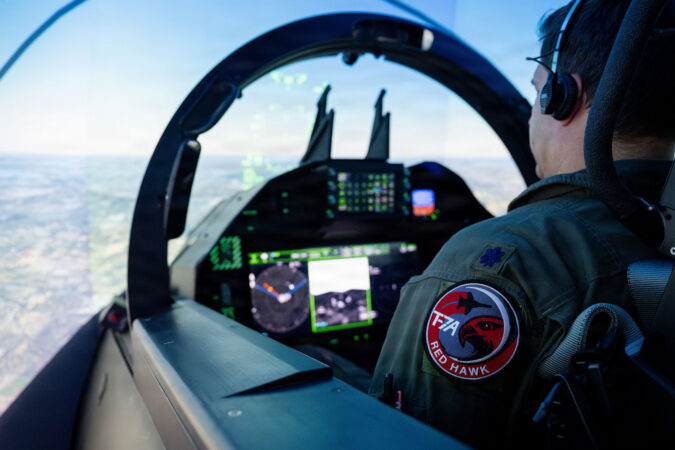
GBTS isn’t a single simulator, but a system including several “flavors,” said Steven “Stein” Dobrinski, a Boeing flight simulator design engineer. The most basic is a simple “Part Task Trainer,” which amounts to a desktop computer fitted with a stick and throttle. New pilots use it to acclimate themselves to the T-7’s central Large Area Display.
“What menus do what? How do I move things around? How do I program stuff so that you can learn the really basic stuff at a really insignificant price,” said Dobrinski.
The T-7’s Large Area Display centralizes all the screens and controls in the T-38 into a single screen that can show as much or as little as an individual pilot needs—or can handle—for a given mission or training event. One basic option is dubbed the “snowman”—an Attitude Director Indicator over a Horizontal Situation Indicator; another divides the screen into four “portals,” Trott explained, each with up to two smaller “insets,” for a potential total of 12 functions that can be monitored at once.
The second T-7 trainer is the Unit Training Device, a high fidelity cockpit mockup combined with a large video monitor and an instructor operator station. Students “fly” the simulator while instructors can track their work and inject alerts, giving students practice, Dobrinski said, with “checklists and just the basic flow, switchology and all that.”
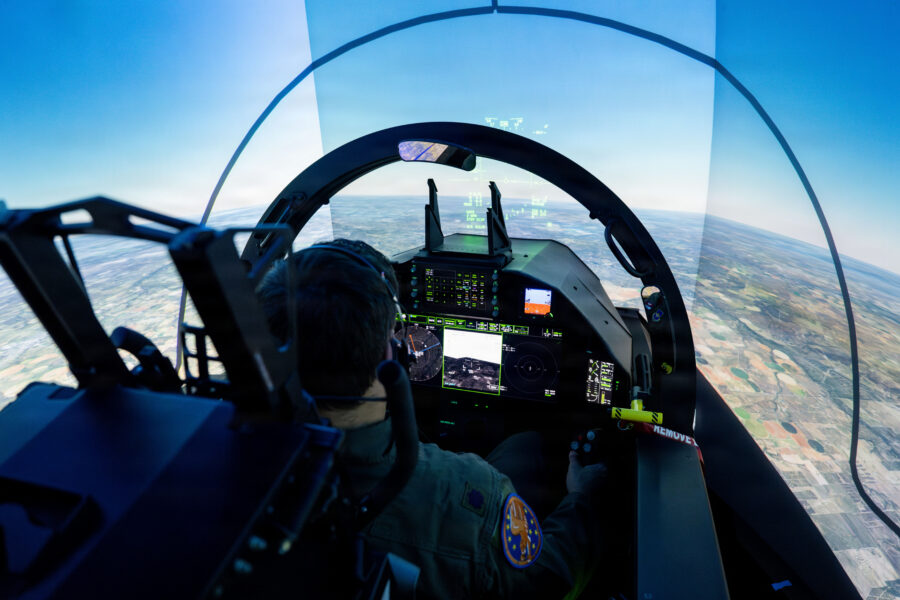
The third T-7 training component is the Operational Flight Trainer. Intended for basic flight training, it features screens with a 300-degree field of view display, a canopy latching mechanism, a seat that moves based on users’ inputs, and even an associated G-suit.
“If I’m pulling Gs, it will apply pressure into your suit,” Dobrinski said. “And if you’re pulling seven and a half, eight Gs, It’s pumping up hard, so you really have to strain against the G-suit, which is getting your brain [primed]: If I’m pulling, I better be straining. After a while, when you get into a tactical aircraft, you’re straining before you’re pulling, just subconsciously.”
Finally, the Weapons System Trainer is the top-tier T-7 trainer. Boeing says it supports both basic and advanced fighter maneuvers, including air combat maneuvers and tactics. Encased in an egg-shaped structure, it includes a 360-degree field of view.
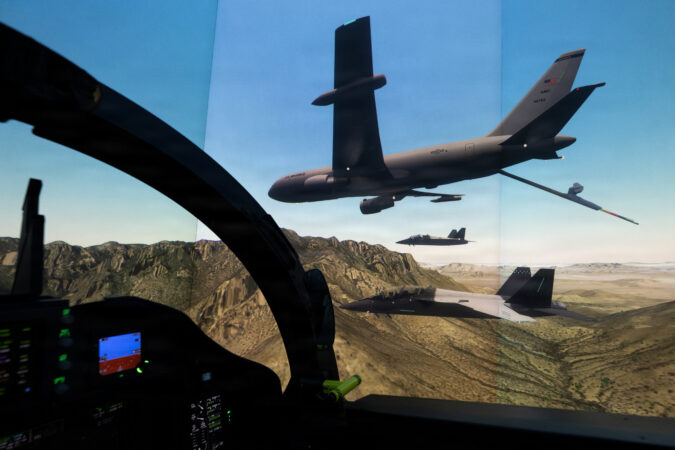
“The concept is that we’re going to be able to pull some of these more advanced training tasks into the sim,” Dobrinski said. “If I’m dogfighting, I need to be able to see the aspect angle on what I’m fighting and most sims, basically outside of a certain distance, it just becomes a dot. And so the goal is that our models and our imagery allow people to make decisions based on a perceived aspect angle, and we should be able to see it farther out in this than any of the other sims that are out there.”
Student pilots can practice air-to-air refueling and close formation flying in the WST, and the simulator responds with motion, so they can feel the turbulence field, see precise details about the other aircraft, and perceive depth, Trott and Dobrinski said.
“The T-38 sim—even the F-15 sim—the physics of it and the resolution wasn’t such that I could gauge range and line of sight rate of the other aircraft to fly close formation,” Trott said. “This is the only one I’ve ever been in where it can do that.”
Both the stick and throttle adjust to respond like the real thing. “We have back-driven flight controls that are electric motors that run whatever we tell them to do,” Dobrinski explained. “So we’re going to get the data from the jet … and we’ll fine tune the gains to match what the aircraft is really doing.”
Built using the T-7’s Operational Flight Program, the simulators will update as the OFP evolves.
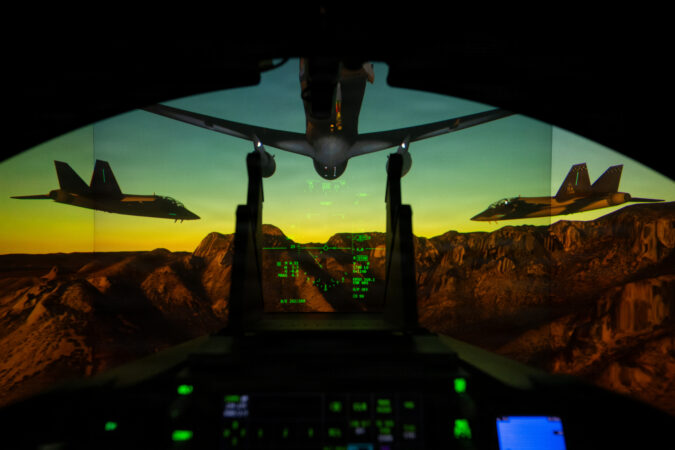
The push to enhance realism ties directly to the most ambitious aspect of T-7 training: the ability to conduct Live, Virtual, and Constructive Training, or LVC, by enabling a sim to link up and operate with any T-7 jet as if they are together.
“Think of it as a gaming area,” Dobrinski said. “If I’ve got everything programmed and I’m in the data link, now I’m able to have all the entities, the sims and the airplanes, that are all talking to each other in the same gaming area.”
Using LVC, the simulators and jets can fly as if equipped with missiles, bombs, or pods attached, and when employed by a pilot, others will “see” the effects play out in their displays.
Boeing has tested the system to link T-7s in the air with simulators on the ground, Dobrinski said. “We tested all the different things: communications, the weapons interaction, seeing if the jet was generating constructive entities, were we seeing it in the sim, could we blow them up, we’re dropping bombs,” he said.
Right now, the Air Force is focused on testing the basics of the training system and getting its first simulators properly configured. But eventually, Dobrinski said, up to eight manned entities—simulators or jets—could fly together in a blended formation against up to 64 constructive entities.
That goes well beyond conventional simulators, promising a future where new pilots learn not just how to fly but also how to manage a complex battlespace and employ the tools they will have in fifth- and sixth-generation combat jets.
“Let’s call it a four-drawer Craftsman toolbox,,” Dobrinski said. “T-38 is probably like a one-drawer. We’ve got more capabilities with all the tactical things we can teach.”
Part 1 of the series on AETC’s simulator training is now available.