
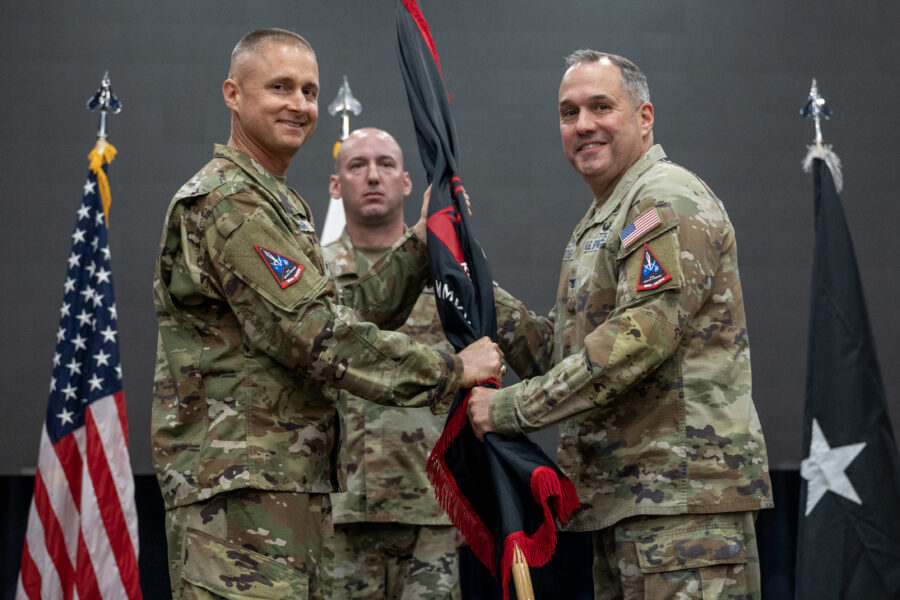
For the next leader of its component in Korea, the Space Force is turning to a colonel who has decades of experience in the Army, historically the leading service for all things U.S. military on the peninsula.
Col. Dorian C. Hatcher took command of U.S. Space Forces Korea in a June 2 ceremony at Osan Air Base, South Korea. Hatcher, who enlisted in the Army in 1992 and received his commission with the land service in 2001, transferred to the Space Force in 2023, the same year he made colonel.
During his decadeslong Army and Space Force career, Hatcher has worn many hats, spending time in maintenance, explosive ordnance disposal, counter-drone initiatives, and launch and missile testing. He also previously spent time in Korea with the Army.
Having a former Soldier with experience in Korea could give the Space Force a little extra boost in its broader effort to integrate itself more deeply into the various combatant commands.
The push to have Space Force leadership in these combatant command roles gives the fledgling force a seat at the table as it seeks to permeate their space-focused mission into the joint services and commands. Since its establishment in 1957, U.S. Forces Korea, the highest U.S. command on the peninsula, has always been led by an Army officer.
Space Forces Korea reports directly to USFK and is colocated with the 7th Air Force and 607th Air Operations Center. In 2025, it stood up the service’s first forward-deployed Space Operations Center.
When it began establishing component commands in 2022, the Space Force prioritized the Pacific theater and established its first two organizations under U.S. Indo-Pacific Command and USFK. Lt. Col. Joshua McCullion served as the first commander of Space Forces Korea.
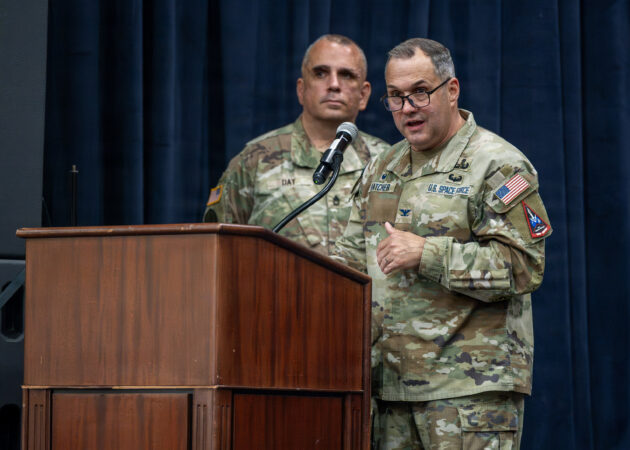
Hatcher’s predecessor, Col. John Patrick, took over in July 2024 and is headed to take over U.S. Space Forces Japan, according to a release.
Now, Hatcher pledged to keep Space Forces Korea “unequivocally focused on warfighting and joint integration,” according to the release.
The space expertise that he and his personnel bring to the Korean Peninsula are aimed at “seamlessly weaving space combat power into shared operations.” That includes South Korean allies, Hatcher said.
Hatcher’s experience with those allies goes way back—he first served in South Korea as an Army private first class in 1997 at Camp Casey, South Korea.
“It was my very first duty station,” Hatcher said during the June 2 ceremony. “To return decades later and lead our Guardians as we integrate space into this critical joint fight is a true full-circle moment for me.”
Following his Korea deployment, Hatcher commissioned as an Army officer through the Green-to-Gold program in 2001.
He later deployed to combat zones for more than 57 months over the coming decades, serving in or supporting operations in Iraq, Afghanistan, and Syria. The colonel went from maintenance work to Explosive Ordnance Disposal, later commanding Task Force Hellhound, supporting CENTCOM and multiple Joint Special Operations Task Forces.
Over his time from a company to field grade officer, Hatcher served in Army positions on Air Force installations, such as when he led the Counter IED/small UAS Force Protection Branch Chief at U.S. Army Central on Shaw Air Force Base, S.C.
After he transferred to the Space Force, Shaw worked as the deputy director of space architecture and division chief of the Joint Capabilities Division in the Office of the Assistant Secretary of the Air Force for Space Acquisition and Integration.
His last posting before taking command of the Korea component was as deputy commander for Space Force Launch Delta 30 at Vandenburg Space Force Base, Calif.
There he managed launch and range operations for the Western Range, space launches and DOD developmental missile system testing.
Components
The Space Force has eight component commands:
- Space Forces-Space under U.S. Space Command
- Space Forces Indo-Pacific under U.S. Indo-Pacific Command
- Space Forces Korea under U.S. Forces Korea
- Space Forces Japan under U.S. Forces Japan
- Space Forces Central under U.S. Central Command
- Space Forces Europe-Africa under U.S. European Command and U.S. Africa Command
- Space Forces Southern under U.S. Southern Command
- Space Forces Northern under U.S. Northern Command
Chief of Space Operations Gen. B. Chance Saltzman said at the 2023 Mitchell Institute Spacepower Security Forum that strong relationships with the combatant commands are “critical to our success” as a servkce.
“We will use the service component model to strengthen space integration in all combatant commands,” Saltzman said.
Space Force leaders also want to grow their leadership within commands for more “surge operations,” U.S. Space Forces-Space Commander Lt. Gen. Dennis O. Bythwood said at a Mitchell event in March.
Many component leadership jobs have also been upgraded since they were first established, just as the head of Space Forces Korea has now progressed from an O-5 to an O-6,
The only combatant commands left without space components are the functional ones: U.S. Special Operations Command, U.S. Cyber Command, U.S. Strategic Command, and U.S. Transportation Command.