
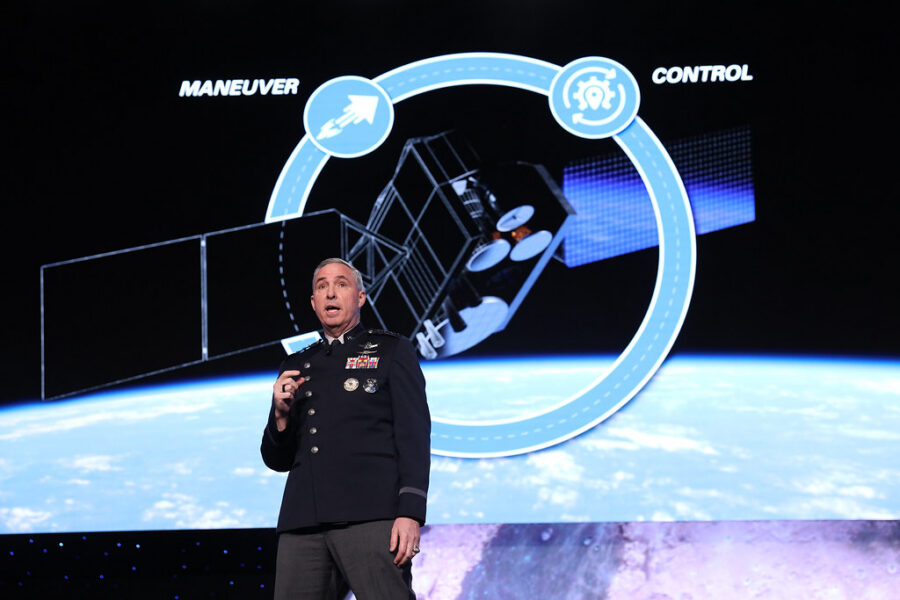
HUNTSVILLE, Ala.—U.S. Space Command is preparing to host a live-fly exercise in the coming weeks to test advanced maneuver concepts that will inform its strategy for dynamic operations in orbit.
Gen. Stephen Whiting announced the plans Aug. 12, telling reporters during a briefing at Redstone Arsenal, Ala., that the event will include live operational demonstrations with U.S. military satellites as well as a tabletop exercise.
“We will take some of our existing satellites and work with partners to demonstrate what are some of the requirements and capabilities to be able to maneuver for advantage, not just maneuver when you have to change your orbital position,” Whiting said.
The exercise is part of SPACECOM’s Apollo Maneuvers, a demonstration series Whiting unveiled in January aimed at refining tactics and ultimately informing future maneuver warfare doctrine. The command in recent years has stressed the need for spacecraft that can move unrestricted by the amount of fuel they carry. The effort’s name is a nod to the Army’s 1941 Louisiana Maneuvers, a series of major battle management exercises designed to test ground tactics during World War II.
“This is to get after the requirement that we see to be able to execute a maneuver warfare strategy in space, just like we do on the land, in the air, and at sea,” he said. “We want to be able to maneuver for advantage.”
Whiting didn’t expand on the scenarios the exercise would run, what partners would be involved, or which satellites they would leverage. A SPACECOM spokesperson told Air & Space Forces Magazine the effort is linked to Operation Olympic Defender—a partnership between seven countries to better integrate space operations and data sharing among allies. The spokesperson noted that the Apollo Maneuvers exercise will involve “coordinated activities” across multiple orbits to “execute contested logistics and develop satellite servicing requirements.”
Whiting previously told reporters that SPACECOM would coordinate Apollo Maneuvers events to coincide with on-orbit logistics and refueling demonstrations the Space Force plans to run this year and next.
“Obviously those programs will have their own technical mission requirements that they need to test out certain things, and we don’t want to interfere with that, but we have high confidence that we’ll be able to partner with those organizations to to demonstrate capability, and then to also leverage their test points as part of a broader tabletop exercise,” Whiting said in April.
Space Command has also formed a team of analysts to build a digital environment that its warfighting branch will use to run the upcoming exercise.
Speaking Aug. 12 at the Space and Missile Defense Symposium here, Whiting said his command’s push for more maneuverable spacecraft and the tactics to support them is in part linked to advancements China has demonstrated in on-orbit refueling and logistics.
“We do not want to be in a position where an opponent has a maneuver advantage over us in the space domain,” he said.
Earlier this month, Space Command released a document meant to provide a vision for space operations in 2040 and serve as a lens through which planners, commanders, and operators should think about the future operating environment. The document describes maneuver as a key enabler for U.S. advantage in space, stating that it has the potential to “unlock” emerging capabilities to reposition damaged satellites and extend the life of “critical systems.”
“In a future where satellites can rendezvous, refuel, repair, or replace components in space, on-orbit architectures become dynamic rather than fixed,” the document states. “The side that can maneuver persistently and at scale will set the operational rhythm in orbit.”