
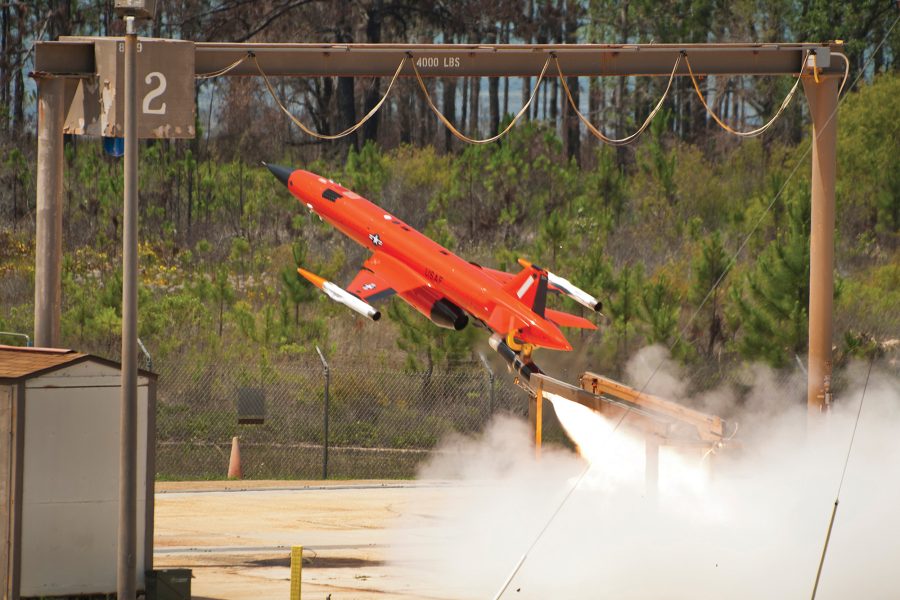
The Air Force is looking for a new family of drones to serve as aerial targets for test missions, ranging from cheap, expendable quadcopters to large, reusable aircraft that can mimic fifth-generation enemy fighters.
The service’s Aerial Targets Program Office published a request for information on Aug. 14 asking the defense industry for ideas for a “family of systems needed throughout the spectrum of missions in Defensive and Offensive Counter Air capabilities” to provide realistic aerial targets for Air Force munitions and missile programs during validation testing prior to full-rate production.
The Air Force wants interested firms to submit ideas to satisfy any of three tiers of unmanned aerial targets:
- Tier One: High-end, reusable targets capable of emulating “modern threat” fighter aircraft capable of flying from Mach .9 to supersonic speeds and withstanding maneuvers between five and nine Gs.
- Tier Two: Reusable but expendable Group 3 and 4 drones similar to the size of an MQ-1 Predator. Systems should be capable of speeds between Mach .5 and.8 and withstanding maneuvers between six and eight Gs. Designs should feature a low-cost construction permitting a service life of up to 10 flights.
- Tier Three: Low-cost, Group 1 and 2 drones weighing up to 55 pounds. These targets should be capable of flying at speeds of up to 172 miles per hour and designed to be “to be shot down in high volumes during air defense and close-in weapon system” training.
The Air Force currently uses systems such as the BQM-167A unmanned aerial target and threat simulator for weapons development, testing, and training. The system can represent air targets maneuvering at up to 9 Gs at speeds up to Mach 0.91.
“As operational environments evolve, there is increasing demand for” capabilities such as “lower-cost, scalable target systems, flexible and rapidly deployable solutions” as well as systems that can be treated as expendable when required,” the notice states.
Interested firms have until Sept. 28 to respond to the solicitation. “The objective is to identify a diverse range of options capable of satisfying the specified performance requirements, as these target solutions will be tested in live fire settings,” the RFI states.
Where practical, systems should be capable of safe and efficient launch and recovery operations. Launch options may include standard runway operations as well as ground-based assisted or rail launch systems, th states. Recovery options for Tier One and Two designs should include runway landings or parachute recovery and minimize damage and reconstitution time wherever possible, the notice stated.
“Proposed solutions should demonstrate threat-representative aerial target capabilities and flexible performance characteristics,” the solicitation states. “Submissions should detail compatibility with existing or adaptable control systems, such as the Air Force’s Advanced Airborne Threat Target Control System (AATTCS) or satellite communications-capable.”
If incompatible with AATTCS, “submitters should provide the capabilities and associated costs of maintaining their alternative control system,” according to the RFI. “Physical platforms should have on-board aerial target flight termination resources that ensure required range safety” such as “aircraft destruct” mode or a “thrust control neutralization” feature.
Interested firms should describe the “maturity of their system’s design and any existing modeling, simulation, or flight test data that validates performance claims,” according to the RFI.
The aerial target RFI is the latest Air Force move to scour the defense industry for ways to use drones to solve future battlefield challenges. In an Aug. 7 request for information, the service’s Rapid Sustainment Office asked industry to submit ideas for creating a drone factory in a box—expeditionary manufacturing equipment for producing and maintaining Group 1 and 2 drones for reconnaissance, attack, and counter-drone missions.