


Editor’s Note: This article was updated Sept. 11 to include information from the 178th Wing and the Air Force Life Cycle Management Center.
The Air Force announced Aug. 13 it recently tested prototypes for a portable ground station for commanding and controlling semi-autonomous Collaborative Combat Aircraft, and a spokesperson now says the plan is to award a contract for the effort next summer.
The Air Force Life Cycle Management Center’s Agile Development Office revealed the progress on the Portable Command and Control Enclave, or C2E, in a release explaining how it evaluated the prototypes at Springfield Air National Guard Base, Ohio.
A combined team from the Experimental Operations Unit, Air Combat Command, and the AFLCMC’s Software Autonomy and Teaming Branch tested various metrics, such as weight, time to power on, time to connect, time to command, and size packed on a pallet.
“We cannot give specific examples due to the ongoing evaluation; however, broadly, feedback was provided to improve upon on how the equipment was packed, setup configurations, and connectivity,” an Air Force spokesperson told Air & Space Forces Magazine. “The EOU also gave feedback on how they intend to use the applications in the field.”
“The next phase focusing on cloud testing will run through the spring,” the spokesperson added. “The C2E program includes multiple form factors, and the plan is to award an initial integration partner in the early summer.”
Five unnamed companies participated in the C2E “fly-off” at Springfield. The spokesperson declined to identify the companies, citing operational security concerns.
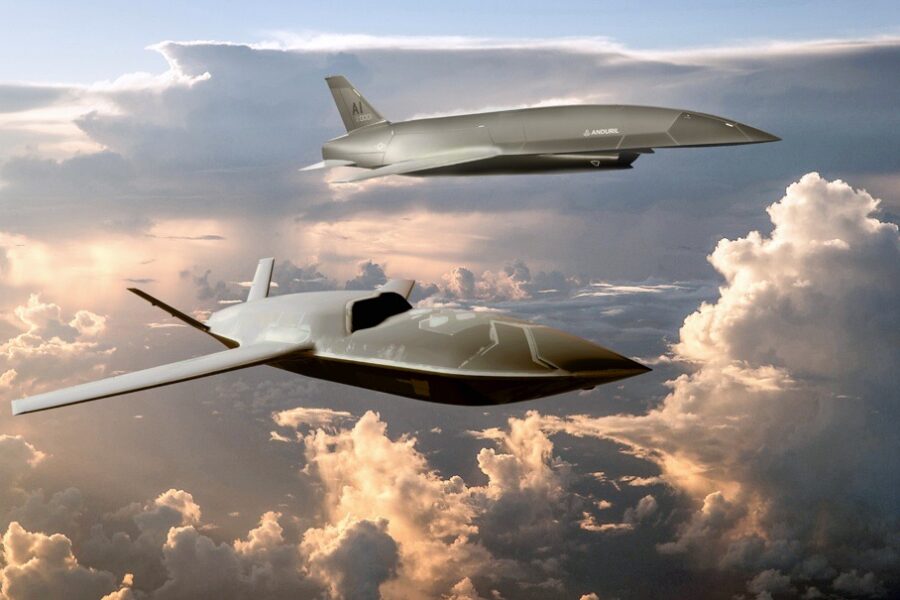
CCAs are semi-autonomous drones the Air Force is pursuing to bolster its combat “mass” at a lower cost than manned fighters. The first iteration of CCAs, to be built by General Atomics Aeronautical Systems and Anduril Industries, will focus on air-to-air missions, but future versions could carry out missions such as air-to-ground strikes, reconnaissance, or electronic warfare operations.
The CCA concept has long been for these drones to fly alongside crewed aircraft as “wingmen” and take directions from human pilots. But Air Force officials have discussed the potential for controlling them from other locations.
The Ohio flyoff used the AFRL SkyVision system, a ground-based “detect-and-avoid” system that lets air traffic controllers use radar feeds to follow Group 1-5 drones Beyond Line of Sight across more than 200 square miles of airspace without a chase aircraft.
While the C2 enclave has been tested in a lab, this was the first physical fly-off using multiple prototypes in a real-world setting.
And, of course, it rained.
“Rainy weather conditions added novel considerations for testing that we wouldn’t have otherwise experienced in a controlled environment,” the Air Force spokesperson said.
Beyond the weather, the team learned more about “the logistics of moving equipment outside of usual indoor facilities, like reducing gear weight and optimizing equipment setup,” the spokesperson added.
Airmen from the 178th provided the space and helped with setup and coordination of the enclave testing.
The wing has worked with the SkyVision system for this and other testing needs since it went operational in 2019. Just last year the unit flew an MQ-9A in this airspace as part of a counter-UAS experiment with the National Geospatial-Intelligence Agency and the Ohio Department of Transportation UAS Center, spokeswoman Maj. Courtney Slater told Air & Space Forces Magazine.
More Control Options
Col. Timothy Helfrich, the service’s portfolio acquisition executive for fighters and advanced aircraft, first mentioned the C2E program in June, and a spokesperson subsequently described the idea as separate from the software fighter pilots will use to control CCAs and instead called it “an application suite on a range of networks to enable the right operator, with the right permissions, to operate CCA.”
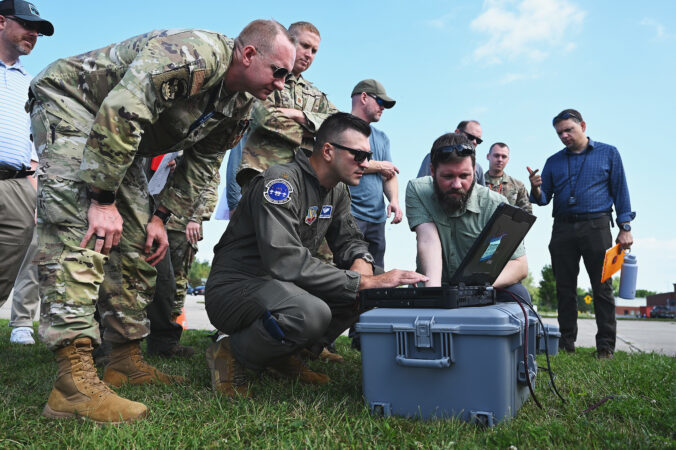
Beyond fighter pilots, CCAs could be controlled from battle management aircraft like the E-7 Wedgetail. But the portable C2E effort is focused on the ground. The prototypes being evaluated are command-and-control systems meant to be rapidly deployed and operated anywhere worldwide, even in austere environments, the Air Force’s Aug. 13 release said.
After testing the command-and-control systems’ mobility and footprints, the Air Force said vendors carried out another round of demonstrations to show how well their software operated.
The Air Force said these evaluations mark “a pivotal milestone in advancing the tactical control of semi-autonomous systems” and are a critical first step towards selecting a vendor to integrate a C2E system.
While the release did not specify which contractors participated in the evaluations, Anduril has already touted its own system, Menace-T, as capable of controlling its YFQ-44A Collaborative Combat Aircraft. In April, the firm said it used Menace-T—which consists of two portable cases and a rugged laptop—to upload mission plans, initiate autonomous taxi and takeoff, task the aircraft while in flight, and manage post-flight data ingestion and checks.
The information collected from the Air Force’s Ohio demonstrations will help speed up the acquisition strategy for C2E and help shape the selection process going forward. A second C2E prototype phase will soon begin, the Air Force said, and vendors are expected to further refine and demonstrate their systems’ cloud capabilities.
Once the Air Force selects a C2E system, the service said, it will go to the Experimental Operations Unit, which is currently testing CCAs, to support agile combat employment operations. The C2E system will directly control production CCAs, the Air Force said, “ensuring service members maintain a decisive advantage in contested environments.”
“Getting prototypes into the hands of our operational and acquisitions warfighters for a swift, combined evaluation is a direct embodiment of acquisition transformation,” Agile Development Office director Col. Eric Reagan said. “This partnership allows us to accelerate the fielding of the best-value capabilities to the Department of War,” using the alternative name for the Defense Department.