


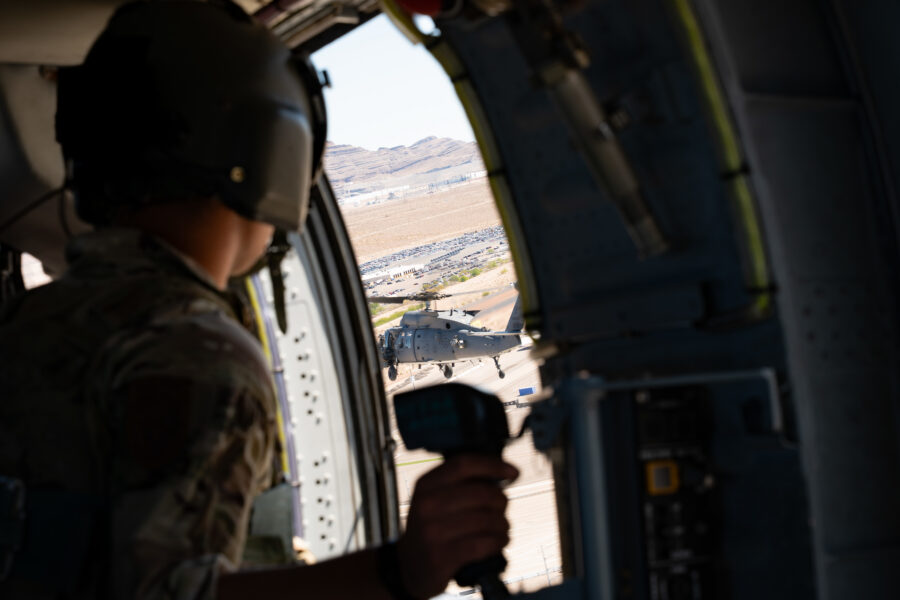
Search and rescue Airmen from Nellis Air Base, Nev., flew more than 200 miles in two HH-60W Jolly Green IIs last week to rescue five of their Navy helicopter crew counterparts who were forced to land in mountainous terrain near Naval Air Weapons Station China Lake, Calif.
Members of the 88th Test and Evaluation Squadron and the 355th Aircraft Maintenance Squadron at Nellis had to work quickly after being notified at 11:30 a.m. on Aug. 10 that the Navy MH-60S Seahawk had to conduct a hard landing in mountainous terrain during a high-altitude training flight near China Lake, according to an Air Force press release.
The two Jolly Green IIs were not on standby, ready to launch, and a critical circuit breaker issue threatened to ground one of the aircraft when no spare parts were available, the release states.
“We diagnosed the master caution warning press-to-reset button as what was causing the circuit breaker to pop and provided aircrew with a workaround to keep the system operational and allow on-time takeoff,” Staff Sgt. Cody Adams, an avionics craftsman, recalled.
The HH-60Ws departed Nellis at 1 p.m., spotted the survivors on the ground and established two-way radio contact by 3 p.m., according to the release.
Capt. John Howe, a combat rescue officer with the 88th, led the pararescue team that deployed to the landing zone and assessed that no survivors were injured. The team then made the call to have the helicopters reposition to a closer landing area to minimize the amount of physical exertion on Navy personnel moving to the pickup point, the announcement states.
The HH-60Ws successfully extracted all five Sailors by 3:50 p.m., transferring them safely to their unit’s ramp at China Lake before returning to Nellis.
“That is why people join these career fields—because they want to have an impact and they want to be able to be there for their fellow service members in a time of need,” Lt. Col. Kenneth “Buddy” Wilkins, flight lead for the rescue and commander of the 88th, said in the release.
“We have trained our whole careers to execute in these circumstances, and we have prepared and executed so many similar missions, that to us, it just felt like Monday,” Wilkins said. “It feels great to do the mission and help those in need.”
Leaders from both the 88th and the 355th credited the successful rapid response to the strong, preexisting relationship between the maintenance and operations units.
“There’s an immense amount of trust, and that was evident,” said Lt. Col. Joshua Bedel, commander of the maintenance unit. “You can tell there’s a deep respect for each other when it comes to getting that aircraft off the ground.”
Wilkins knew from experience that the maintainers from the 355th would have the aircraft ready to launch as soon as possible.
“We’ve exercised this a number of times,” Wilkins said. “This mission was a really good example of us taking the lessons learned from those previous events and executing as quickly and efficiently as possible.”
The Air Force first selected the HH-60W to replace the aging HH-60G Pave Hawk in 2014 as the service’s combat search and rescue helicopter. It received the first production Jolly Green IIs in 2021. The service originally planned to buy 113 HH-60Ws but cut that total to 85 in its 2023 budget plan—which included 75 production airframes and 10 test aircraft. Congress added funds for another 10 more aircraft in 2024 and four more in 2025, for a total of 89 production aircraft. The Air Force 2026 budget request confirmed that “funding is available to procure 100 aircraft,” including 11 test airframes.
Then in 2025, the service decided to modify 26 HH-60Ws to replace aging UH-1 Hueys now operating out of Joint Base Andrews, Md., to perform executive airlift mission for Air Force District of Washington. The mission includes contingency response for the government and senior leadership transportation.
Modifications detailed in budget plans include reconfiguring the cabin to accommodate 11 passengers and removing specialized equipment for combat search and rescue, such as the gun system, chaff/flare buckets, armor, and personnel litter. Budget documents indicate the HH-60W modifications would be made in fiscal 2028 and continue into 2030.