


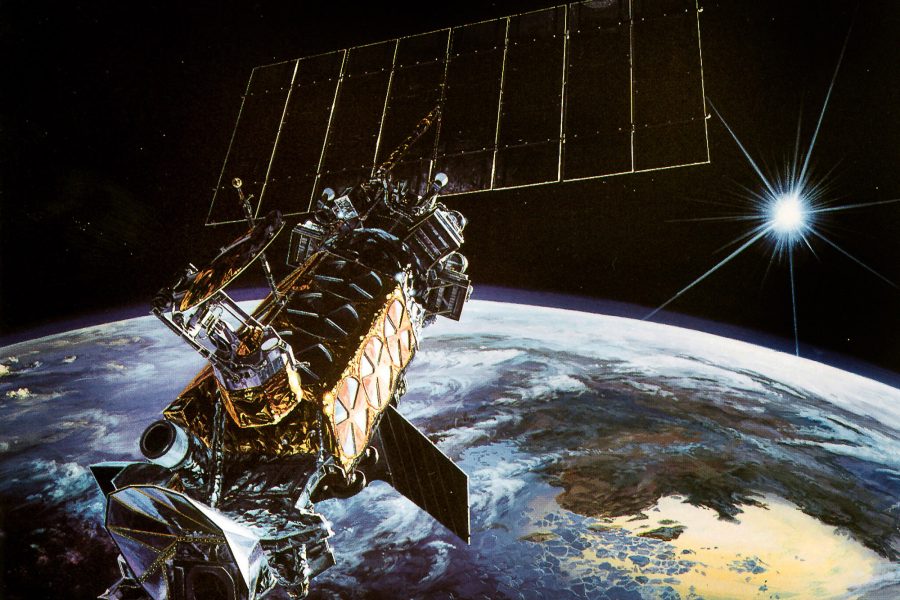
The Space Force will maintain its aging weather satellite fleet—which provides key forecasting data for military planners—until at least 2028 as it transitions to a new replacement architecture.
The service had anticipated decommissioning the three remaining Defense Meteorological Satellite Program spacecraft this year, but a spokesperson told Air & Space Force Magazine that timeline will stretch to 2028 as the Space Force works to field a new constellation of weather satellites.
The decision follows a provision in the fiscal 2026 National Defense Authorization Act that requires the Space Force to continue operating the satellites as long as possible in order to support weather data needs across the military as well as other government agencies like NASA and the National Oceanic and Atmospheric Administration.
“Because of their value to the greater meteorological community, the USSF will continue operating the Defense Meteorological Satellite Program constellation until the functional end of life of the on-orbit satellites, expected no earlier than 2028 at this time,” the Space Systems Command spokesperson said.
The Space Force launched its first DMSP satellites in the 1960s, and the last three functioning spacecraft were sent up in 2003, 2006, and 2009—far outlasting their initial five-year service life estimate. While there has been some degradation to the sensors and devices that control the satellites’ orbit and orientation—known as “attitude controls”—they’re still performing their mission as required, according to SSC.
“The DMSP constellation remains resilient and continues to meet its primary weather-monitoring mission requirements,” the spokesperson said. “While there is some sensor and spacecraft system degradation, it’s all in line with expectations of legacy systems operating this long.”
The service is in the midst of replacing DMSP with a mix of smaller satellites with disaggregated payloads. The near-term plan is to split DMSP sensors across two programs: the Weather System Follow-on Microwave program, or WSF-M, and the Electro-Optical/Infrared Weather System, or EWS. WSF-M satellites will identify and characterize tropical storms and high winds and measure snow soil and depth, while EWS satellites will carry electro-optical infrared sensors to provide imagery of cloud coverage and forecasts for military planners.
The first WSF-M satellite launched in April 2024 and the Space Force accepted it for initial operations a year later in 2025. Testing delays have pushed the next major milestone, full operational capability, from September 2025 to “early 2027,” SSC said.
“Achieving FOC requires resources from the acquisition, operational, test, and user communities to fully verify that the system has met all required parameters,” the spokesperson said. “Due to higher USSF priorities and the availability of users to support FOC … activities, the program office projects FOC completion in 2027.”
A Pentagon acquisition report published Aug. 3 notes that the slowdown is partially linked to resource constraints at the Air Force’s 557th Weather Wing, which supports the modeling platform that’s used to calibrate and validate systems like WSF. The report notes that “insufficient operational test resources and test personnel” contributed to the schedule slip, adding that those issues are “outside of WSF program control.”
The delay won’t have a significant impact on how operators use the data WSF is already providing on orbit, the report said. SSC noted that the satellite offers the “highest-precision passive microwave sensing measurements” available to users across the Defense Department and other government agencies. Those measurements are important for monitoring winds, cloud cover, snow depth, sea ice, and soil moisture.
A second WSF-M is slated to launch in early 2027 on the Space Force’s USSF-178 mission. The supporting command and control system is housed at the Naval Research Laboratory’s Blossom Point Tracking Facility in Welcome, Md. The service is also working with NRL to develop a cloud-based C2 system that will provide a “backup ground node” should the Blossom Point facility “become non-operational,” the spokesperson said. To date, NRL and the Space Force have finished three of four development phases for the cloud-based system and are on track to complete the effort in 2027.
Meanwhile, the first EWS satellite is scheduled to launch this year or next and the second in 2028. The service launched an EWS cubesat demonstration in 2024 meant to prove out technologies for the larger program.
The Space Force is also exploring options to use commercial spacecraft and data to complement the dedicated military satellites it’s fielding. Last year, it awarded a $44 million contract to Muon Space to modify one of its multispectral imaging payloads for military use and install it on three satellites to support Space Force demonstrations.
The service has indicated it is interested in a range of ground and space-based remote sensing technology and is working with other companies to better understand what data and services are commercially available.