
The Pentagon is counting on Congress to navigate a legislative tightrope and pass a party-line bill to fund nearly a quarter of its $1.5 trillion budget request for fiscal 2027, including billions of dollars for top priorities like Golden Dome, the F-35, munitions, and unmanned systems.
Experts and lawmakers from across the political spectrum think the Defense Department is betting too big on that plan—and fear a future headache if it fails.
In its budget request released earlier this month, the Pentagon split its $1.5 trillion topline between two funding mechanisms—$1.15 trillion from the traditional “discretionary” base budget, and $350 billion from reconciliation, or mandatory, funding. Reconciliation isn’t subject to the typical appropriations process and can be passed by a simple majority in both chambers of Congress. Last year, Congress approved $150 billion in mandatory defense spending as part of larger reconciliation legislation called the “One Big Beautiful Bill Act.”
Frustration with the new reconciliation request—expressed this week in a series of hearings with senior DOD officials—largely amounts to concerns about risk and process. While the reconciliation mechanism can be used to fast-track defense priorities, it requires strong buy-in from the political party in power.
Last year’s bill took months to wrangle, and Republican margins are even tighter now in both the House and Senate, while midterm elections in November could flip that majority altogether. GOP lawmakers are also working on a narrow, immigration-focused reconciliation package, leaving it unclear what the appetite may be for approving a third mandatory spending bill on top of that.
The stakes are high for both the Air Force and Space Force.
The Air Force’s $397 billion topline includes $16 billion in reconciliation funding. According to a Pentagon budget document detailing the department’s mandatory spending proposal, that includes:
- $2.3 billion for 14 F-35s
- $1 billion for 330 extended range Joint Air-to-Surface Standoff Missiles
- $990 million for Joint Advance Tactical Missiles
- $953 million for up to 618 Advanced Medium Air-to-Air Missiles
Of the Space Force’s $71 billion request, about $12 billion is mandatory—$7.8 billion of that would fund the Air Moving Target Indicator program and nearly $4 billion is for Space Data Network development and procurement.
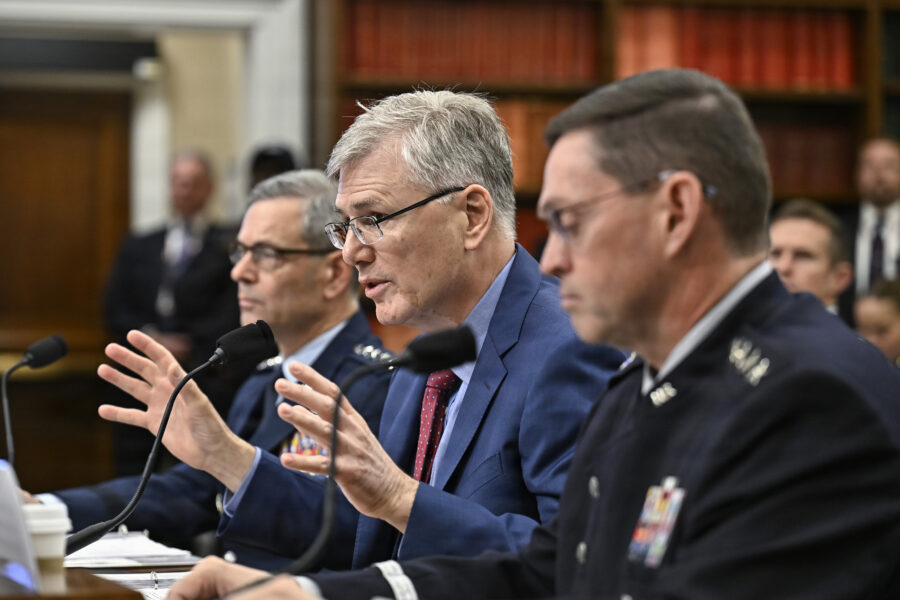
In an April 30 House Appropriations defense subcommittee hearing with Department of the Air Force leaders, Chairman Ken Calvert (R-Calif.) said many of these key priorities shouldn’t be left to the uncertainty of reconciliation and should should be moved into the base budget or be included as part of a separate supplemental funding proposal. DOD officials have said they plan to request supplemental appropriations to replenish depleted weapons stocks and repair systems damaged during Operation Epic Fury.
“Mandatory funding bypasses the annual appropriation process, which is how Congress exercises oversight responsibility,” Calvert said. “If these programs are as critical as the budget request suggests, and I believe they are, then they deserve all the full scrutiny and sustained attention that the appropriations process provides. I would urge the department to work with us to bring these programs into the discretionary budget where they belong.”
During the same hearing, Rep. Joe Morelle (D-N.Y.) asked Air Force Secretary Troy Meink whether the services have a backup plan should reconciliation fail. Meink declined to address the department’s strategy.
Rep. Ronny Jackson (R-Texas) raised similar concerns during an April 29 House Armed Services Committee hearing with Defense Secretary Pete Hegseth and Chairman of the Joint Chiefs of Staff Gen. Dan Caine. Jackson’s questioning focused on the Pentagon’s Defense Autonomous Warfare Group—which plays a key role in implementing the department’s push to field thousands of drones in the coming years—and he observed that most of the $54.6 billion funding request for DAWG falls within the reconciliation budget.
“I remain concerned about the potential gaps created if such a package fails to occur or if DAWG funding is not included in future budget requests,” Jackson said. He then asked Hegseth how the Pentagon would fund DAWG if the package stalls and whether it would transition the program to the base budget in future years.
Hegseth didn’t offer a backup plan, but said the Pentagon plans to work “hand in glove” with Congress and White House “to ensure that the reconciliation package is properly tailored and timed so that it is passed.”
It’s Complicated
While the annual appropriations process is often drawn out, reconciliation adds a layer of uncertainty and complication that could delay passage of a final appropriations bill even longer than usual, experts say. Approving both a reconciliation bill and a regular appropriation before the midterms would be a challenge given the enormity of this year’s budget, said Seamus Daniels, a defense budget analysis fellow at the Center for Strategic and International Studies.
Lawmakers must pass a budget resolution in order to start the reconciliation process, and Daniels said the timing of that will “have a major impact” on the bill’s prospects.
“I think it’s ultimately going to come down to the divide between budget hawks and other moderate Republicans who are willing to spend more, especially on defense, whether they’ll ultimately be able to overcome those divisions,” he told Air & Space Forces Magazine. “I do think starting that process before the midterms will show that they are serious about trying to get this done.”
Regardless of when Congress opts to begin the reconciliation process, it that bill fails, that would require a major reshuffling—either to push funding priorities into the base budget or to include them in a separate supplemental spending package. Byron Callan, a managing partner and defense analyst at Capital Alpha Partners, said in an April 26 newsletter there could be domino-like implications for the broader appropriations process if the bill doesn’t pass.
“It’s a set-up for a messy [2027] that won’t be at $1.5 trillion and for which Congress will have to make major adjustments to the request to fit priorities into a smaller budget,” Callan wrote.
Process and Precedent
Some lawmakers—and appropriators in particular—have been skeptical about the White House’s use of the budget reconciliation to bypass normal processes and potentially avoid budget scrutiny. During an April 27 Senate Armed Services Committee hearing discussing the fiscal ‘27 budget for missile defense, Sen. Angus King (I-Maine), called reconciliation the “son of OCO,” referring to the Pentagon’s infamous Overseas Contingency Operations account. Congress created OCO in 2001 as a temporary account to supplement funding for operations in Afghanistan, but it remained in place until 2021, becoming what many viewed as a slush fund for defense spending.
“We’re talking about taking 25 percent of the defense budget away from the appropriations committee, and effectively away from the Armed Services Committee, and handing it to … the White House,” King said of the fiscal ‘27 reconciliation package. “That’s not the way our system is supposed to work.”
Morelle, in the House Appropriations defense subcommittee hearing, called the approach “a dangerous precedent” that bypasses appropriators’ oversight role.
“The role that is vested in this committee to do oversight … this is really important not only for congressional integrity and congressional responsibilities, [but] for the American people,” he told Air Force leaders. “I would pass that message along to those who are helping make those decisions.”
Not all lawmakers are anti-reconciliation, though.
House Armed Services Committee Chairman Mike Rogers (R-Ala.) has championed the use of reconciliation funding to address major defense needs. In an April 28 hearing, Rogers asked Hegseth to recount how last year’s bill helped the department. The defense secretary said the request provided “rocket fuel” for priorities like shipbuilding, Golden Dome, and munitions.
Funding Flexibility
Pentagon officials have said there are benefits to putting important programs in its mandatory request—primarily, flexibility. While annual funding typically expires in two or three years, depending on the account, reconciliation funding can be used for up to five years. During an April 21 budget briefing, acting Comptroller Jules Hurst said many of the department’s largest programs could benefit from that.
“If we use mandatory spending, number one, we have some more flexibility on when we obligate those funds,” Hurst told reporters. “Number two, we did it for things that were kind of a one-time plus up that we really wanted to increase our funding of. And then finally, when there’s technology that’s changing quickly, like for Golden Dome or for the DAWG, we try to put things there.”
Daniels noted that despite having that opportunity with last year’s bill, the Pentagon has said it plans to spend the entire $150 billion in fiscal ‘26.
“That would point to the fact that they may not be taking full advantage of that flexibility that comes along with it,” he said.
Congress also has an opportunity in the fiscal ‘27 National Defense Authorization Act to weigh in on how the department uses its mandatory funding, possibly limiting how and when it can spend the money.
“What we saw in the One Big, Beautiful Bill last year is they sent over guidance after the fact, meaning that that’s not in law,” Daniels said. “So, they have to follow the rules as the bill was written. [There is] the chance that we could see Congress write more detailed provisions that are actually in the text of the law, which then affects flexibility.”