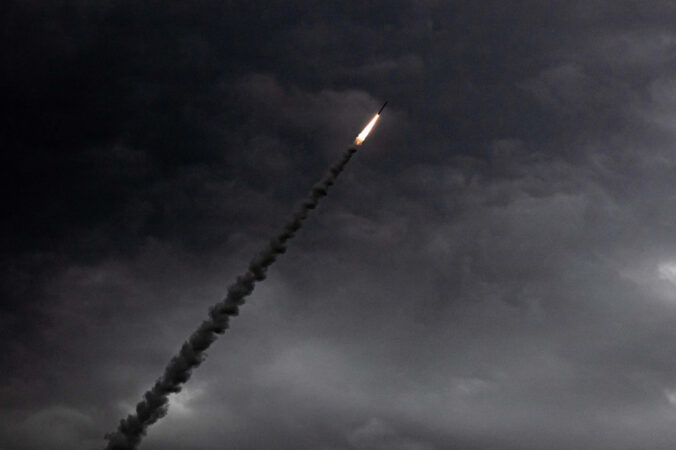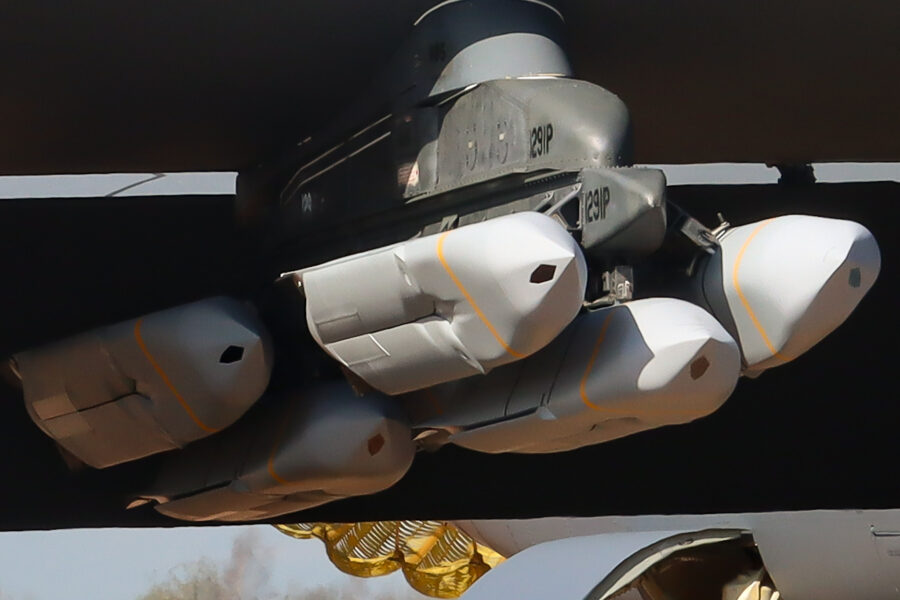
U.S. munitions have been expended at a high rate during Operation Epic Fury against Iran, prompting concerns the Pentagon is eating into weapons stockpiles it needs to deter threats around the world.
Yet the newly released $1.5 trillion defense budget request was developed before the war against Iran and won’t cover all of the growing shortfall.
“This budget was formulated, honestly, before we went into conflict with Iran,” Jules “Jay” Hurst III, the Pentagon’s acting comptroller and chief financial officer, told reporters this week.
In fiscal 2027, the Pentagon is requesting over $70 billion dollars for missiles and bombs, according to budget documents, including $52.9 billion for the department’s dozen most “critical munitions.”
The Pentagon may go to Congress for yet more money for weapons in a supplemental spending request, though it has not yet decided to take such a step.
“Every time we use something in combat, we’re always looking at how to reconstitute and sustain that capability,” Hurst said. “There could certainly be overlap in a supplemental request, because there is going to be a focus on munitions in this budget or a supplemental.”
Over six weeks of conflict, the U.S. attacked over 13,000 targets, according to the U.S. military. Multiple weapons are typically used on an individual target. The U.S. also intercepted more than 1,700 Iranian ballistic missiles and one-way attack drones, said Chairman of the Joint Chiefs of Staff Air Force Gen. Dan Caine.
That fighting has consumed a substantial portion of the U.S. inventory of critical munitions, according to a recent analysis from the Center for Strategic and International Studies.
CSIS estimates that the U.S. has expended around 1,000 Tomahawk cruise missiles compared with a prewar estimated inventory of 3,100, and more than 1,000 Joint Air-to-Surface Standoff Missiles, or JASSMs, compared with a prewar inventory of 4,400. Most of the Army’s stock of PrSM ballistic missiles were fired.
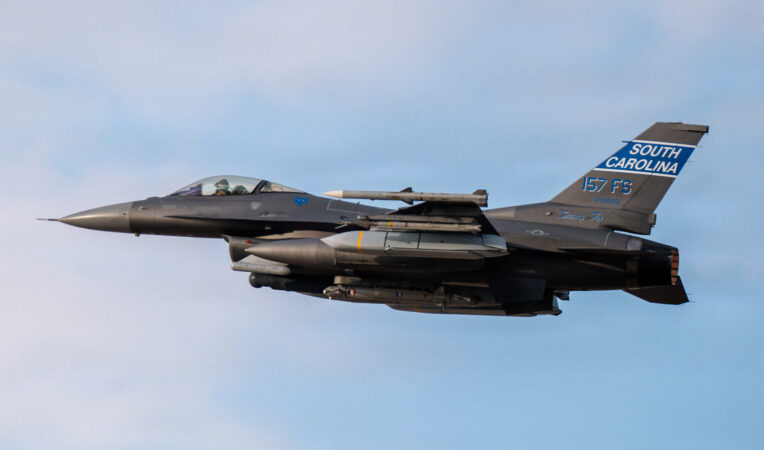
CSIS also estimates that the U.S. used over 1,000 Patriot interceptors and hundreds of THAAD, SM-3, and SM-6 missile defense interceptors as it sought to fend off Iran’s attacks on U.S. bases and countries across the region.
“The United States didn’t have enough munitions prior to the conflict for some of the potential future contingencies that it might face, particularly against a more advanced adversary in the Indo-Pacific,” said Becca Wasser, defense lead for Bloomberg Economics. “But now, with such a high rate of expenditure, especially of some of those higher-end munitions, more needs to be done in order to rebuild those stockpiles.
“If the munitions buy does not reflect the Iran war, I think we’re all in for a bit of sticker shock,” she added. “I think there’s an open question about industrial capacity, as well as some of the bottlenecks that we continually see.”
Hurst said while the new budget request does not cover the “operational costs” of the conflict with Iran, it is an important step to “reconstitute America’s defense industrial base and give us capacity.” However, turning those expenditures into weapons stockpiles will take years, experts say.
“There’s a huge amount of money in ’27 for munitions. That’s the right thing to do,” said Mark Cancian, a retired Marine Corps colonel and one of the authors of the CSIS report. “The problem is that it’s going to take many years for that money to turn into missiles.”
The munitions expenditure in the Iran conflict is already affecting some American allies. On April 20, Estonia’s minister of defense, Hanno Pevkur, said the U.S. had paused weapons deliveries to the country, which he had raised with Secretary of Defense Pete Hegseth.
The Trump administration has pushed U.S. allies to invest more in defense. And that has added to demand for an overtaxed defense industry.
“For the first time in a long time, money is not the problem in Europe,” Air Force Gen. Alexus G. Grynkewich, NATO’s Supreme Allied Commander Europe and the head of U.S. European Command, told lawmakers last month. “The real challenge is the production capacity and the defense industrial base, and will capabilities be able to show up on time?”
The shortfall is a particular concern for U.S. efforts to deter China, which is seeking to pressure Taiwan to come under the control of Beijing.
“The risk is in a future conflict, like with China, there is now a window of vulnerability, and it’s going to be years before we fully close that,” Cancian said.
America’s top commander in Asia, U.S. Indo-Pacific Command boss Adm. Samuel Paparo, told the Senate Armed Services Committee on April 21 that he is also concerned with a munitions shortfall.
“The traditional defense primes have to innovate to go faster. I think it will take one to two years for them to scale,” Paparo said. “It won’t be soon enough, and I think that we really must press the system with nontraditional vendors, bringing to bear new low-cost munitions such as hypersonics, low-cost cruise missiles, and then across a variety of drones and unmanned systems.”
The conflict has also affected munitions supplies on the Korean peninsula.
Army Gen. Xavier Brunson, the commander of U.S. Forces Korea, told the Senate committee that the U.S. kept its THAAD anti-missile system in South Korea during the conflict but was moving munitions to the Middle East.
“We are sending munitions forward, and those are sitting, right now, waiting to move,” Brunson said.