
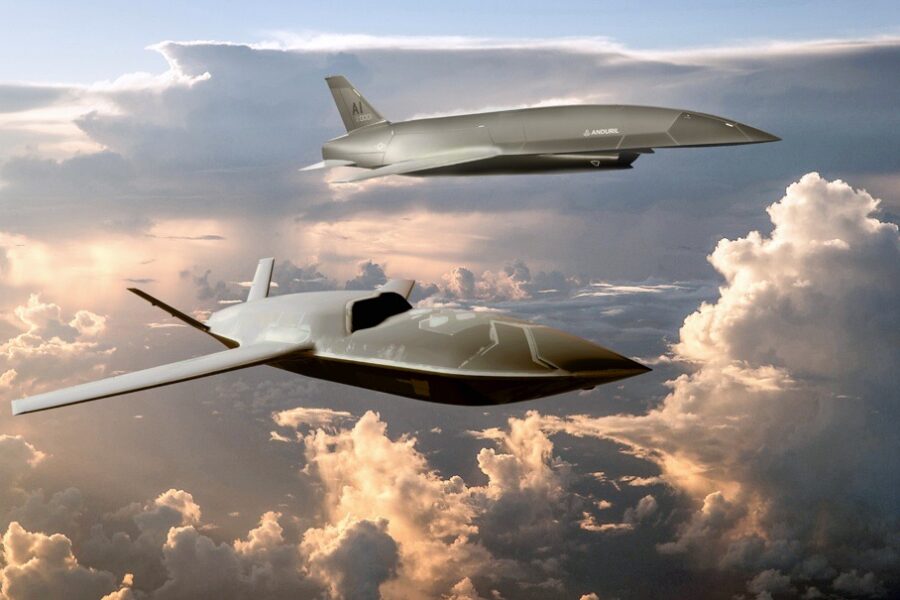
The Air Force has selected both General Atomics Aeronautical Systems and Anduril Industries to build its first fleet of semi-autonomous Collaborative Combat Aircraft, based on their YFQ-42A and YFQ-44A drones, respectively.
The department announced June 17 it has awarded both companies engineering and manufacturing development and production contracts to officially build at least 150 CCAs combined by the end of the decade for the program’s first increment.
The Air Force simultaneously announced it has competitively awarded production options to three companies—Anduril, Shield AI, and Collins Aerospace—to deliver the critical mission autonomy software to fly the CCAs. Those companies were selected from a potential vendor pool that also includes Lockheed Martin, Northrop Grumman and General Atomics.
“We see CCA as representing the next evolution of airpower,” Col. Timothy Helfrich, the Air Force’s portfolio acquisition executive for fighters and advanced aircraft, said in a conference call with reporters. “It is our first instance of taking human-machine teaming into the aviation world … and being able to drive it operationally. When paired with our manned fighters, we can extend reach, increase survivability, and generate the mass that is necessary in combat in a highly contested environment.
The Air Force eventually wants a fleet of around 1,000 CCAs, of various types and levels of complexity, to augment its crewed fighters and aircraft such as the F-35A Joint Strike Fighter, the sixth-generation F-47, and the F-22A Raptor. CCAs are intended to fly themselves and conduct strikes, reconnaissance missions, electronic warfare or jamming operations, with minimal direction from the pilots in the crewed aircraft they accompany. The Air Force wants the first increment of CCAs to have a combat radius of at least 700 nautical miles.
In April 2024, the Air Force awarded General Atomics and Anduril contracts to continue designing, building, and testing their proposed CCAs—for General Atomics, the YFQ-42A, and for Anduril, the YFQ-44A—and throughout 2025, both models proceeded through ground testing into flight testing.
Helfrich said the new contracts awarded were not extensions of the previous contracts awarded in 2024. The Air Force resolicited all five companies that originally bid on CCAs—including heavyweight contractors Lockheed Martin, Northrop Grumman, and Boeing—and ultimately continued with the companies that won the first round.
Now that production contracts have been awarded, these two CCAs now in testing will drop the Y prefix—which signifies an aircraft is a prototype—and become the FQ-42A and FQ-44A. Helfrich said the production CCAs have evolved and been refined to meet the Air Force’s operational needs, but are still fundamentally the same design.
“This is an exciting day for our company and the nation,” General Atomics Aeronautical Systems President David Alexander said in a statement. “Moving to production on FQ-42A is the result of an extraordinary partnership and many years of investments between General Atomics and the U.S. Air Force. We’ve been preparing for this order, and manufacturing is already well underway.”
“We have been refining, testing, and iterating on our production system, in parallel with aircraft development, for the past two years,” Anduril’s Vice President for autonomous airpower Mark Shushnar said in a statement. “We have already implemented our full rate production processes and tooling on prototype aircraft, identifying and addressing issues during prototyping to streamline the transition into production.”
Helfrich said the value of these CCA contracts is classified and could not be released, but that the Air Force is meeting or exceeding its stated goal of one-third as much as an F-35, or roughly less than $30 million per tail.
The contract covers the first three lots of CCAs, Helfrich said, and more production contracts will be awarded in the future for the first increment. He did not say how the lots will be divided between Anduril and General Atomics, but said how many tails the Air Force orders will depend on factors including how well they can deliver “capability at speed and scale.” Helfrich said details on how many CCAs will be built in each lot, and the cost of each CCA, will be released at a later date.
Helfrich said the Air Force plans to keep using innovative acquisition strategies to continue rapidly awarding CCA contracts and developing the technology while keeping costs down.
Part of that unique acquisition approach, he said, is in disconnecting the purchase of the CCA’s hardware—the aircraft itself—from its mission autonomy software under a strategy the service calls “software sold separately.”
This approach will allow the Air Force to make sure it buys “agile, easily updatable software” that will work with “state-of-the-art physical platforms … effectively breaking traditional procurement molds,” the service said in a statement.
The air vehicle contracts were awarded four months ahead of schedule, Helfrich said, which shows both Anduril’s and General Atomics’ CCAs were mature enough to move ahead towards full-scale manufacturing.
“We are moving with urgency on this program, and that is urgency with purpose,” Helfrich said. “It is important for us to deliver [CCA] capability to the warfighter.”
In deciding to go with both Anduril and General Atomics, Helfrich said the Air Force considered whether vendors were able to meet the service’s schedule, cost criteria, and performance requirements.
From the start, Helfrich said, the Air Force thought it might have two vendors creating the first increment of CCAs, to better foster competition and innovation.
“A big reason for that is that we believe that continuous competition drives the best outcomes, both in schedule, cost, and often times in performance as well,” Helfrich said. “Both General Atomics and Anduril demonstrated that they had the ability to meet our schedule, meet our cost requirements, and meet the capabilities” needed for a CCA.
Helfrich said the April crash of a General Atomics YFQ-42A, which occurred in California shortly after takeoff for a test flight, was not a factor in the Air Force’s decision to award contracts to two firms. That crash led to a roughly six-week pause in YFQ-42A test flights, before resuming in May with a software fix.
Anduril, Shield AI, and Collins each received a six-month contract line item number, or CLIN, to advance their mission autonomy software as much as possible in that time to meet the Air Force’s initial operating capability criteria, Helfrich said. After that six months, the Air Force will see how far each company’s software has progressed and then down select further to two or even one remaining vendor for another six-month option. At the end of that second option in summer 2027, a company will need to have reached IOC, and the Air Force will ultimately make a single choice.
Helfrich said the Air Force’s mission autonomy contract will provide different opportunities for the six vendors in the pool, such as a future command-and-control project. The Air Force can choose to order software licenses from any of those vendors, he said.
“There’s quite a bit going on in the mission autonomy contract, because we wanted to provide max flexibility and keep continuous competition,” Helfrich said.