
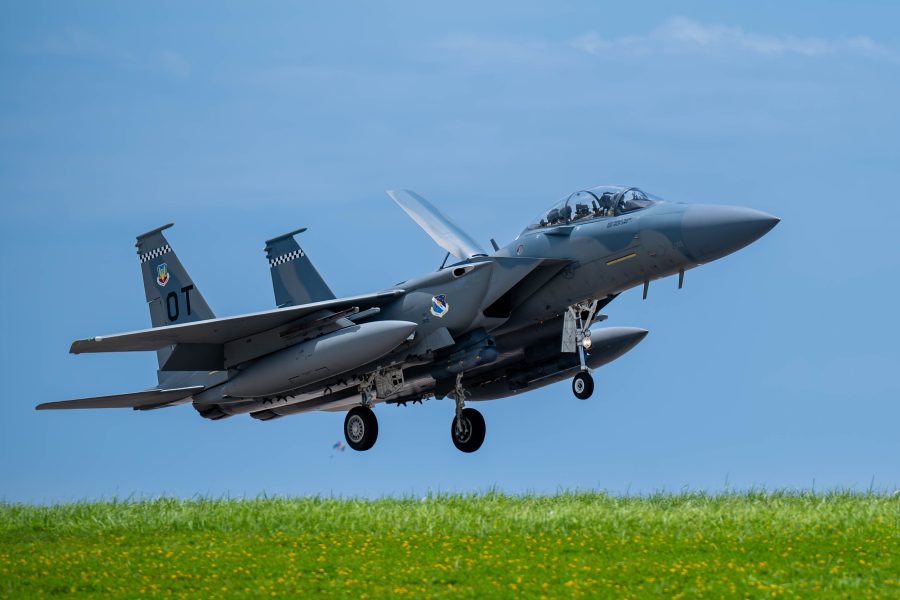
The Air Force would be able to sign multiyear contracts to buy F-35A Joint Strike Fighters and F-15EX Eagle II jets under the Senate’s version of a key defense policy bill.
The multiyear fighter procurement authority—which would also cover the F-35Bs and Cs flown by the Navy and Marine Corps—would provide flexibility that Air Force leaders have strongly endorsed. Advocates say multiyear buys would allow the Air Force to save money by locking in prices, in effect providing a hedge against inflation, while giving contractors a guaranteed, steady flow of work.
The Senate Armed Services Committee on June 11 voted 18-9 to advance its fiscal 2027 National Defense Authorization Act, which will now go to the full Senate for consideration and a vote. Sens. Ted Budd (R-N.C.) and Jeanne Shaheen (D-N.H.) had previously proposed legislation allowing multiyear procurement and championed its inclusion in the NDAA. The House’s version of the NDAA also has a similar multiyear procurement provision.
But an executive summary of the Senate NDAA said that the F-15EX multiyear contracts would only be allowed if the secretary of the Air Force can certify that its manufacturer, Boeing, can meet the required delivery schedules.
That is something Boeing has struggled with at times. Workers at its St. Louis, Mo., factory, where the F-15EX is built, went on strike for months in 2025, which left production and deliveries behind schedule. Kadena Air Base in Japan, for example, was supposed to get three dozen F-15EXs starting in 2026, but they will now start arriving in 2027.
In a June 11 statement, SASC Chairman Sen. Roger Wicker (R-Miss.) said the NDAA would represent “a seminal breakthrough for the American military.”
“Through a historic level of investment and bold innovations in organization and procurement, this legislation facilitates the modernization of an American arsenal that will define the next generation of warfare,” Wicker said. “The bill responds to the modern battlefield with thoughtful approaches on artificial intelligence, autonomous weapons, low-cost munitions, and cyber operations. Its provision will pave the way for a manufacturing revival and an expansion of existing and emerging industries throughout the American economy—a reindustrialization the scale of which we have not seen since the Second World War.”
The draft bill would also require the Air Force to submit a study to Congress on its requirements for combat search and rescue “and avoid making any changes in combat search and rescue forces force structure in the Air Force pending completion of that study,” according to the summary.
The CSAR mission has gained renewed attention during the conflict with Iran. First, U.S. forces mounted a massive effort to rescue two F-15E aviators shot down over Iran in early April. Then, an unmanned boat rescued two Apache crew members on June 9 after their helicopter went down near the Strait of Hormuz. In both cases, U.S. aircraft flew patrols over the downed aircrew to protect them—in the F-15E incident, an A-10 was hit and the pilot was forced to bail out over friendly territory.
The Senate bill would also renew a requirement for the Air Force fighter inventory to be at least 1,800 aircraft, which was set to expire.
And it would continue to prevent the Air Force from retiring or otherwise mothballing any more E-3 Sentry airborne warning and control system aircraft, or AWACS—a prohibition that also was scheduled to expire. The summary said the NDAA would require the Air Force to maintain at least 16 AWACS, but Iran’s destruction of one E-3 in March brought the service’s inventory down to 15.
SASC also wants the Air Force to put together a plan to boost its spare parts availability, which has been a persistent issue that has helped drag its aircraft availability rates down. The NDAA said this acquisition and sustainment strategy should focus on maximizing competition and expanding the defense industrial base’s sustainment supply chain.
The NDAA would also require the Air Force to produce a report on the B-21 Raider stealth bomber’s force structure and production strategy. And it would direct a comprehensive strategic plan on how the Air Force would develop, acquire, modernize, and integrate its mobility capabilities through fiscal 2047.