



China is expanding the arsenal of counter-space weapons it could use in a potential conflict with the U.S., to include on-orbit systems, according to a new report from the Defense Intelligence Agency.
The DIA released the third edition of its “Challenges to Security in Space” report Oct. 26, following on 2022 and 2019 versions. Among its findings, it noted that China “is developing space-based technology, including on-orbit counterspace weapons, capable of holding space systems at risk.”
Specifically, the report repeats previous warnings that China has ground-based laser weapons that can “disrupt, degrade, or destroy” satellites in low-Earth orbit but then goes further in adding that, by the late 2020s, “China may field space-based directed energy systems and higher-powered ground-based directed energy systems capable of threatening satellites in higher orbits.”
Directed energy weapons could include anything from microwaves to high-powered lasers—the most common at this point are lasers that can “dazzle” satellites with electro-optical sensors.
The new report also goes beyond previous versions in stating that the People’s Liberation Army’s electronic warfare jamming systems “include a combination of ground-based and on-orbit systems that enable it to leverage a variety of options during a conflict.” It’s the first time DIA has noted the existence of on-orbit jammers.
DIA also states definitively that Chinese firms are developing electronic jammers for the People’s Liberation Army to target synthetic aperture radar, “including military reconnaissance platforms.” The agency’s 2022 report only said China was “probably” developing such a capability, which may prove pivotal given the Space Force’s push to field hundreds of new targeting satellites to track objects on the ground and in the air.
The new report also notes that the Chinese military “probably intends to deploy additional [anti-satellite] missiles that can destroy satellites in low, medium, and high orbits”—previously, the agency had only said China “probably intends to pursue” such weapons. It highlights recent developments with mysterious Chinese satellites maneuvering within 10 kilometers of other nations’ satellites in geosynchronous orbit.
“These close approaches to foreign spacecraft are largely inconsistent with the stated mission of the satellites, suggesting China may have obfuscated their true mission,” the report states.
Taken together, the DIA’s findings reinforce what then-Chief of Space Operations Gen. B. Chance Saltzman told reporters in 2025: that China is pursuing new capabilities across what he calls the six types of counterspace weapons, three in orbit and three terrestrial:
- Kinetic, destructive weapons;
- Directed energy; and
- Radio frequency energy and jamming.
The new DIA report’s focus on on-orbit weapons follows closely on the Space Force’s own acknowledgement for the first time that it has on-orbit weapons for “space control,” something leaders revealed at this September’s AFA conference.
The report also includes a rare image of China’s experimental space plane, a mysterious system often compared to the Space Force’s X-37B orbital test vehicle. The image, captured by a commercial Maxar satellite, shows the Chinese spacecraft’s shape is not unlike the X-37.
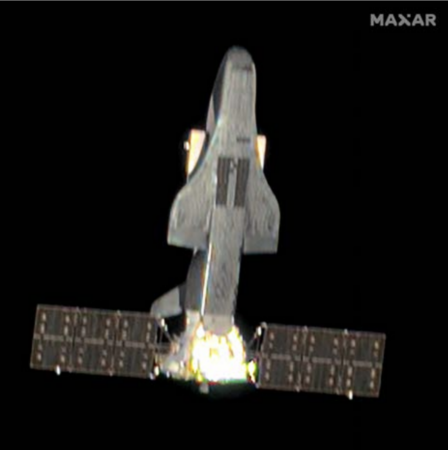
“Spaceplanes are … reusable and feature enhanced maneuverability, making them more suitable for certain missions than traditional satellites,” the DIA report states, noting that the Chinese space plane has released, maneuvered around, and rendezvoused with other satellites during its time in orbit.
Besides China, the 2026 report also noted expanded counter-space activities by less advanced adversaries like Iran and North Korea.
Iran in particular has used jammers to disrupt satellite communications and navigation signals around the Strait of Hormuz, according to the report, and during Operation Epic Fury, both the U.S. and Iran “took offensive actions against each others’ space capabilities to degrade and disrupt military actions on both sides.” Pentagon and Space Force officials have claimed they have achieved “space superiority” in the conflict but have not detailed Iran’s efforts in space.
North Korea, meanwhile, managed to successfully launch a reconnaissance satellite into orbit in 2023, and “may also be developing jammers effective against military GPS signals,” according to the report.