
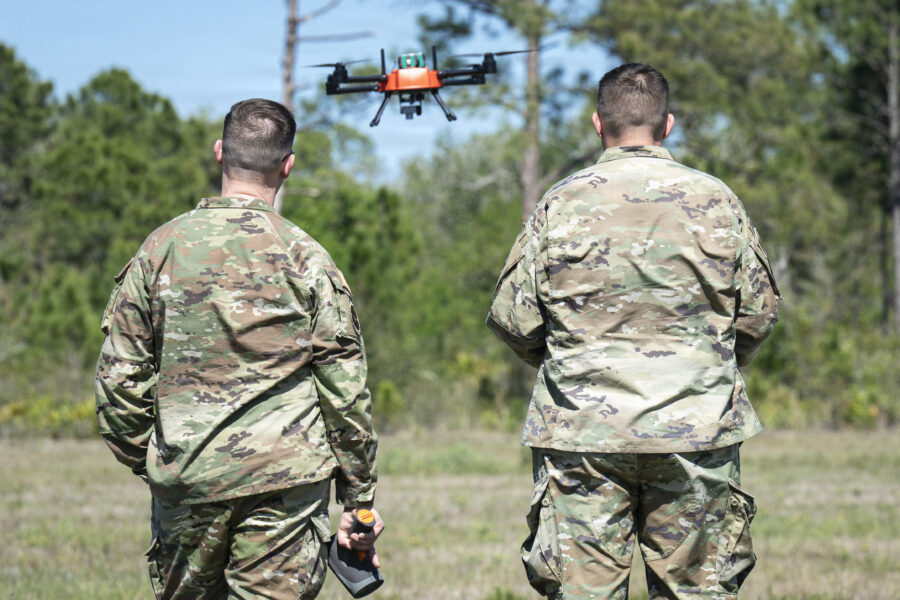
The Air Force will identify the skill training needed to prepare future point defense Airmen to repulse enemy drone attacks at home and abroad, Air Education and Training Command Boss Lt. Gen. Clark J. Quinn said Nov. 16.
Air Force leaders began decided to launch a new point-defense Air Force specialty code in June at a “Corona” meeting of senior officers. The decision followed Iranian attacks that inflicted extensive damage to air bases across the Middle East during Operation Epic Fury.
New interim counter-drone units, known as point-defense flights, stood up this summer, assembled from about 20 enlisted Airmen with aviation and battle management backgrounds. The flights are intended to be quick reaction forces that can rapidly deploy to protect bases against potential drone attacks.
Developing a full-fledged career field will take longer, beginning with the training requirments and curriculum.
“If the United States Air Force is going to develop a new AFSC … it’s going to come to us to train it,” Quinn said during an event with AFA’s Mitchell Institute for Aerospace Studies.
Air Force Chief of Staff Gen. Kenneth S. Wilsbach said in September that the new point defense career field should be operational in two years and that two senior master sergeants had been designated the field’s first point defense career managers.
“That is going to kickstart a process that actually begins in January of identifying exactly what we’re going to teach, and then the resources that we’re going to need to teach it,” Quinn said. “Some of those resources will be equipment… We need to understand what we’re going to be expected to train to.”
Point defense took on urgency in late 2023 after unidentified drones were seen flying repeatedly over Langley Air Force Base, Va. When Ukraine launched its devastating Operation Spider Web against Russian air bases in July 2025, Air Force leaders realized just how vulnerable their own air bases and aircraft could be to similar attacks.
Pentagon officials launched a review of U.S. military base defense systems and former commanders called for developing robust new defenses for a critical mission too long ignored.
Current Air Force tactics employ Small Unmanned Air Defense Systems, or SUADS, which is USAF’s program of record for point defense. The system is a detection platform capable of identifying and tracking enemy drones of all sizes and can take drones down with its integrated electronic warfare effector. Additional commercial systems are also being acquired through the Pentagon’s Joint Interagency Task Force 401 SUAD program office.
“Manpower, people, and money” are the keys to standing up the new career field, Quinn said. “In other words, we’re going to need instructors. We’re going to have to teach instructors to be able to teach this course. That whole process kicks off Jan. 27.”
Future instructors are attending the three-week course at the Joint Counter Unmanned Aircraft Systems University, located at Fort Sill, Okla. “But that is not United States Air Force AFSC specific,” Quinn said. “We are still building that one.”