
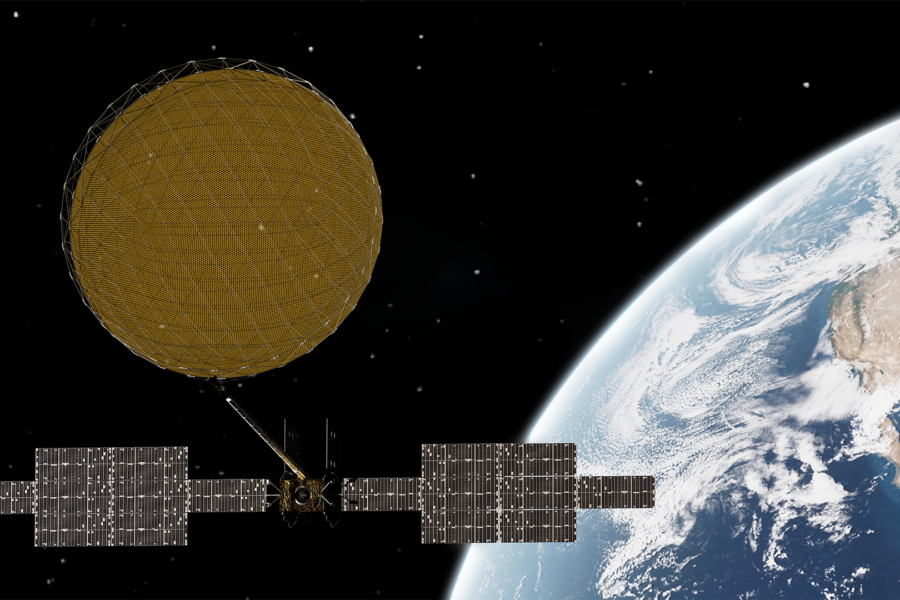
Space Systems Command recently awarded Viasat a contract with a $450 million ceiling to design and field a mission operations center for the command’s burgeoning Space Data Network.
The indefinite delivery, indefinite quantity contract includes a $115 million initial tasking order.
The mission ops center, or MOC, will act as the central integration hub for the SDN, which Space Force officials say will consist of both government and commercial satellites and be able to meet both the tactical and enterprise communication needs for the entire joint force. At the heart of it is a “Backbone” that will provide “robust, resilient, high-capacity, and low-latency data transport … delivering worldwide tactical communications and broadband communication services,” SSC has said.
Industry giant SpaceX got a $2.9 billion deal in May for SDN Backbone and is slated to deliver an operational prototype capability by the end of next year. While there was briefly concern that the firm would dominate the program, SSC has since awarded contracts to Rocket Lab, York Space Systems, Northrop Grumman, Lockheed Martin, and Amazon LEO for Government.
The introduction of more vendors encourages competition and less reliance on any one constellation or system, but the Space Force will need a “central integration hub” across multiple satellite constellations.
“Establishing this Mission Operations Center is a crucial step in maturing our Space Data Network into a fully operational, multi-vendor capability,” Space Force Lt. Col. Alexa Eggert, materiel leader for the SDN-Backbone program, said in the release.
The goal is to orchestrate the transport of critical data across different vendors’ satellites and to all domains, routing and rerouting data in real time to be as efficient as possible.
“The MOC establishes the mission operations layer needed to integrate the diverse space data transport and space exchange systems being developed across related efforts,” Eggert said. “By bringing the systems together in one place, it positions us to deliver a more integrated mission capability across multiple constellations and systems.”
The MOC is part of SSC’s broader open-architecture approach to delivering secure, resilient space-to-ground connectivity for joint force users across air, land, sea, and space domains, the spokesperson wrote in an email response.
“Specific technical standards, system interfaces, performance measures, operational employment concepts, and future task-order details are not available for public release,” the spokesperson wrote.
SDN is tied closely to the planned Golden Dome missile defense shield, and the most recent contract award was made “in partnership with Golden Dome for America,” an SSC spokesperson told Air & Space Forces Magazine on Nov. 9.
In August, Viasat won a separate SSC contract to develop a dual-band X/Ka-band, mini-geosynchronous maneuverable satellite for the Protected Tactical SATCOM-Global program. The company picked Rocket Lab to build the spacecraft for the mission.
In May, Viasat and Intelsat General Communications won a combined $437 million USSF contract to develop anti-jam communication satellites for tactical SATCOM missions.
PTS-G is part of the Protected Tactical SATCOM system replacing the Advanced Extremely High Frequency constellation. It encompasses satellites, the PTS-W waveform, ground controls, and an anti-jam modem. The Space Force requested about $450 million for fiscal 2027 and $2 billion through fiscal 2031, Air & Space Forces Magazine reported.
In 2022, hackers attacked Viasat terminals and cut communications for thousands of European users of the company’s system. The attack occurred in parallel with a Russian attack that February, hitting thousands of terminals in Ukraine and elsewhere in Europe, Air & Space Forces Magazine reported.
The company brought thousands of satellites online each day following the attack. Despite estimates that it would take weeks to fully resolve the issue, it took from late February to April to fully recover and replace the necessary nodes.
In the current fiscal 2027 National Defense Authorization bill, USSF has requested $1.5 billion for the SDN-Backbone. That breaks down to $685 million to speed up constellation growth and another $800 million to add commercial tech currently under development.