
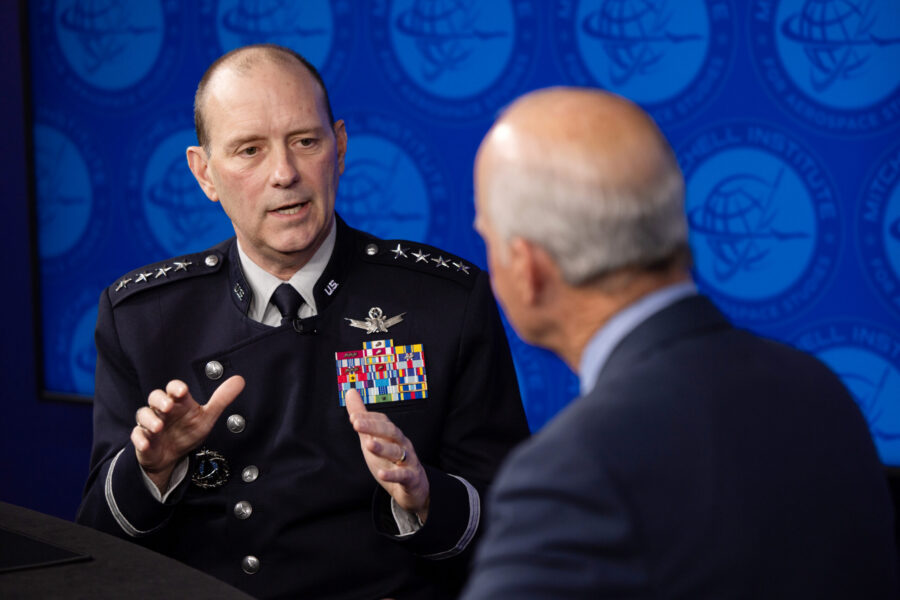
The Space Force wants to increase the size of its components to better support combatant commands in the coming years, according to Chief of Space Operations Gen. Douglas Schiess.
“We’re going to add 2,800 Guardians and 2,000 civilians in fiscal 2027 if the budget comes through,” Schiess said Nov. 4 at an event hosted by AFA’s Mitchell Institute for Aerospace Studies. “A lot of that will go into our components.”
The Space Force has components within all seven geographic combatant commands and U.S. Special Operations Command, the last of which is its newest component, formally activated Nov. 2. Officials haven’t announced plans to establish elements for the remaining functional commands—U.S. Cyber Command, U.S. Strategic Command, and U.S. Transportation Command—but a Space Force spokesperson told Air & Space Forces Magazine the service plans to eventually create components within each, though it hasn’t set a firm timeline for doing so.
These components are charged with providing space effects to commanders in the field, either from remote operations centers or from forward deployed locations. During Operation Epic Fury, Space Forces Central deployed Guardians to the Middle East, and some of them took enemy fire or were injured while operating electronic warfare and missile defense systems, Schiess said.
To adequately support combatant commands both in their area of responsibility and from their home stations, the Space Force needs to grow the size of its components, Schiess said. He didn’t offer details on how much each element will grow, but said the service will prioritize the larger commands as well as those with the greatest need for space effects.
From late 2023 to 2025, Schiess led the Space Force’s component under U.S. Space Command component, its largest element. Schiess said he expects the components to CENTCOM, European Command, Northern Command, Africa Command, and Pacific Command components—all led by one-star generals—will be prioritized for growth in the future.
“We’ve got to grow those to the proper size,” he said. “We did it on the cheap a little bit to get them out there. We’ve still got some that we’ve got to bring on, but we’ve also got to get them the capabilities.”
While Schiess didn’t say disclose how many personnel may be added to those components, he did say he’d add “several hundred people” if he had unlimited resources.
Integrating Guardians into joint force and allied operations at a greater scale has been one of Schiess’ early top priorities since he took the helm of the Space Force in September. That will not only require more funding to bring on those civilian and military personnel, but the resources to train them to operate downrange and to procure the systems they’ll be running.
The Space Force requested $71 billion to start funding that growth in fiscal 2027—more than double its request in fiscal ‘26—but the fate of that budget is unclear. About $12 billion was part of a $350 billion reconciliation package that isn’t likely to be approved, especially with Democrats set to take control of both the House and the Senate in a few months. The timeline for passage of regular appropriations is also murky.
Schiess acknowledged those challenges, adding that the Space Force is also operating under a continuing resolution that holds funding at fiscal ‘26 levels and prevents the service from starting new programs.
“We have a great plan,” he said. “But as the CR continues, then it becomes more difficult.”