


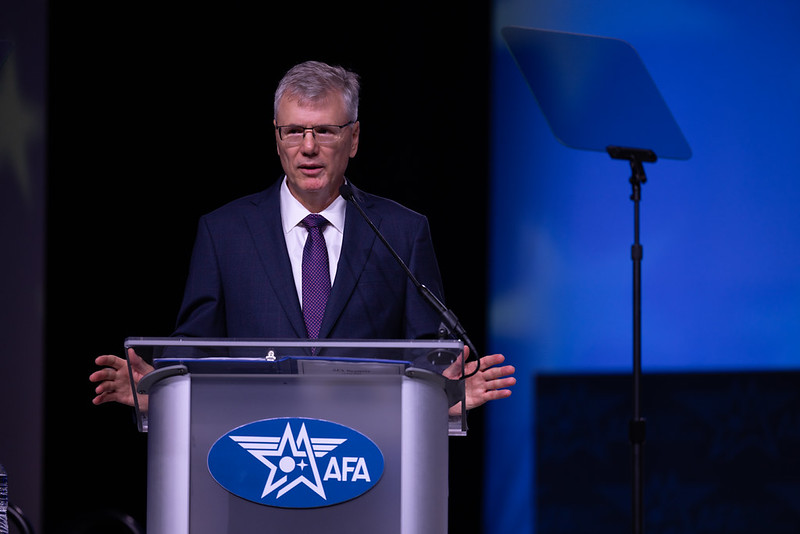
NATIONAL HARBOR, Md.—Air Force Secretary Troy Meink revealed Sept. 14 the Space Force has “space control weapons” on orbit today—the Pentagon’s most direct acknowledgement to date that the U.S. is operating offensive capabilities in space.
“Today, we continue to ensure we remain ready to meet the challenge of evolving threats wherever they exist,” Meink said during the opening keynote at AFA’s Air, Space and Cyber Conference. “This is why the Space Force now has on-orbit space control weapons capable of defending the joint force against hostile adversary action.”
Meink’s explicit nod to U.S.-operated space weapons comes amid a concerted push to speak more openly about on-orbit threats and the Space Force’s ability to respond to them. China and Russia, in particular, continue to demonstrate aggressive maneuvers and are developing—and demonstrating—space weapons of their own. U.S. officials in recent years have discussed the need for “counter-space” capabilities and “space fires,” as well as the development of space-based interceptors designed to shoot down missile threats. And last December, President Donald Trump issued an executive order underlining the Space Force’s role in not only defending space assets, but also in the attack mission.
But Meink’s mention of existing on-orbit space weapons is a first. During a question and answer session following his speech, Meink said the acknowledgement was intentional and the phrasing “very well thought out.”
“It is critically important that we maintain our dominance, not only in the air but in space,” he said. “So, we’ve had to take steps to make sure that when we’re threatened, we can take care of that.”
Meink declined to discuss the capabilities in more detail during a briefing with reporters following his keynote—including whether the systems in question are kinetic or non-kinetic. He argued that while acknowledging the existence of U.S. space weapons in orbit may serve a deterrent function, “talking about the details of what we’re doing would actually not benefit that deterrence.”
“We’re not going to talk about the specifics of what we’re doing, whether we’ve tested, not tested, or anything else,” he said. “I would just say that the space environment is critical for military and economic security, and we need to make sure that the U.S. can operate freely there.”
Meink said the Space Force is working now to proliferate systems meant to help track and take out threats from space and highlighted two key efforts: the Space-Based Interceptor program and the Space-Based Air-Moving Target Indication constellation. Both are part of the Pentagon’s Golden Dome advanced missile defense shield.
On SBI, one of Golden Dome’s more ambitious technical lifts, Meink said the program has moved from “initial contract to flight-ready hardware” in under a year. The Space Force is leading a prize competition to evaluate the affordability and scalability of SBIs in increments and potentially field an initial capability by 2028.
Gen. Michael Guetlein, Golden Dome director, said in August the SBI contractor pool has completed the program’s first increment, called Gate One, which focused on solidifying a design and conducting component level testing. Guetlein said it appears all of the providers will move to Gate Two, where they will build a prototype. Those that progress to Gate Three must prove the capability works in space, and Gate Four providers must show their interceptors can be integrated with the broader Golden Dome architecture.
Another key Golden Dome contribution for the Space Force is its Space-Based AMTI program. While tracking airborne threats has long been a mission performed by aircraft, the Space Force is working with the National Reconnaissance Office to add satellites to the mix, with the goal of making the mission more resilient against adversaries’ anti-access/aerial denial systems.
The service awarded SpaceX a $4.2 billion contract in May to start building out the Space-Based AMTI constellation, and Meink said the first of those satellites will launch this month. The Space Force hasn’t disclosed how many spacecraft will initially launch or how many satellites the constellation will eventually feature.
“Taken together, these investments will help us adapt and scale the force for today and tomorrow’s threats,” Meink said.