
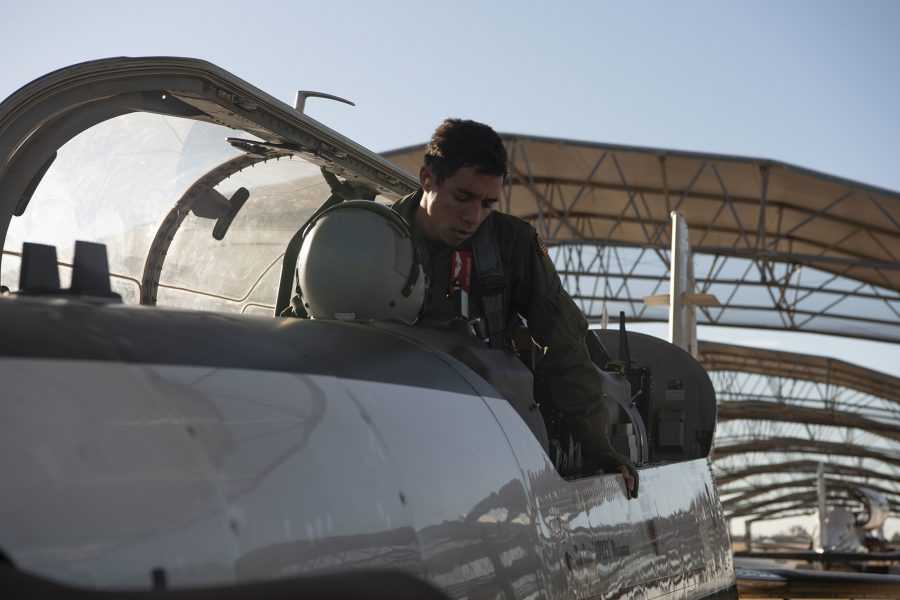
The Air Force graduated 1,518 new pilots in fiscal 2026, its most in 35 years, and Air Education and Training Command boss Lt. Gen. Clark J. Quinn credits the shift to a hybrid private/military training model for making it possible.
AETC announced in September it was on track to meet its 1,500-pilot goal by the end of the fiscal year on Sept. 30–Quinn confirmed it and gave the final total during a Nov. 16 event with AFA’s Mitchell Institute for Aerospace Studies.
Just under 1,000 of the 1,518 newly trained pilots are on Active Duty, Quinn said. “There’s Guard numbers in there, Reserve numbers, and there’s about 150 to 175 international training that falls under that [1,518] number as well.”
The last time the Air Force produced 1,500 pilots in a year was 1991, Quinn said. Back then, the service still had Reece Air Force Base, Texas, and Williams Air Force Base, Ariz., open, and “we also had about 200 more aircraft on the ramp,” he noted.
Over the last three and a half decades, AETC’s pilot production goal has fluctuated anywhere from 1,200 to less than 1,000, Quinn added. But in recent years, it’s returned to that 1,500 number, as the Air Force has tried to make progress on a pilot shortage that has proven stubborn.
“We can probably talk more about, is 1,500 the right number, but ultimately, if you’re going to look at healthy career fields, the number of [company grade officers] and [field grade officers]in all of these different platforms, that is where the 1,500 number comes from,” Quinn said.
In spring 2025, AETC announced a major overhaul of its pilot production pipeline, dubbed the Future of Undergraduate Pilot Training, or FUPT.
Under the new system, the Air Force offloads much of the basic, initial instruction to a commercial, university-based program, while retaining military-specific elements at Air Force training bases.
“Why did we do that? Well, we failed to make 1,500 for several years, and we realized that continuing to go down that path was probably going to continue with that same result,” Quinn said.
Critics have raised “valid questions” about the shift, Quinn said: “Oh really, Gen. Quinn, you’re the greatest Air Force in the world, and you had to go to civilian flight schools to make pilots?”
But Quinn made the case that the approach is more efficient.
The new construct gives flight students 120 flying hours over 139 days at one of four flying universities, in a course now called Initial Pilot Training, or IPT. Upon completion, students receive their private pilot licenses—with instrument and multi-engine ratings—under FAA Part 141 standards.
They then transfer to one of USAF’s four Undergraduate Pilot Training, or UPT, bases—Columbus Air Force Base, Miss.; Laughlin Air Force Base, Texas; Sheppard Air Force Base, Texas; and Vance Air Force Base, Okla.—where they can learn the skills necessary to be a military pilot like “low levels and formation and acrobatics and other skills that are not common across the world,” Quinn said.
The AETC commander presented the system as not only more efficient, but better for the larger Air Force.
“Do I want to take somebody out of a C-17 or an F-22 to teach somebody how to fly an [instrument landing system]? That is a basic skill that is universal across flying training,” Quinn said. “I don’t necessarily need to take one of my combat-ready people out of the line to spend doing that.”
He also harkened back to World War II-era programs like the Civilian Pilot Training Program that helped produce pilots for the military
“That’s exactly how we became the world’s greatest Air Force because that’s the partnership that we did throughout World War II, and we built up through civilian flight schools to get where we are,” Quinn said.
Regardless, now that the Air Force has hit its 1,500 mark, the question is how long it will take to start closing the pilot shortage, which officials said stood at roughly 2,470 pilots at the end of fiscal 2025. Training new pilots is only part of that equation, along with other long-standing issues like retention and absorption into operational units.
Gen. Adrian Spain, commander of Air Combat Command, said in September that it will likely take “at least” a decade to make a meaningful improvement in the pilot shortage.
“I think if we are disciplined about keeping production at 1,500 [per year] then in a decade, we’ll be in a much better place than we are today,” Spain told an audience at AFA’s Air, Space & Cyber conference.