
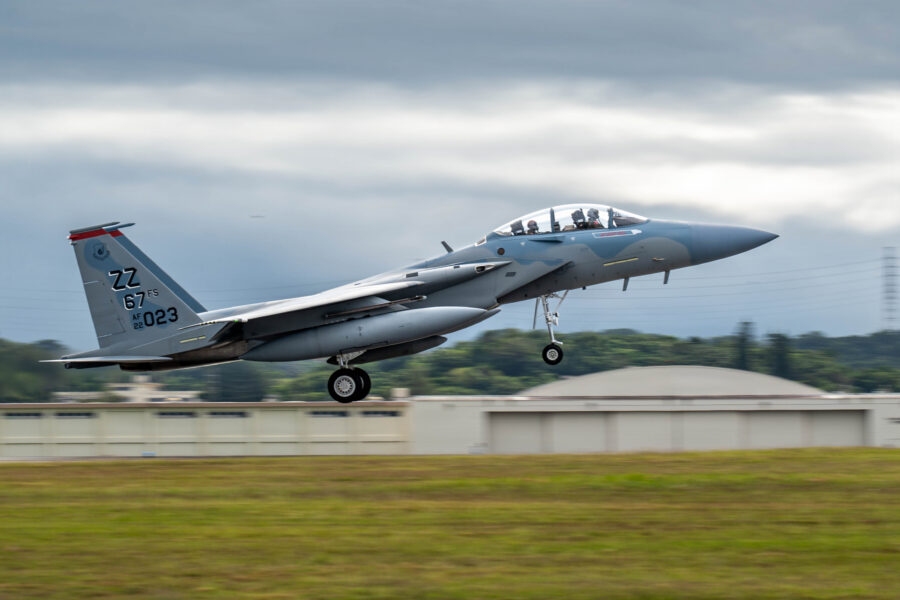
The arrival of the first permanently stationed F-15EX Eagle II at Kadena Air Base this week doesn’t just give the strategically vital base an advanced new fighter; it also signals a small step toward relieving pressure on the Air Force to keep rotating fighter units there, experts told Air & Space Forces Magazine.
For the last four years, the Air Force has sent a series of units flying F-35s, F-22s, F-16s, F-15Es, and F-15Cs to Okinawa to cover the operational gap left when it decided to withdraw the 18th Wing’s aging fleet of 48 F-15C/Ds, creating a “bathtub” effect while the wing waited for the F-15EX.
Rotational units came from Pacific Air Forces, Air Combat Command, and the Air National Guard. Many flew fifth-generation F-22s and F-35s:
The rotations won’t end right away—the 18th Wing isn’t scheduled to have its full fleet of 36 F-15EXs until 2028, and F-15Cs from the 159th Fighter Wing out of Naval Air Station Joint Reserve Base New Orleans, La, just arrived in October.
But the arrival of the first EX signals the end is in sight.
“More F-15EXs, getting them forward in Kadena is great news for the Air Force. It just can’t happen fast enough,” retired Gen. James C. Slife told Air & Space Forces Magazine.
Slife, former Vice Chief of Staff, said a full complement of F-15EXs will relieve pressure on U.S. Pacific Command and let it keep the squadrons it needs on mainland Japan and in Alaska for its far-reaching mission. It also free up units that could be tasked to other combatant commands as needed.
“In theory, it will make essentially two to three squadrons’ worth of capacity available for other taskings, whether it’s SOUTHCOM, AFRICOM, or CENTCOM,” Slife said. “We are starting now to grow the number of allocatable fighter squadrons.”
With the recent operational demands of the Iran war, finding any relief for the fighter community is key for an overtaxed force, Slife said.
Retired Lt. Gen. Joseph T. Guastella Jr. also noted that ending the rotations at Kadena will allow the fifth-generation fighter pilots that had been deploying to do the complex training they need at ranges where they can practice the competencies that make those aircraft such a threat to adversaries.
“It will unencumber the fifth-generation fighters that had been a rotational presence in there to do more high-end, advanced training,” Guastella, former deputy chief of staff for operations, told Air & Space Forces Magazine.
A deployed unit can’t train to the same level as one at its home station, where they have better ranges and training opportunities, he said.
“It’s the irony that by being forward deployed, you actually diminish your own readiness,” he said.
Additionally, both Slife and Guastella noted that permanently based fighter squadrons have more time and focus to build relationships with partners, such as the Japan Air Self-Defense Force, learn the area, and reinforce the deterrence effect such units have in locations so close to China.
In a larger context, Slife suggested that easing the burden of rotational deployments and allowing for more training and flying time could help with retention.
Rotational Units at Kadena
| Unit | Home Base | Aircraft |
|---|---|---|
| 525th Fighter Squadron, 3rd Wing | Joint Base Elmendorf-Richardson, Alaska | F-22 Raptor |
| 480th Fighter Squadron, 52nd Fighter Wing | Spangdahlem Air Base, Germany | F-16 Fighting Falcon |
| 355th Fighter Squadron, 354th Fighter Wing | Eielson Air Force Base, Alaska | F-35A Lightning II |
| 336th Fighter Squadron, 4th Fighter Wing | Seymour Johnson Air Force Base, North Carolina | F-15E Strike Eagle |
| 391st Fighter Squadron, 366th Fighter Wing | Mountain Home Air Force Base, Idaho | F-15E Strike Eagle |
| 144th Fighter Wing, California Air National Guard | Fresno Air National Guard Base, California | F-15C Eagle |
| 159th Fighter Wing, Louisiana Air National Guard | Naval Air Station Joint Reserve Base New Orleans, Louisiana | F-15C Eagle |
| 356th Fighter Squadron, 354th Fighter Wing | Eielson Air Force Base, Alaska | F-35A Lightning II |
| 34th Fighter Squadron, 388th Fighter Wing | Hill Air Force Base, Utah | F-35A Lightning II |
| 19th Fighter Squadron, 15th Wing | Joint Base Pearl Harbor-Hickam, Hawaii | F-22 Raptor |
| 199th Fighter Squadron, 154th Wing, Hawaii Air National Guard | Joint Base Pearl Harbor-Hickam, Hawaii | F-22 Raptor |
| 114th Fighter Wing, South Dakota Air National Guard | Joe Foss Field Air National Guard Station, Sioux Falls, South Dakota | F-16 Fighting Falcon |
| 148th Fighter Wing, Minnesota Air National Guard | Duluth Air National Guard Base, Minnesota | F-16 Fighting Falcon |
| 27th Fighter Squadron, 1st Fighter Wing | Joint Base Langley-Eustis, Virginia | F-22 Raptor |
| 77th Fighter Squadron, 20th Fighter Wing | Shaw Air Force Base, South Carolina | F-16 Fighting Falcon |
| 158th Fighter Wing, Vermont Air National Guard | Burlington Air National Guard Base, Vermont | F-35A Lightning II |
| 421st Fighter Squadron, 388th Fighter Wing | Hill Air Force Base, Utah | F-35A Lightning II |
| 177th Fighter Wing, New Jersey Air National Guard | Atlantic City Air National Guard Base, New Jersey | F-16C Fighting Falcon |
| 140th Wing, Colorado Air National Guard | Buckley Space Force Base, Colorado | F-16C Fighting Falcon |
| 90th Fighter Squadron, 3rd Wing | Joint Base Elmendorf-Richardson, Alaska | F-22 Raptor |
Deliveries and Quantities
The Nov. 15 delivery of the first combat-coded F-15EX to Kadena came about six months later than planned due to a late 2025 strike at the Boeing plant that makes the aircraft.
Since then, deliveries have resumed and are on schedule so far.
Lt. Col. Alli Stormer, 18th Wing spokesperson, told Air & Space Forces Magazine that “the F-15EX beddown is a phased transition, with additional aircraft arriving as production and operational requirements allow.”
Due to operational security restrictions, she could not provide exact details and timelines for the current quantity or arrival of future aircraft.
Boeing spokesman Josh Roth told Air & Space Forces Magazine that the company is working closely with USAF and the Pentagon to “ramp up F-15EX production.”
“We have completed all Lot 2 deliveries, and Lot 3 deliveries are underway,” Roth wrote in an email.
Recently, the company has expanded workforce training and increased its F-15 manufacturing footprint in St. Louis, Mo., the site of the previous strike, to meet the increased demand for F-15EXs.
The Air Force is expanding its planned F-15EX fleet from 129 aircraft to 267 aircraft. Some lawmakers in Congress have proposed legislation that would allow the service to expand even further, to as many as 329 F-15EXs.