
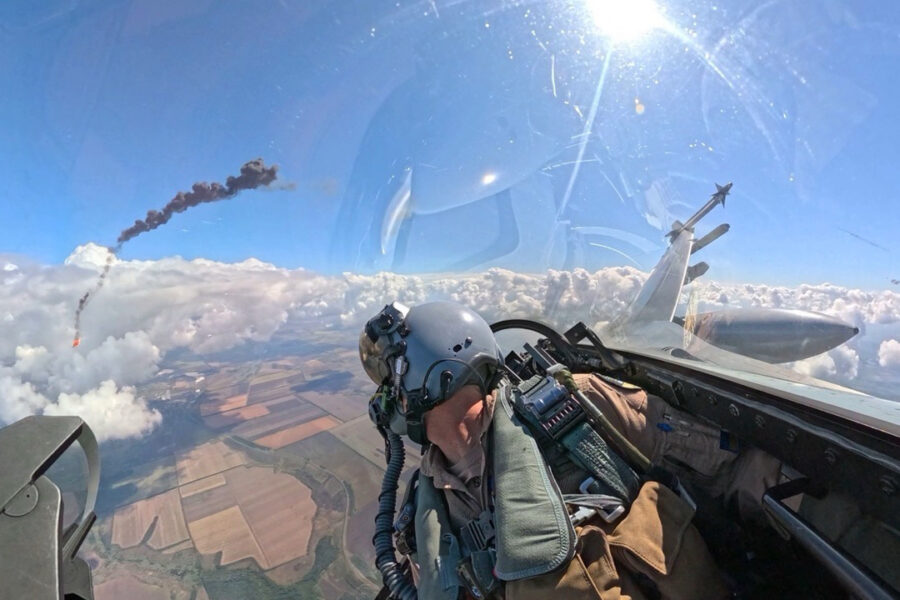
Ukraine’s fleet of F-16 fighters has played a vital role in protecting the country against Russian aerial attacks, including the jet-powered drones the Russians have used to try to overpower Ukrainian air defenses, senior Ukrainian officials said.
But Ukraine has a chronic need for spare parts to keep the venerable jets flying. It would also like to acquire more up-to-date F-16s to expand its air force.
“F-16s are super effective on the front line, super effective for the defense of Ukraine,” Ukrainian Chargé d’Affaires to the United States Denys Sienik told the Defense Writers Group on Nov. 5.
Ukraine flies older F-16s that have been donated by European countries—F-16AM/BM Mid-Life Update aircraft that were built decades ago.
They have received some upgrades since then, but they lack the modern APG-83 active electronically scanned array radars that can detect one-way attack drones more effectively, as well as other modifications such as advanced datalinks and more modern electronic warfare equipment.
Ukrainian F-16s have scored 4,700 shoot-downs of Russian one-way attack drones, 1,100 of which took place in October, a Ukrainian government spokesperson said at a separate event Nov 5. To knock out the drones, Ukrainian pilots have mainly relied on the F-16’s 20mm gun.
“Even those F-16s older versions, Block 30s, that we have are super effective at intercepting jet-powered drones, in particular, that are flying 400 kilometers, that are basically cruise missiles,” said Sienik, who is currently serving as Kyiv’s most senior diplomat in Washington.
But maintenance and sustainment are a problem. Roughly half of Ukraine’s F-16s are spending time undergoing maintenance and repairs in Europe at any given time, according to Ukrainian President Volodymyr Zelenskyy.
That means the Ukrainian government has been on a continual quest to acquire the spare parts to keep its warplanes flying.
“We have grounded aircraft. They need to be repaired, and the answer is that—everyone knows this—we are looking for spare parts now,” said Sienik, who said he has discussed the issue with F-16 maker Lockheed Martin. “That’s the priority for us. Not only to find new F-16s, but actually the spare parts for them.”
Seinik said Ukraine would like to eventually acquire the newer variants—such as the current Block 70/72—rolling off the factory line but acknowledged that it would require approval from President Donald Trump’s administration.
Because the jets are American-made, the U.S. government needs to sign off on their use by Ukraine, a decision former President Joe Biden’s administration initially resisted after Russia’s full-scale invasion in February 2022 but eventually made in mid-2023 when it allowed allies to transfer F-16s from their inventories and trained some pilots in the U.S.
The first F-16s arrived in Ukraine in 2024, and Ukrainian officials say they need more.
“Newer versions, definitely yes,” Sienik said. “All that is missing is the political decision. I will tell you even more. It’s not even more about money. We will find money. Not us, our partners.”
Ukraine also plans to field Mirage 2000s and Swedish Gripens as it transitions from a Soviet-style to a Western air force.
Ukraine is also facing a shortage of air-to-air missiles, which are pricy. That has forcing Ukrainian pilots to rely on the F-16’s 20mm Vulcan cannon. Other fighter types are also resorting to tricky attempted gun kills.
Denmark recently donated more than 50,000 rounds of 20mm F-16 ammunition to Ukraine, though with winter approaching and Russia stepping up its drone and missile attacks, that is likely to just prove to be a stopgap.
Airpower experts say Ukraine’s air force also needs key enabling equipment such as airborne early warning aircraft, effective and numerous ground-based air defenses, inexpensive interceptors, protected infrastructure, command and control, and more.
“The Ukrainian Air Force is not confronting a single threat,” retired Lt. Gen. David A. Deptula, dean of AFA’s Mitchell Institute for Aerospace Studies, wrote in Air & Space Forces Magazine in September. “Its pilots face an extraordinarily complicated mixture of slow propeller-driven drones, faster jet-powered Gerans, cruise missiles, Russian fighters, long-range surface-to-air missile systems, electronic warfare, and dense ground-based air defenses.”
“The next chapter is about whether Ukraine’s wartime collection of fighters evolves into the sustainable, technologically modern, and fully integrated air force it needs, with the capacity to defend its airspace for decades—and carry the fight to the aggressor if required,” Deptula added.