
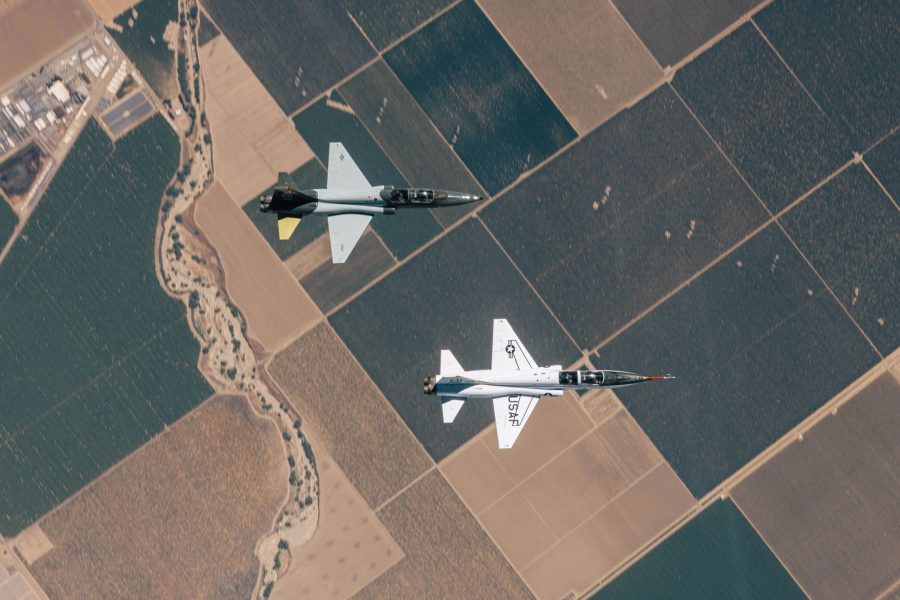
The Air Force will keep flying its 1960s-era T-38C Talon trainer into the late 2030s, the head of Air Education and Training Command said Nov. 16. The T-7A Red Hawk is making progress, but slowly, as its replacement.
Lt. Gen. Clark J. Quinn confirmed the T-7 is scheduled to achieve initial operational capability next August, but noted “there is risk to making that date” and that it will take years to acquire enough T-7s to fully phase out the T-38, among the oldest and largest fleets in the Air Force inventory.
The first T-38 flew in 1961, and the fleet of 490 trainer jets now averages nearly 60 years old.
USAF leaders have worried for years about the Talon’s rising age and declining reliability. Quinn confirmed that T-38s are mission capable only half the time, and said that won’t improve as the fleet ages “based on the fact that it’s 65 years old, it’s not in production, we are overhauling the same engines over and over again.”
Though engine problems limited T-38 availability recently, Quinn said most of those issues are resolved.
“It’s going to be flying until 2037 or 2038, doing pilot training missions, which sounds fantastically far away, and it is,” Quinn said. “But we believe the aircraft will will make it. There’s always the black swan event that nobody can predict, but I’m just hopeful. We don’t have any indication that that’s going to be out there.”
Earlier this year, the Air Force awarded contractor Boeing a $900 million contract for T-38 avionics sustainment through March 2036.
The Air Force plans to buy more than 350 T-7 Red Hawks, but getting to a high production rate is taking time. The plane only just moved the T-7 into low-rate initial production in May. For fiscal 2027, the Air Force budget request includes 23 T-7s, though projections show that ramping up to 60 by 2030.
Meanwhile, as the T-7 comes on line, some of the T-38s will retire. There are 490 T-38s in the inventory now, and the Pentagon’s report on force structure changes in the 2027 budget, released in May, shows plans to retire 157 Talons over the next five fiscal years, ramping up from just one in fiscal ’27 to 82 in 2031.
T-7 Progress
Quinn praised the the T-7 in comparison to the older jet. “That T-38 is a 1950s design,” he said. “It was built to teach people how to fly Century Series fighters. I never have flown an F-100, but I understand it’s pretty difficult to fly. So we had to create a training aircraft that built those skills. None of our airplanes today fly like a Century Series fighter. … Managing the systems, managing the amount of information that comes in, processing it, and making a decision is something that I need our pilots to know.”
The T-7 is designed to simulate the information load pilots experience flying modern aircraft. Recalling a flight he took with the T-7 several months ago, Quinn noted “my second landing in the T-7 was probably better than my average landing in the T-38. It was just a relatively easy-to-fly airplane. There actually was a part of me that thought maybe this is too easy to fly.”
The real challenge, he noted, will be teaching students how to make decisions midflight and manage their many sensors, weapons, and other systems.
To get to that point, though, AETC needs jets. It has just three T-7s so far, To reach IOC, Quinn laid down three conditions:
- 14 aircraft
- 14 certified training instructors
- Expanded flight envelope for the aircraft
Right now, one aircraft is not flying because it is being used to train maintainers. More deliveries will enable more flying and testing, and more testing will open up the flight envelope, as Air Force Materiel Command and the Air Force Test Center validate the aircraft’s performance. A greater flight envelope is necessary to fully certify training instructors.
“There really is no mission or instructor check yet. That’s something that needs to be built,” Quinn said. “So I do have eight pilots that are qualified to fly it, but that’s not really a mission representative sortie yet. Still waiting on some of the the flight envelopes and a few more aircraft before we’re going to start getting into that.”
Through developmental testing, the flight envelope is expanding, Quinn said, “incrementally every day.”