
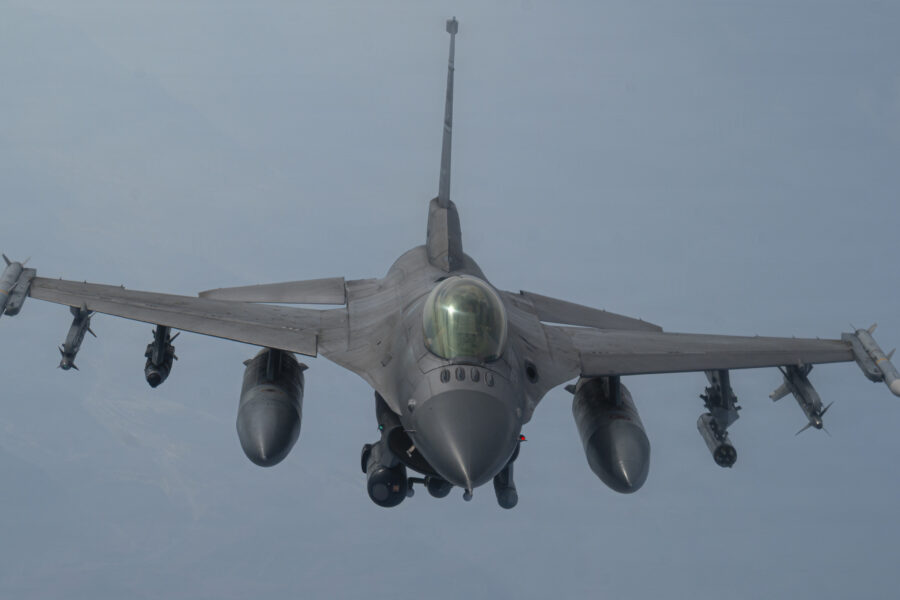
U.S. fighter jets struck an Iranian missile launch site operated by Iran’s Islamic Revolutionary Guard Corps Nov. 17 in “self-defense,” a U.S. military official told Air & Space Forces Magazine. The latest strike comes after Iran renewed its attacks on Gulf state bases and commercial shipping in recent days.
“The strike was in response to IRGC aggression targeting U.S. personnel and assets,” the official added.
Using precision-guided munitions, fighters targeted the site on Qeshm Island, which hosts Iranian military sites and has been a frequent target of U.S. attacks, the official said.
The island sits in the Persian Gulf just outside the critical chokepoint of the Strait of Hormuz, where Iran has repeatedly attacked commercial shipping since the U.S.-Iran war began in February, seeking to impose economic and diplomatic costs on the U.S. and its partners.
The strikes came after Iran launched an attack on facilities used by U.S. forces in Bahrain and claimed to hit a radar site at Isa Air Base. U.S. Central Command acknowledged the incident but said it was thwarted. Multiple Iranian one-way attack drones launched towards Bahrain “were intercepted without any damage to U.S. equipment or injury to American personnel,” CENTCOM wrote in a social media post. The Bahrain Defense Force also said the drones were “intercepted and destroyed” before reaching their target.
Iran also claimed it downed an U.S. MQ-1 drone in the latest exchange of hostilities, an assertion that has not been independently verified. Iran has downed around 50 American MQ-9 Reaper drones and several MQ-1 remotely aircraft since the U.S. and Israel began hostilities on Feb. 28, people familiar with the matter told Air & Space Forces Magazine.
The U.S. has been conducted a series of limited airstrikes on Iran since early September that were not publicly announced, Air & Space Forces Magazine previously reported. Those attacks have been limited in nature and have included targets such as air defenses and other facilities—similar to the latest U.S. strike.
Several tankers have been attacked near the Strait of Hormuz in recent days, and a liquefied petroleum gas tanker exploded after being attacked Nov. 16.
The strikes come as the U.S. has now deployed more airpower to region with the arrival of third aircraft carrier. The USS Theodore Roosevelt and its embarked carrier air wing with squadrons of fighters and other aircraft are now operating in the Middle East, CENTCOM announced Nov. 16, joining the USS George Washington and USS George H.W. Bush. Dozens of Air Force fighters, including F-35 Lightning II, F-16 Fighting Falcons, F-15E Strike Eagle, and A-10 Thunderbolt II squadrons, are also deployed to the region, as are Marine Corps warplanes, including F-35s, operating from land.
The U.S. military has engaged in smaller-scale strikes during tit-for-tat exchanges since an April ceasefire that ended the all-out U.S. and Israeli strike campaign, Operation Epic Fury. Since then, the U.S. has maintained firepower in the region as part of a military pressure campaign and blockade of Iranian ports.
U.S. officials have explored diplomacy with Iran in past months, though the two sides’s positions appear to be far apart. Earlier this month, President Donald Trump announced on Truth Social that he was pulling Vice President JD Vance off Iran talks, saying the U.S. no longer needed a deal with Iran.
During a Nov. 16 appearance on Fox News, Vance said that “whatever [Trump] ultimately decides to do, however he ultimately decides to bring the conflict to a close, he is not going to let this become a forever war.”
The Trump administration is still trying to maintain economic pressure on Iran by maintaining a blockage, tightening sanctions against Iran, and attempting to help commercial shipping pass through the Strait of Hormuz.
“U.S. Central Command remains highly vigilant and fully postured to protect Americans across the region,” the military official said.