
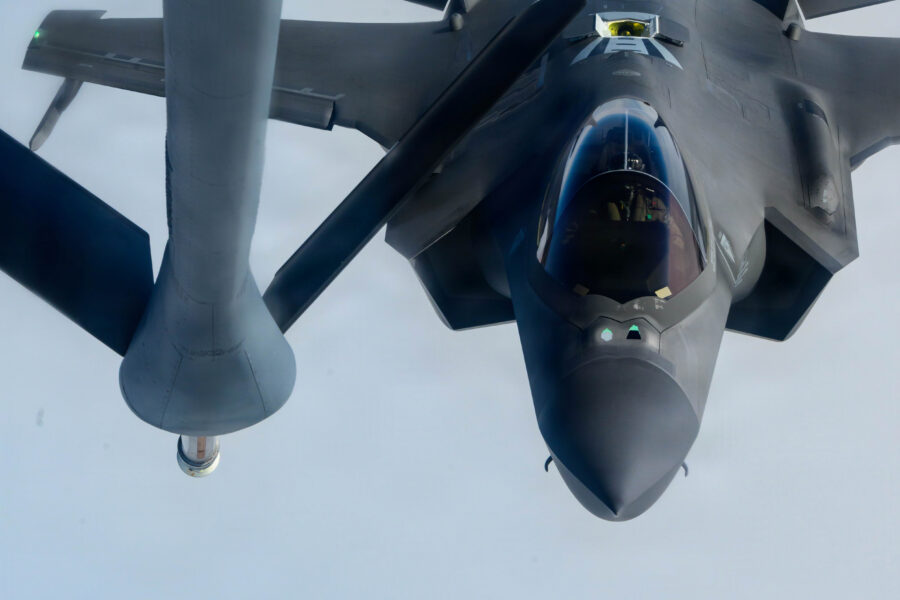
The Senate Appropriations Committee takes a hard line with Air Force programs in its planned defense bill, refusing to back multiyear procurement for the F-35A and F-15EX, among other programs, and funding fewer fighter jets, advanced semi-autonomous drones, and development funds for the Air Force’s future F-47 fighter.
The bill would add five F-35A fighters to the administration’s base budget proposal for a total of 29 Lightning II jets in fiscal 2027, and reduces by 25 percent the Air Force’s planned buy of F-15EX Eagle II fighters, cutting it from 24 to 18 aircraft.
Senate appropriators on Nov. 16 released a nearly $1.1 trillion budget bill for the Defense Department, among its last five 2027 appropriations bills. The defense measure adds $69 billion over and above the base budget, but falls far short of President Donald Trump’s $1.5 trillion goal.
The White House asked Congress last spring to fund a $1.5 trillion Pentagon budget, divided between a “base” appropriations bill of $1.15 trillion and a separate $350 billion reconciliation bill. With the Democrats’ overwhelming electoral victory earlier this month, however, that two-stage, $1.5 trillion budget plan is now all but dead.
For the Air Force, the result is 15 fewer new fighter jets than requested—just 47 total new Air Force fighters in 2027—well short of the Air Force’s stated goal of acquiring 72 new fighters annually.
The proposed budget includes $11.1 billion for USAF, Navy, and Marine Corps F-35 accounts, including new procurement, modifications, and sustainment. It also includes $2.9 billion for F-35 research, development, test, and evaluation. Increasing the base budget to fund five more F-35As added $704 million to the total.
Senators largely offset the funds for more F-35As by cutting six F-15EX jets from the base request, a saving of $618.7 million. That leaves just over $2 billion to buy 18 Eagle IIs in 2027. At the same time, the committee would add $245 million for advance F-15EX funding, without specifying how that would be spent.
Notably, the Senate bill denies the Pentagon’s request to sign multi-year procurement deals for F-35 and F-15EX fighters, the Joint Advanced Tactical Missile, Lower Tier Air and Missile Defense Sensor, and the Air-Launched Rapid Response Weapon Increment 1 hypersonic program.
In an explanatory statement accompanying the bill, the committee said it denied those requests because the budget proposal either “did not request sufficient fiscal year 2027 discretionary funding, the program is not adequately funded over the [Future Years Defense Plan], or the program has not proven an ability to manufacture at scale.”
The committee did approve multi-year procurement authority for the KC-46 Pegasus refueling tanker, and the Guided Multiple Launch Rocket System program.
The revised Senate budget would cut $603 million from the Air Force’s proposed R&D spending on the next-generation F-47 fighter, from $5 billion to $4.4 billion.
It would also significantly cut proposed spending on the Air Force’s semi-autonomous Collaborative Combat Aircraft, one of the service’s top priorities. The Pentagon originally asked for $1.37 billion for CCAs in its budget, but the Senate revision would nearly halve that to $711 million.
The Air Force originally asked for more than $996 million in procurement funds to buy CCAs in 2027, plus another $150 million for further purchases in fiscal 2028. The Senate’s revised budget would cut 2027 procurement funding to nearly $848 million, and 2028 advance spending to $120 million.
The Senate appropriations bill would slash $164 million in advanced development and prototyping funds from the CCA program, from $214 million down to nearly $50 million. Budget documents said that spending was “misaligned acquisition phasing”
Senate appropriators’ budget would also:
- Provide a $205 million increase in discretionary funds to the original budget request to fully fund Lot 6 of the F-35’s upgraded APG-85 radar
- Add $223.7 million for sustainment
- $300 million more for spares and repair parts
- $243.8 million more to fully fund the F-35’s Engine Core Upgrade program
- $89.8 million to fully fund the Power Thermal Management Upgrade program, and
- $500 million to fully fund Block 4 upgrades