
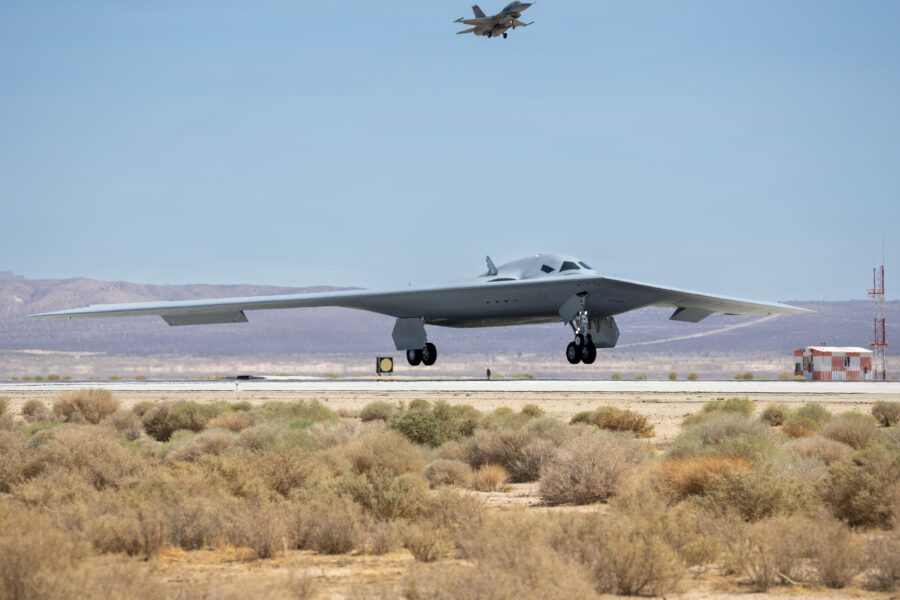
The B-21 Raider this month conducted a weapons release test for the first time, the Air Force and manufacturer Northrop Grumman said Nov. 13.
The weapons release, which took place the first week of November, marks the aircraft’s transition from a flight test aircraft to a functional weapons platform, the service said in a statement. Northrop Grumman, in its own statement, said it advances the bomber into the weapons testing phase.
The Northrop-made B-21 is the Air Force’s newest stealth bomber and the service’s first new bomber in more than three decades. Its advancements in stealth capabilities, open systems architecture, advanced sensors, and data-sharing capabilities have led the Air Force and Northrop to tout the Raider as the world’s first sixth-generation aircraft.
The Raider will be able to fly long distances before needing to be refueled, can carry both conventional and nuclear weapons, and carry out penetrating strikes into enemy territory.
In the early November test, a B-21 took off from Edwards Air Force Base, Calif., and released a conventional weapon, the Air Force said in its statement, without specifying what the weapon was.
That test was successful, the service said, “validating its digital models and the maturity of its open systems architecture” and proving its strike capability. The test also showed the Raider can rapidly take on new weapons, “and solidifies its role as the future backbone of the U.S. bomber fleet.”
“The B-21 is designed to deliver improved combat capability to the warfighter, combining reliability and maintainability to quickly integrate new weapons,” Air Force Secretary Troy Meink said in a statement. “This successful test demonstrates our ability to adapt rapidly and hold any target at risk if deterrence fails.”
The Air Force said this test came after thousands of hours of virtual modeling with the B-21’s digital twin, which allowed the bomber’s Combined Test Force to speed up weapons integration. It also allowed the test force to “predict and refine the weapon’s trajectory with unparalleled precision before the aircraft ever left the ground.”
Northrop Grumman, in its own release, also praised the B-21 Combined Test Force’s “sustained rapid test pace and progress.”
“B-21 is another step closer to giving the U.S. unrivaled deterrence,” Tom Jones, president of Northrop Grumman Aeronautics Systems, said in the company’s statement. “Northrop Grumman is turning advanced technology into real capability and delivering with both performance and speed.”
The Air Force and Northrop Grumman said the first operational B-21 is on track to arrive at Ellsworth Air Force Base, S.D., in 2027.
Northrop also said the B-21 program is working to accelerate its production and test capabilities to lay the groundwork for the Ellsworth arrival.
Northrop Grumman said it recently opened another B-21 manufacturing facility in Layton, Utah, with 265,000 manufacturing square feet. It also has broken ground on a assembly line facility with 1 million square feet at Plant 42 in Palmdale, Calif.
“These facilities—and more to come—show how Northrop Grumman is moving with speed to meet the Air Force’s directive to accelerate B-21 production and delivery capability to the field,” Northrop said.
Northrop Grumman said the B-21 has “exceptional payload flexibility” allowing commanders to tailor the bomber’s weapons loadout to specific missions, such as long-range strikes or operating in heavily contested enemy airspace.