
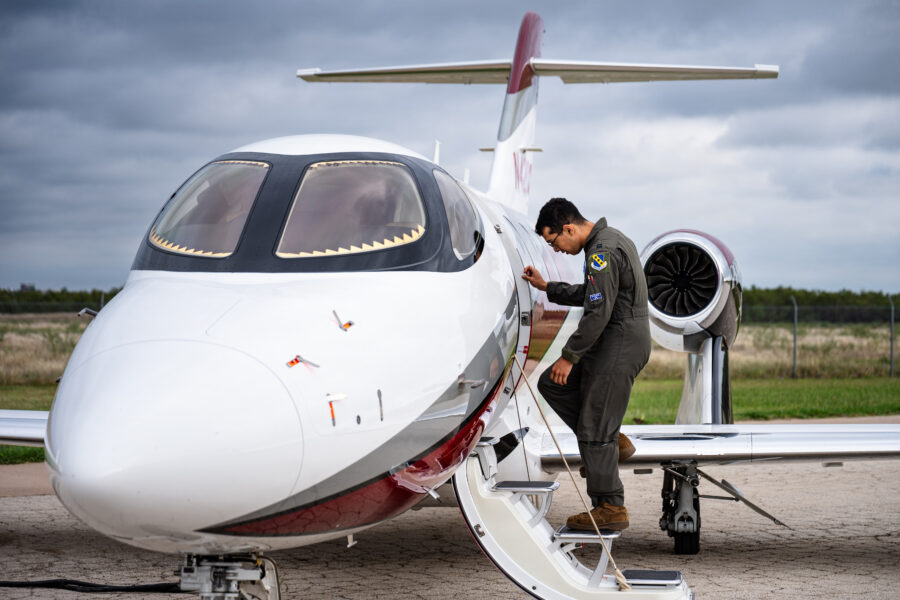
B-1B Lancer pilots can now train using light business jets to hone their flight skills under a new program Air Force Global Strike Command is testing.
The new initiative, dubbed the Bomber Supplemental Trainer for Aircrew Readiness, or BSTAR, program, gets B-1 pilots more flight time by getting them into contractor-owned light business jets near Dyess Air Force Base, Texas, the Air Force said in a Nov. 5 statement. That way pilots get air time, while their bombers are reserved for mission-specific training requirements. The change saves money and maintenance, the Air Force said.
“I want our pilots flying as much as possible,” said Col. Robert Sturgill, Dyess’s commander and head of the 7th Bomb Wing. “Every additional hour they spend in the air builds experience they bring back to the B-1. BSTAR gives us that opportunity without taking away from the training they need in the bomber.”
The BSTAR program uses HondaJet HA-420 aircraft owned and operated by XSTAR Aviation, which also provides instructor pilots, maintenance, and scheduling services. The flights take off from and land at Abilene Regional Airport, near Dyess.
The Honda jets have a wingspan of just 40 feet and weigh under 8,000 pounds, a small fraction of the size of a B-1 bomber. But pilots can still benefit from practicing fundamental skills, such as instrument procedures, mission planning, aircraft handling and crew resource management, the Air Force said. The flights will be in addition to flying time in the B-1 Lancer, providing each participating pilot about 100 more flying hours per year, the Air Force said.
“B-1 sorties remain essential for developing proficiency in mission-specific tasks, including aerial refueling, tactical employment and weapons delivery,” the Air Force’s statement said.
The BSTAR program kicked off Nov. 2 with an inaugural military training flight by a Dyess B-1 pilot, the Air Force said. On Nov. 4, Global Strike Commander Gen. S.L. Davis and Major Gen. Ty Neuman, commander of the Eighth Air Force and Joint-Global Strike Operations Center, followed up with in their own observer flights.
“Combat-ready aircrews are built on foundational airmanship, sound decision making, and time in the air,” Davis said in the statement. “We expect BSTAR’s innovative approach will allow us to better develop and experience our pilots by providing additional flying opportunities that complement the specialized training they receive at a much lower cost.”
The Air Force said it plans to closely track sorties during BSTAR’s prototype period and use feedback from air crews to refine flight profiles and evaluate how effective the training is. Global Strike will use those findings to decide whether to keep using supplemental flight training to develop B-1 aircrews.
“Our B-1 aircrews must be prepared to execute complex missions that demand precision, discipline and sound judgment,” Neuman said. “BSTAR increases airmanship, which translates to safer, more effective and lethal B-1 operators, while preserving B-1 flight hours for our specialized, mission-specific training.”