


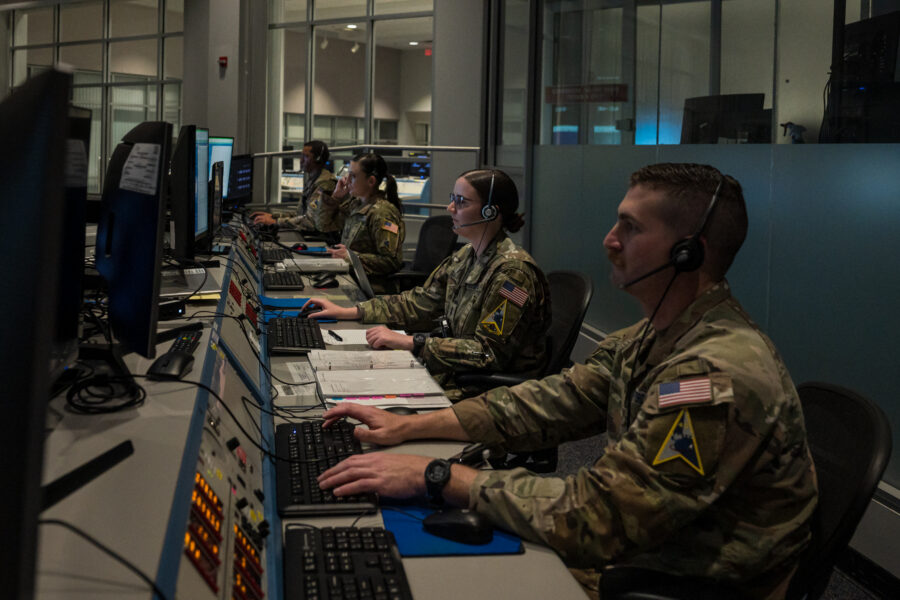
The Space Force is requesting $1 billion in fiscal 2027 to build four space operations centers around the country, part of a broader push to build up the service to match growing demand for space capabilities.
The expansion is intended to support resilient operations for space control, space-based sensing and targeting, and data transport, Maj. Gen. Frank Verdugo, deputy assistant secretary of the Air Force for budget, said in an April 21 budget briefing.
Because the Space Force doesn’t have its own military construction budget, the funding is included in the Air Force’s request. The four operations centers would cost $250 million each and be built at:
- Kirtland Air Force Base, N.M
- Redstone Arsenal, Ala.
- Schriever Space Force Base, Colo.
- Grand Forks Air Force Base, N.D.
The new ops centers will bring “resiliency through distribution,” a Department of the Air Force spokesperson said, eliminating single points of failure.
“They will ensure we maintain our competitive advantage and meet critical deployment timelines for new weapon systems and support additional training throughput requirements to grow the force,” the spokesperson told Air & Space Forces Magazine.
The funding request covers both the cost of the buildings and temporary facilities while operators await completion of the projects.
The request comes as the Space Force prepares to double in size over the next few years. In addition to the personnel and funding needed to enable that growth, service officials say infrastructure is also a high priority.
Speaking April 1 at the Mitchell Institute’s Spacepower Forum, Lt. Gen. Doug Schiess said the service has “maxed out” its capacity at Schriever and needs to make room at other installations for operations centers. While that need is driven in part by space constraints, it’s also a resiliency issue, he said.
“One of the things that we’re looking at is, from a resiliency perspective … we have some operation centers that have backups,” Schiess said. “We’ve talked about some at contractor facilities, but we just need to make sure that we have more resiliency and where we do operations from and and where we go with new programs and things like that.”
Charles Galbreath, director of the Mitchell Institute’s Spacepower Advantage Center of Excellence and a former space operator, said expanding missions and demands require more people and workspace.
“It’s not just a light switch that you say, ‘OK we’re now double the people,'” Galbreath said. “You’ve got to double the size of the facilities, potentially, and the ops locations to execute the mission, and then also expand the training pipelines to allow for that growth to effectively matriculate into the service.”
The Space Force plans to spend $3.5 billion over the next few years to address its construction requirements, which amount to more than 50 projects including the four new operations centers, the spokesperson said. Other needs include facilities to support commercial partners, the person said, without expanding on specifics.
“There is a deliberate plan to invest in the combat units, global posture, and advanced training necessary to deter conflict and secure our nation’s interests in space,” they said. “Investment directly enhances warfighting advantage and integrates space capabilities across the Joint Force.”
Alongside the operations centers, the fiscal ‘27 budget requests funding to improve the Space Force’s launch ranges through an effort known as Spaceport of the Future, and includes $600 million to support U.S. Space Command’s headquarters move from Peterson Space Force Base, Colo., to Redstone Arsenal in Alabama. The command announced April 15 that a cadre from its Joint Intelligence Support Element have already relocated, and it expects a total of 200 personnel to transfer this year.