
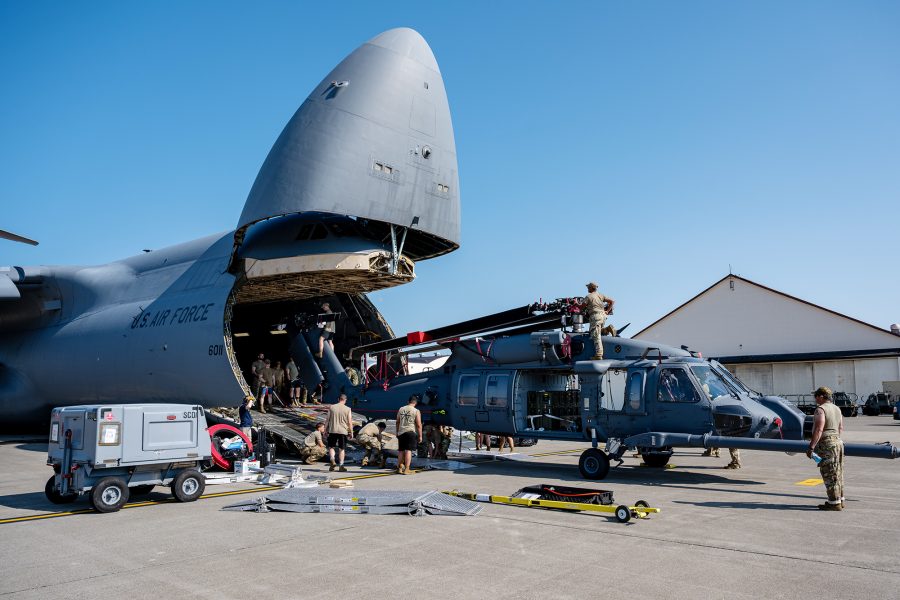
Air Force Chief of Staff Gen. Kenneth S. Wilsbach told lawmakers Apr. 30 that the service’s biggest airlifter, the C-5 Galaxy, has a 37 percent mission capable rate—one of several challenges facing the mobility fleet.
Mission capable rates are one of the best-known metrics for aircraft availability. Aircraft are deemed mission capable when they are able to perform at least one of their core missions. In fiscal 2024—the last year the Air Force publicly released rates—the Vietnam War-era C-5’s rate was 49 percent.
Wilsbach said the decline in the C-5’s rate is one of the reasons the Air Force requested $24.7 billion in its fiscal 2027 budget for aircraft sustainment.
“That dollar figure will allow us to buy the parts and maintain those aircraft and bring the availability up,” he said.
During the hearing, committee members questioned Wilsbach and Air Force Secretary Troy E. Meink about Air Force efforts to modernize its mobility and tanker fleets, which have operated at a high tempo during Operation Epic Fury.
Rep. Harold Rogers (R-Ky.) asked about the status of the Next Generation Airlifter, or NGAL, program and questioned whether the Air Force is moving forward with replacing the C-5 and the C-17 Globemaster III or “simply managing the decline of a critical capability.”
Meink said the Air Force has “finished some of the analysis on what that next generation system is going to look like” and extended the C-5s “out through 2040.”
“At that point, we intend to start replenishing those aircraft first, and then following that, we will go into replenishment of the C-17s, which are in very good condition right now,” Meink said.
In addition to the $24.7 billion in the budget for the Weapons Systems Sustainment account, Wilsbach said the 2027 budget request includes more than $4 billion for the Working Capital Fund, so the service can buy the critical spare parts needed for repair work and maintenance on the C-5s, C-17s and other aircraft at the completion of Epic Fury.
“We’ll bring those aircraft back, we’ll refurbish them to extend their lifetime,” Wilsbach said. “I wouldn’t categorize our mobility force as declining, but rather sustaining.”
In February, Air Mobility Command interim boss Lt. Gen. Rebecca J. Sonkiss said “there is no other aircraft that can do what the C-5 does,” but figuring out a pathway to replacing the Galaxy and C-17 fleets with the NGAL will be “key to the readiness for the joint force.”
While responding to a tanker modernization question from Rep. Chuck Fleischmann (R-Tenn.), Wilsbach noted that the budget request also includes $105 million for updating the battlefield connectivity of the tanker force “so that they have a similar data link network that we have in our fighters.”
Modernized connectivity is another problem area for the mobility and tanker fleets that Sonkiss has highlighted. The Air Force has been “woefully negligent … way too long” by failing to invest in connectivity for the air mobility and tanker fleets, she has said.
While much of the focus on tanker modernization has been on the proposed Next Generation Air refueling System, Sonkiss has also argued for improving the survivability of existing aircraft. “There’s various ways to get after survivability,” she told reporters in February. “It starts with being connected so that you have battlespace awareness.”
Fleischmann wanted to know how the Air Force is ensuring its tanker fleet has the capacity for a sustained conflict in the Pacific.
A congressional mandate in the fiscal 2026 National Defense Authorization Act requires that the service have 478 tankers in fiscal 2027 and reach 502 by the start of fiscal 2029. Fiscal 2027 documents released in April indicate the Air Force has roughly 475 tankers—370 KC-135 Stratotankers and 105 KC-46 Pegasus refuelers.
“We have a number that we’re supposed to meet this year of 478, which we will do,” Wilsbach said. “And we are working our way with this budget, and perhaps future budgets, to get to 502.” The Air Force is requesting $3.9 billion to buy 15 KC-46s and service expects to receive 20 Pegasus aircraft in 2027 as part of its existing contract with Boeing.
