


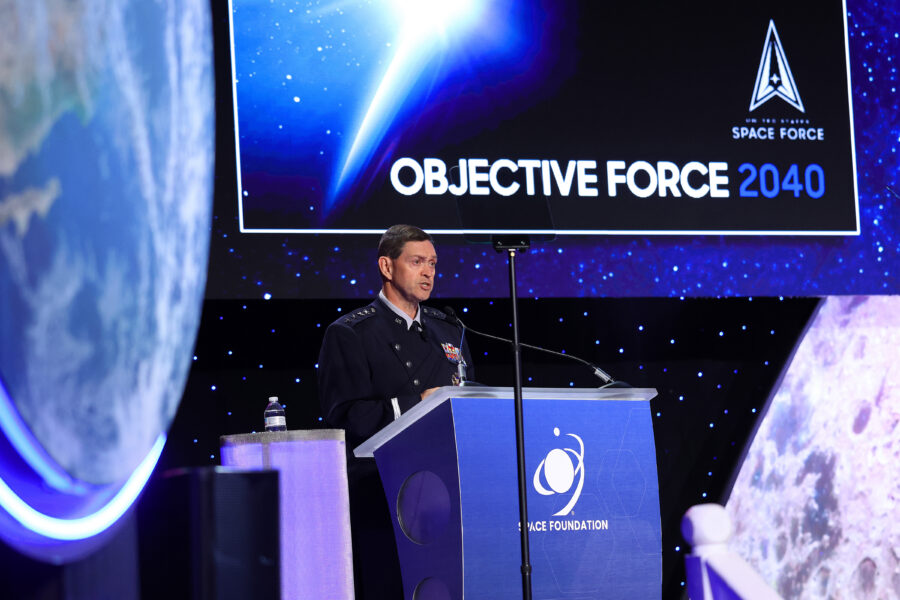
COLORADO SPRINGS, Colo.—The Space Force on April 15 released two highly anticipated future-casting documents that describe what the service expects the space environment will look like in the year 2040 and lay out the force structure it thinks it will need to operate in that environment.
Combined, the “Future Operating Environment” and “Objective Force” visions offer insight into how the Space Force expects on-orbit threats and enabling technology to evolve over the next 15 years and a roadmap for how it will meet that change. In a speech at the Space Symposium here, Chief of Space Operations Gen. Chance Saltzman cautioned an audience comprised of industry and international partners as well as Space Force Guardians and civilians to view the documents as the start of a conversation rather than a definitive strategy or intelligence assessment.
“I ask you to read it critically, debate our assumptions, and then offer suggestions to help us build a stronger Space Force for the future,” he said. “The aim here is to drive questions, not provide answers. Because this approach is visionary and predicting the future is tough, we will certainly get some things wrong. But on the new battlefield it describes, one reality becomes clear: The Space Force we have today is not the Space Force we need to secure the future domain.”
The Future Operating Environment, a 68-page document, predicts that by 2040, the U.S. will be operating more than 30,000 satellites, and that technologies like AI, quantum sensors and radars, and reusable rockets will reshape the space domain.
From a threat perspective, the Space Force argues that without investments in key technologies and sustained Space Force growth, the U.S. could face persistent electromagnetic and cyber attacks as well as “covert interference” in orbit. China has the means and the will to field distributed architectures and harness AI for rapid decision-making in that timeframe. In that scenario, continuous disruption—including spoofing and jamming—could make U.S. kill chains “brittle,” giving commanders less confidence in space-enabled networks.
But with the right resources and priorities over the next 15 years, the Space Force can monitor, shape, and control the environment, the document contends. It can partner with allies to maintain credible capabilities in space and counter attempts by China and Russia to blind its sensors. And it can build a space architecture that serves to deter aggression from adversaries.
“Failure means our adversaries will not just close the gap—they will leave us behind,” the document states. “Success will ensure the United States stays ahead and that our spacepower will always provide an offset. Success means that the Space Force dominates the domain in the long tradition of overwhelming American firepower.”
The Space Force’s “Objective Force” document offers a mission-by-mission snapshot of where the service should invest to avoid the “failure” described in its sister document. The objective force is meant to be conceptual and a complement to current space system inventories and those that are included in today’s budgets and align with current priorities.
“The Objective Force is more conceptual in nature, describing the broader force design the Service must pursue over a much longer time horizon,” the document states. “It describes the potential Space Force: the force it must become to fight and win in the future operating environment.”
The missions listed in the unclassified version of the document include: space control, missile warning and tracking, navigation warfare, satellite communications, space-based sensing and targeting, and space access. Saltzman told reporters the classified annex explores other areas like electromagnetic warfare and orbital warfare.
Of the mission-area roadmaps, Saltzman highlighted navigation warfare, which includes GPS satellites, ground systems, and user equipment. Recognizing that today’s GPS enterprise wasn’t designed to operate in a contested environment, the objective force calls for more augmentation systems from allies and commercial partners and says the service should add a second “NavWar” squadron with its own operations center.
It also says the service should pursue lower cost, simplified satellites in the near term and a more resilient “Gen 4” PNT system to be delivered in 2040.
“Combined, this family of systems ensures a secure, U.S.-controlled foundation for global PNT,” the document says.
On top of that “sovereign” PNT layer, the service should integrate commercial navigation services as well as signals from allied constellations like Europe’s Galileo and Japan’s Quazi-Zenith Satellite System.
Within the SATCOM portfolio, the objective force lays out the service’s plan to integrate the service’s communications systems as part of a new Space Data Network. Like navigation warfare, the architecture would include a commercial layer and a government-owned layer as well as an open architecture. The SDN will also require an orchestration function to automate and scale network services across the network.
“Moving forward, the SDN enables flexibility at the user level to connect to legacy services with singularly scoped and designed receivers or to adopt a more modern approach that leverages more spectral bandwidth and the ability to switch between allocated frequency bands,” the document states.
Saltzman noted that this foundational work to describe the objective force is just the beginning.
“Defining our future force is only the first step to making this force design a reality—and doing it fast enough to meet emerging threats over the next 15 years requires a generational shift in how we acquire and field new systems,” he said.