
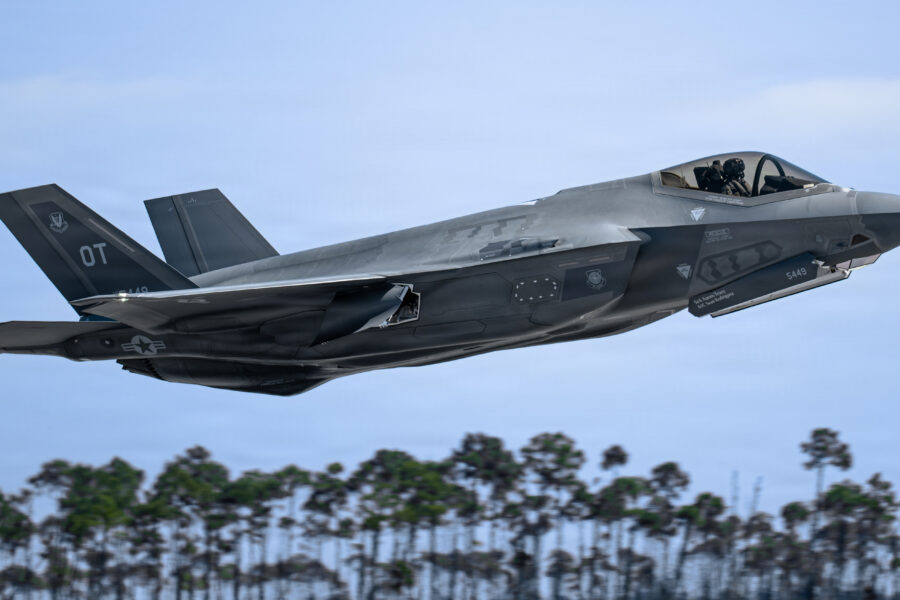
Key lawmakers want to give the Pentagon more flexibility buying F-35 fighters, more money for spare parts, and more homework analyzing the program.
The House Armed Services Committee released its first draft of the fiscal 2027 National Defense Authorization bill on May 26. Among the many provisions in the defense policy bill are elements of legislation introduced in the Senate last month authorizing multiyear procurement contracts for the F-35 and F-15EX fighters.
Currently, the Pentagon buys these fighters in lots on a year-by-year basis. Multiyear procurement deals allow officials to sign purchasing agreements covering as much as five years, which they say drive down costs by giving manufacturers more predictability. The Congressional Research Service in 2025 released a report that found multiyear contracts can save the government between 5 and 15 percent.
Sen. Ted Budd (R-N.C.) and Sen. Jeanne Shaheen (D-N.H.) proposed authorizing F-15EX and F-35 multiyear procurement in their Airpower Acceleration Act in April, but the NDAA often incorporates language from smaller defense bills introduced throughout the year.
The HASC’s draft bill—which the committee will further refine during a June 4 markup session—also states that the Pentagon would be allowed to procure larger amounts of materials and equipment needed to build F-35s, when money could be saved that way.
The F-35 is built by Lockheed Martin, and the F-15EX is built by Boeing. Both jets can cost around $100 million apiece.
Air Force Secretary Troy E. Meink has endorsed the idea of multiyear procurement for the fighter jets and praised Budd and Shaheen’s bill. In a May 21 Senate Armed Services Committee hearing, Meink said year-to-year contract limitations can be inefficient, while multiyear procurement authorities would be ideally suited for the F-15EX.
“Because [of] the instability in the [F-15EX] production rates and the unknown future, the contractor [Boeing] just couldn’t make the investments necessary to tool up and improve,” Meink said. “That long-term stability allows a contractor to do those things that eventually save the government money, and allow us to produce those aircraft quicker.”
The proposed 2027 NDAA includes some restrictions. The Defense Department would not be able to enter such a contract before certifying to the congressional defense committees that the deal will provide the full complement of initial spare parts and alternate mission equipment. F-15EX multiyear procurement agreements would also have to include conformal fuel tanks for the jets.
A multiyear F-35 or F-15EX contract also must specify that Pentagon would only be able to make payment for subsequent years if appropriations or funds are available for that purpose, the bill said.
Spare Parts and Reports
In addition to multiyear procurement, the draft bill proposes authorizing an extra $300 million for F-35A spare parts. That would more than double the Air Force’s request of $269 million.
The NDAA does not appropriate, or provide, funding. It does, however, permit certain spending and signals where lawmakers want the Pentagon to focus.
It can also require the Pentagon to conduct and submit studies—and the HASC draft has multiple such requirements for the F-35.
One section would require the Pentagon to submit to lawmakers and the Government Accountability Office a plan to address GAO’s recommendations from multiple reports on the F-35 dating back as far as 2014.
Those recommendations, which the Pentagon has not yet addressed, would have defense officials conduct uncertainty analyses on future F-35 Joint Program Office cost estimates, study and reassess its F-35 sustainment strategies, and set a new cost estimate baseline for its Block 4 upgrades, among others.
And within a year after that plan is submitted, the bill said, the Pentagon would have to take actions to carry it out. The Pentagon would also have to send lawmakers and GAO a report on all critical data rights required for the F-35, estimated costs for acquiring critical technical data rights, the status of efforts to get those data rights, and any known challenges that might stand in the way of doing so.
Another section directs the F-35 Joint Program Office to submit a report on what it needs for the fighter’s planned Power Thermal Management System modernization—officials say the F-35 needs an upgraded PTMS to handle the increased power required for upgrades in the planned “Block 4” and beyond, and committee members wrote in their bill that they are concerned about potential delays. Lawmakers want a report by Dec. 15.