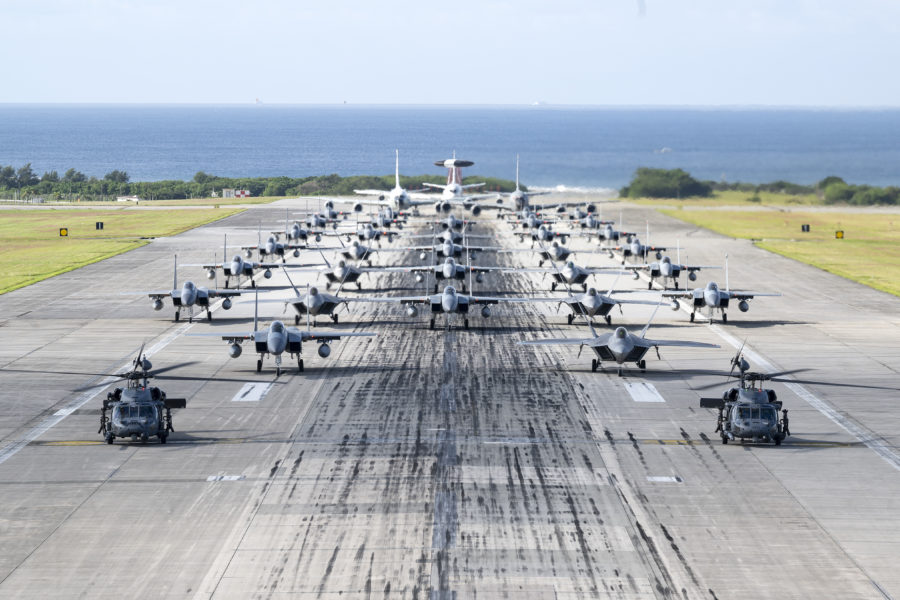
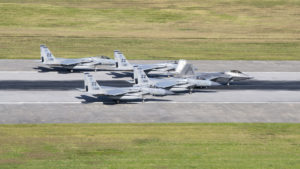
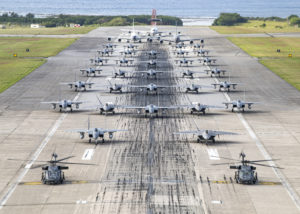
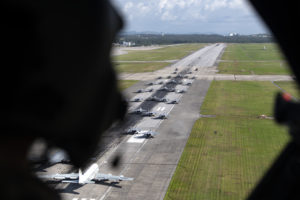
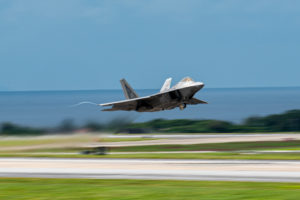
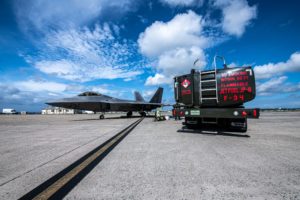
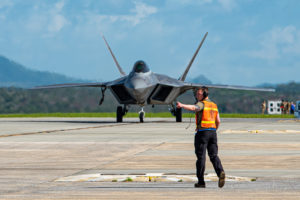
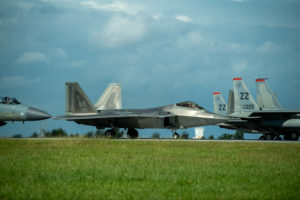
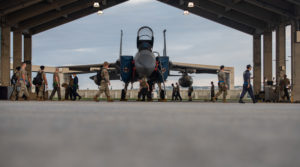
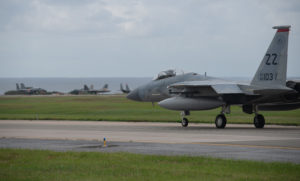
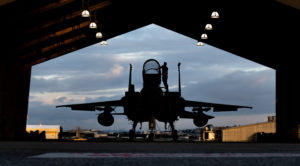
U.S. Air Force aircraft line up on the runway during a capabilities demonstration at Kadena Air Base, Japan, Nov. 22, 2022. U.S. Air Force photo by Senior Airman Jessi Roth.
Audio of this article is brought to you by the Air & Space Forces Association, honoring and supporting our Airmen, Guardians, and their families. Find out more at afa.org
Three dozen aircraft assembled on the flight line for an “elephant walk” at Kadena Air Base, Japan, on Nov. 22, in a show of air power.
The capabilities demonstration included six different kinds of aircraft, all stationed at Kadena at the moment—F-15C Eagle and F-22 Raptor fighters, HH-60G Pave Hawk helicopters, a KC-135 Stratotanker, an E-3 Sentry, and an RC-135 Rivet Joint.
According to images shared by Kadena, the exact breakdown of aircraft included in the elephant walk:
23 F-15Cs
Eight F-22s
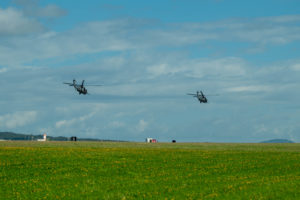
Two HH-60Gs
One E-3 Airborne Warning and Control System (AWACS)
One KC-135
One RC-135
All but the F-22s are part of the 18th Wing, Kadena’s host unit, which has roughly 80 aircraft total. The Raptors are from the 3rd Wing at Joint Base Elmendorf-Richardson, Alaska, and recently deployed to Kadena after the Air Force confirmed that it will be removing the base’s 48 F-15C/D Eagles over the next several years.
The service has said the F-15C/Ds will initially be replaced by a rotation of deployed fighters, while a permanent replacement has not yet been named, though it is likely to be the F-15EX. F-16s from Spangdahlem Air Base, Germany, are expected to follow the F-22s.
The display of air power and capabilities at Kadena came on the same day U.S. Defense Secretary Lloyd J. Austin III met with his Chinese counterpart, Defense Minister General Wei Fenghe, in Cambodia. During that meeting, Austin called on China “to refrain from further destabilizing actions toward Taiwan,” according to a Pentagon readout.
Kadena, located on the island of Okinawa, is the Air Force’s closest land-based location to Taiwan, some 450 miles away. China considers Taiwan, a self-governed island, to be part of its territory, and tensions between the U.S. and China over Taiwan have been steadily growing as of late.
A visit to the island by House Speaker Nancy Pelosi earlier this year sparked a series of aggressive exercises by the Chinese around the island, and in June, Australia claimed that a Chinese fighter jet released chaff in front of an Australian P-8, a move the Australian government described as a “dangerous maneuver.”
Austin raised similar concerns in his meeting with Wei, citing “the increasingly dangerous behavior demonstrated by [People’s Liberation Army] aircraft in the Indo-Pacific region that increases the risk of an accident.”
In addition to the Nov. 22 capabilities demonstration, aircraft at Kadena recently participated in Keen Sword 23, a biennial exercise involving the U.S., Japan, Australia, and the United Kingdom.
Audio of this article is brought to you by the Air & Space Forces Association, honoring and supporting our Airmen, Guardians, and their families. Find out more at afa.org
The U.S. military conducted strikes on Iranian targets around the Strait of Hormuz on May 7, as the conflict with Iran flared up again—though officials say the ceasefire remains in effect.
The Air Force’s BACN may be cooked—the service plans to retire its entire E-11A Battlefield Airborne Communications Node fleet in fiscal 2028 and equip aircraft to use satellite communications instead.
Operations Midnight Hammer and Epic Fury make this crystal clear: Bombers that can precisely deliver large payloads halfway around the world are crucial assets. Given the small size and advanced age of America’s current bomber inventory, it is time to boost investment in the B-21 Raider to ensure long range strike remains a viable option at scale for the foreseeable future.
The Air Force has finished resurrecting a B-1B Lancer, completing a yearslong process to transform a bomber that had been stored for parts in the Arizona desert into the new flagship of the 7th Bomb Wing at Dyess Air Force Base, Texas.
Lockheed Martin’s aeronautics division is getting new leadership, with president Greg Ulmer retiring and Skunk Works general manager O.J. Sanchez tapped to succeed him.
F-22 Raptors from two squadrons have arrived at Kadena Air Base in Okinawa, the latest rotation of fighters at the key Japanese base as its awaits its delayed F-15EX Eagle IIs.
Fresh off the first combat deployment of its new EA-37B, the Air Force is nearly doubling the planned number of new electronic attack jets and projecting more than $3 billion in spending on the program in the next five years.
Air Force fighters, tankers, and intelligence aircraft contributed “defensive overwatch” for the U.S. military effort to guide commercial shipping through the Strait of Hormuz, senior officials said.
The Air Force said May 4 it has approved the T-7A Red Hawk trainer aircraft to move into low-rate production and awarded Boeing a $219 million contract to start building the first 14 production jets.
✓
Thank You!
Check your inbox to verify your email address and finish setting up your AFA account.
★
Welcome Back!
An account with this email already exists. Please log in to continue.
Subscribe to the Air & Space Forces Daily Report
The latest news from Air & Space Forces Magazine, as well as news from other leading publications, delivered right to your inbox every morning!
We’re sorry, there has been an error. Please review your input or try again later.