
Editor’s Note: Late May 5, President Donald Trump announced on social media he was pausing Project Freedom “for a short period of time” as negotiations with Iran progress.
Air Force fighters, tankers, and intelligence aircraft contributed “defensive overwatch” for the U.S. military effort to guide commercial shipping through the Strait of Hormuz, senior officials said.
Defense Secretary Pete Hegseth said May 5 that more than 100 U.S. aircraft were participating in President Donald Trump’s Project Freedom, about the same number that are supporting the ongoing naval blockade of Iran.
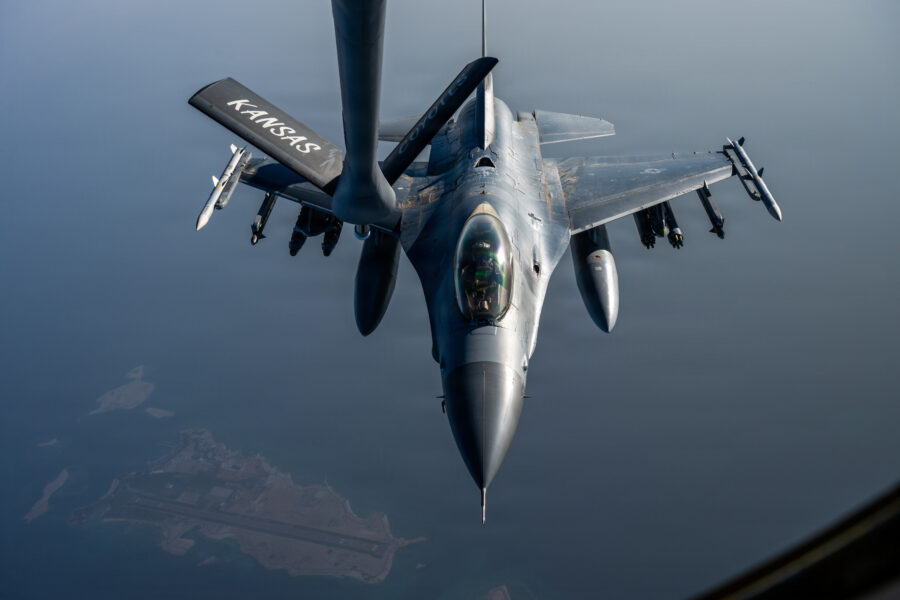
U.S. Central Command boss Adm. Brad Cooper told reporters May 4 that A-10, F-15, F-16, and F-35 fighters, unmanned drones, RC-135 signals intelligence planes, along with Air Force KC-135 and KC-46 tankers, participated. CENTCOM declined to comment on the numbers of different aircraft being used.
Space operators also supported the effort, Chairman of the Joint Chiefs of Staff Air Force Gen. Dan Caine also said May 5. Caine declined to comment on specific systems being used.
Shipping through the strait has slowed to a trickle since the start of the Operation Epic Fury, the U.S. war with Iran, in late February. Iran laid anti-ship mines and has fired missiles and drones, damaging some commercial ships and intimidating others. Caine said about 1,550 ships are stuck in the Persian Gulf as a result. That’s wreaked havoc on the global economy.
Since the start of a ceasefire, Iran has worked to control the strait as leverage against the U.S. With about 20 percent of the world’s oil supply flowing through the strait, the backup has driven global oil prices to the highest levels in years. Along with all those ships, more than 22,500 mariners representing 80 countries are also in limbo, unable to get to their next destination.
In order to free those ships and mariners, the U.S. defined an “enhanced security area” on the southern side of the strait. Two U.S. Navy destroyers, supported by air and land forces, are providing “24/7 overwatch” against Iranian attacks, Hegseth said.
Cooper said the two destroyers passed through the strait this weekend as a demonstration that “we have cleared an effective pathway” through the strait that is safe from Iranian mines.
Three decades ago, in the 1980s, Iran tried to shut down the strait during its “Tanker War” with Iraq. At the time, the U.S. Navy protected nearly a dozen Kuwaiti oil tankers transiting the strait by reflagging them as American ships and providing naval escorts, while the U.S. Air Force supported the operation with E-3 AWACS aircraft collecting airborne intelligence, surveillance, and reconnaissance. The Navy frigate USS Samuel B. Roberts struck a mine during the operation, as did one commercial tanker.
This time, for Project Freedom, the U.S. Navy is not providing one-for-one escorts, Cooper said. “I think we have a much better defensive arrangement in this process where we have multiple layers that include ships, helicopters, aircraft, airborne early warning, and electronic warfare,” he said. “We have a much broader defensive package than you would have ever if you were just escorting.”
A-10s attack jets were already patrolling the Persian Gulf and Strait of Hormuz as part of operations in the theater, and can provide close air support, including against fast-moving gunboats operated by Iran’s Islamic Revolutionary Guard Corps. F-15s and F-16s flying in the region are equipped to shoot down Iranian drones. And F-35s offer powerful sensing and electronic warfare capabilities to further bolster defenses.
Iran “launched cruise missiles, drones, and small boats at U.S. forces defending commercial shipping in the strait” on May 4, Caine said: “U.S. Navy MH-60 and Army AH-64 Apache helicopters successfully defeated those threats.”
Cooper said six Iranian small boats were destroyed and two U.S.-flagged commercial vessels went through the strait.
