
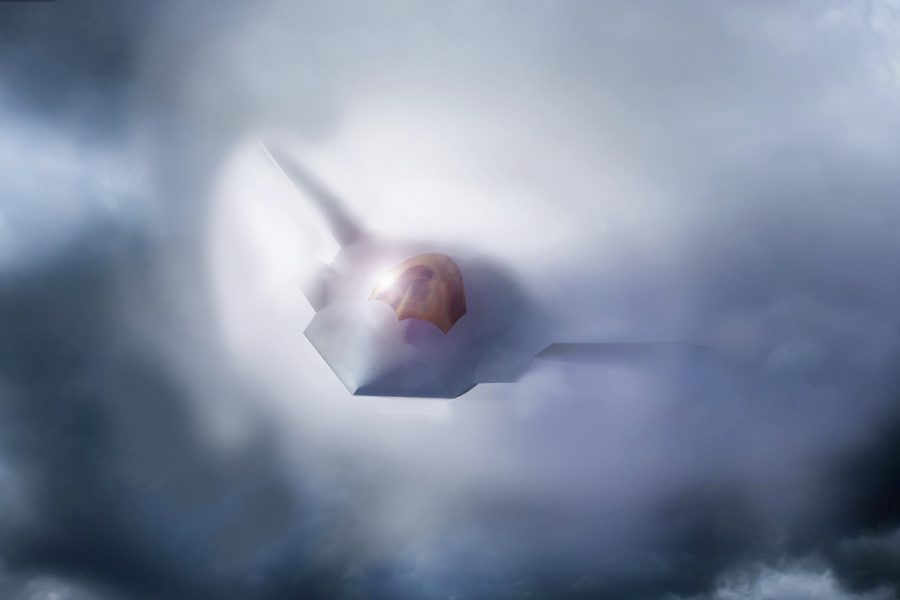
Research and development spending on the Air Force’s sixth-generation F-47 fighter and its advanced propulsion system is expected to peak in 2028 before dropping in the following years, according to Air Force budget documents.
That trend suggests the service anticipates moving toward the next phase of development in the near future, one expert told Air & Space Forces Magazine.
The Air Force in April asked for more than $5 billion in research, development, test and evaluation funding for the Boeing-made F-47 in fiscal 2027, up from nearly $3.5 billion in total spending in fiscal 2026. In fiscal 2028, the Air Force expects that spending to rise to nearly $5.3 billion.
But in the three years that follow, R&D spending for the F-47 will steadily drop until reaching under $3 billion in fiscal 2031.
F-47 Budget
| YEAR | 2026 | 2027 | 2028 | 2029 | 2030 | 2031 |
|---|---|---|---|---|---|---|
| (In billions) | $3.45 | $5.04 | $5.25 | $4.12 | $3.29 | $2.95 |
Similarly, the Next-Generation Adaptive Propulsion, or NGAP, program’s R&D spending is set to rise from its fiscal 2025 funding of $490 million to a requested $514 million in 2027.
That spending is projected to spike in 2028, hitting nearly $906 million, before ticking downward to $865 million in 2029. In fiscal 2030 and 2031, spending is expected to steeply decline to $303 million and $305 million.
NGAP Budget
| YEAR | 2026 | 2027 | 2028 | 2029 | 2030 | 2031 |
|---|---|---|---|---|---|---|
| In millions | $326 | $513.70 | $905.70 | $865 | $303.30 | $304.90 |
Heather Penney, the director of studies and research at AFA’s Mitchell Institute for Aerospace Studies, said the projected funding patterns suggest that by about 2029, the Air Force will have largely finished with the most challenging parts of the R&D process on both programs and could be shifting into the engineering and manufacturing development phase.
The F-47 is expected to replace the F-22 Raptor and be the Air Force’s first sixth-generation fighter. It is intended to have advanced stealth capabilities, a 1,000-nautical mile range greater than other fighters such as the F-22 and F-35, and be able to fly faster than Mach 2. It will also fly alongside semi-autonomous drones the Air Force calls Collaborative Combat Aircraft.
NGAP is expected to provide the engine for the F-47. It will use adaptive engine technologies and advanced materials to deliver an engine that can provide more thrust and cooling power. GE Aerospace and Pratt & Whitney have been working on their own versions of an adaptive engine, which automatically shifts its configuration to provide the most efficient thrust for any given situation. Work on these systems started under the now-defunct Adaptive Engine Transition Program that considered putting one in the F-35.
The Air Force redacted its planned EMD budget figures in the RDT&E chart for the F-47 program from 2025 to 2031. But once the F-47 and NGAP programs reach that phase, Penney said, the R&D efforts will likely be mostly “polishing” the systems, and “they’re maturing the technologies for fielding.”
“This is a surge for development,” Penney, a former F-16 pilot, said. “[20]28 might be the big purchase of test articles, because that’s going to be all R&D money. It’s not going to be procurement money.”
Penney noted that former Air Force Chief of Staff Gen. David Allvin said in September 2025 that the first F-47 jet was in the process of being built and would likely fly for the first time in 2028.
By the time F-47 R&D spending drops in 2029, Penney expects the program to be in the flight test process.
Another sign that testing is on the way is the Air Force request for $730 million in the 2027 budget to build hangars and other support infrastructure for the F-47 at Nellis Air Force Base in Nevada. In budget documents, the service noted that Nellis will host the F-47’s operational testing.
Penney said the F-47’s and NGAP’s similar patterns of a peak and then decline also suggest the two programs are operating on roughly the same timelines. Penney said seeing these funding patterns reassures her that the Air Force is prepared to significantly invest in advanced technologies—especially NGAP.
“This shows me [the Air Force is] serious” about these programs, Penney said. “We know that we need to make investments in next-generation engine technology.
“Our engines have long been our operational strength,” Penney continued. “People overlook engines because they just take thrust for granted. … We cannot take that for granted any longer, and we have to move forward into advanced engines if we want to be able to maintain that kind of advantage.”