
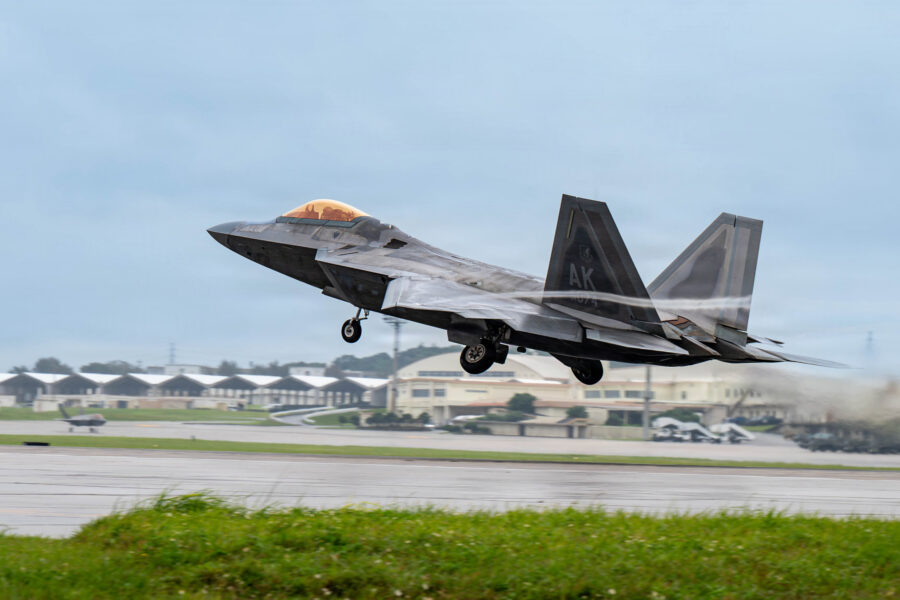
F-22 Raptors from two squadrons have arrived at Kadena Air Base in Okinawa, the latest rotation of fighters at the key Japanese base as its awaits its delayed F-15EX Eagle IIs.
The Air Force said in a May 5 statement that the F-22s were assigned to the 90th Fighter Squadron at Joint Base Elmendorf-Richardson, Alaska, and the 27th Fighter Squadron at Joint Base Langley-Eustis, Va. The release did not specify how many fighters arrived at Kadena, but local newspapers reported that 12 fighters from Alaska landed over the weekend.
The Air Force has been rotating fighters through Kadena since November 2022, as it began retiring the base’s two aging squadrons of F-15C and D Eagles.
Eventually, Kadena will have a fighter force of 36 new Boeing-made F-15EXs, and they were originally planned to arrive in spring 2026. Two F-15EXs from a test and evaluation squadron arrived at Kadena in July 2025 to help pilots and maintainers there learn how to operate and repair the jets.
But a monthslong strike in 2025 at Boeing’s St. Louis, Mo., factory, where the fighters are built, left the company behind schedule. The Air Force announced in February it postponed its F-15EX delivery plans and has not yet released an updated schedule.
Kadena is the Air Force’s closest installation to Taiwan, about 450 miles away, making it a critical base if China were to launch an invasion and the U.S. were to intervene.
For years, Kadena had a force of at least 48 F-15C/D fighters. But as the jets neared four decades in service and grew increasingly harder to maintain, the Air Force decided to start retiring them and rotating in squadrons of replacement fighters on temporary deployments.


The Air Force said in its May 5 statement that the newly arrived, fifth-generation Raptors will fly alongside heavy, reconnaissance, and fourth-and fifth-generation aircraft at Kadena. They also will work together with operations and maintenance groups at Kadena’s 18th Wing, joint partners, and allies to improve their interoperability, refine their tactics, and practice for real-world contingencies to which they may have to respond.
“Together, this mix of aircraft and personnel reinforces the United States’ commitment to defend Japan under the U.S.-Japan security alliance and maintain a free and open Indo-Pacific” region, the Air Force said.
The Air Force said the 18th Wing will continue to follow agreements with Japan to limit noise from operating their fighters.