
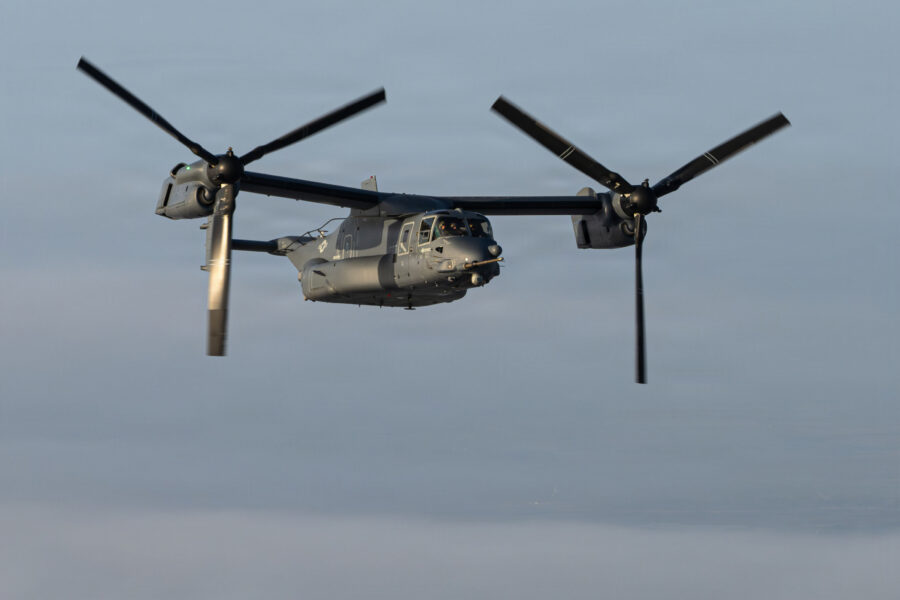
The Air Force plans to spend $213 million on its CV-22 fleet in fiscal 2027, about one-fifth of a $1.12 billion investment in the tiltrotor aircraft across the Pentagon.
Air Force budget documents show plans to install new proprotor gearboxes built from an improved steel alloy to fix the same critical parts that failed, leading to a deadly 2023 crash in Japan, as well as a costly 2024 mishap in New Mexico.
“The V-22 [Joint Program Office], working with our industry partners at Bell-Boeing, began fielding an improved PRGB that implements X-53 Triple-Melt Steel upgrades,” Air Force budget documents state. “Incorporating this cutting-edge steel alloy into PRGB critical assemblies is expected to reduce wear and mitigate risk of premature gear system failures.
The budget documents do not detail the cost of the new gearboxes, but cite $105 million for reliability modifications, which would include the proprotor gearbox. The service is ordering 166 “Group A” kits consisting of wiring and other equipment to support installation, plus 25 “Group B” kits.
The Air Force has already procured hundreds of “reliability” kits, though it only has 56 CV-22s. The joint nature of the V-22, flown by three of the military services, has led to a unique cost-sharing arrangement between the Air Force, Navy, Marine Corps, and U.S. Special Operations Command. The Navy is the lead service and funds development of the MV-22 and CMV-22 variants. The Air Force funds the “service-common” portions of the Osprey, while SOCOM funds the development and procurement of special ops-specific systems.
The first gearbox replacements took place this past January. More work may lie ahead: The Air Force is also asking for money to fund proprotor gearbox work in its research, development, test, and evaluation budget in 2027, which includes $45.7 million to support V-22 R&D.
The gearbox fixes follow multiple fatal accidents and address critical components in the Osprey’s unique “tiltrotor” design. The complexity of the aircraft’s transmission has been a concern since it debuted in the 1990s, with the weight and vibration of tilting the entire engine back and forth imposing enormous stress on the gears and driveshaft.
Military investigations determined a weak metal alloy contributed to past failures: 22 instances of gears cracking since 2006, according to a comprehensive review by Naval Air Systems Command released in December 2025.
Beyond the new gearbox, the Air Force’s V-22 budget includes a veritable alphabet soup of acronyms for improvement initiatives—nearly 20 were name-checked in documents.
One of the most prominent is the Gearbox Vibration Monitoring Hard Clutch Engagement, an upgrade to overcome another known issue; hard clutch engagements occur when the clutch slips and reengages, causing massive swings in torque and making the aircraft difficult to control. The Air Force has grounded the CV-22 in the past while it investigated instances of hard clutch engagements.
Another major effort is the Cockpit Technology Refresh, or VeCToR, a “comprehensive modernization of the aircraft’s avionics systems,” according to the Congressional Research Service.
In addition to all the current improvement programs underway, the Air Force budget also includes research and development funding for future modifications, including changes to extend the CV-22’s range and response time for “enhanced self-deployment.” The service is earmarking $17.5 million for that.
SOCOM is also looking at V-22 modifications in the 2027 budget. The command offers only cryptic details, however, including “defensive/survivability systems; situational awareness systems; mission planning systems … electronic warfare systems.” One new system it did specifiy is a new terrain following radar dubbed Silent Knight, designed to help the aircraft fly closer to the ground in contested airspace.
